Roland Blaettler, 2019
In 1907, Hermann Kaeppeli (1883-1970), originally from Mühlau in the Canton of Aargau, inherited his parents’ business, a convenience store selling a wide range of products (wallpaper, chemicals, paints, glassware, ceramics, porcelain, basketry, foodstuffs, toys – Swiss Official Gazette of Commerce, Vol. 25, 1907, 261). The first official mention of him expanding his business activities to include the “production of art pottery” dates from June 1917 (SOGC, Vol. 35, 1917, 1015). In the following year, Kaeppeli was listed for the first time in the Indicateur vaudois as a “manufacturer of art pottery” at his business address, 26 Grand’Rue. On 28th June 1917, Kaeppeli registered his company mark which consisted of a Geneva-type boat in a rectangular frame accompanied by the initials “KR” (Kaeppeli Rüegger) and the words “marque de fabrique” [factory mark] and “Nyon” (SOGC, Vol. 35, 1917, 1090), see MHPN MH-2015-451.
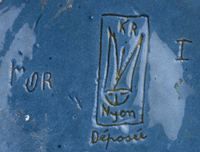
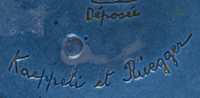
A variation of this mark with the initials “HK” (Hermann Kaeppeli) was registered in 1944; the field of business was described as “faience, refined white earthenware, porcelain, paints and glazes, pottery-making utensils” (SOGC, Vol. 63, 1945, 394). This appears to have been a purely commercial mark, even though the term “factory mark” was retained.
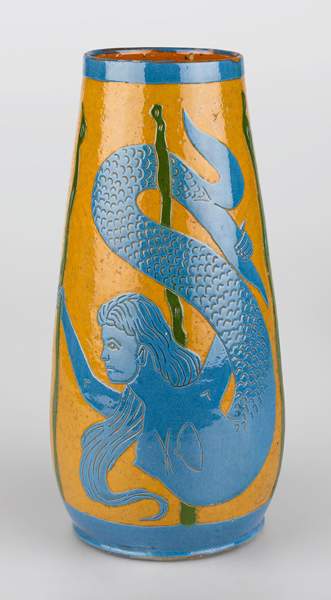
On Christmas Eve 1917, Kaeppeli published a notice advertising his “art pottery from Nyon”. The advertisement also included a double reproduction of his factory mark and six drawings of vases, two of which were decorated with mermaids (MHPN MH-2015-451). The design on another vase was very similar to a piece of finely engraved refined white earthenware, which we have attributed to the Richard brothers (MHPN MH-2015-432). The advertisement recommended customers to “check for ‘La petite barque’ [The little boat] mark” (Feuille d’avis de Vevey dated 24th December 1917, 4).
The second person, whose name usually appeared in the mark but not in the company name, was Oscar Rüegger (1882-1960). The Indicateur vaudois, which listed him from 1915 to 1919, identified him as a “portrait artist”. He lived at 13 Rue du Vieux-Marché, and from 1919, at 20 Rue de Rive. We know very little about him, except that he was originally from Rothrist in the Canton of Aargau, and had lived in Nyon for a number of years, as he had applied for a character reference from the council on 11th January 1915 (Communal Archives of Nyon [ACN], Bleu A-74). He needed the reference to apply to the local authority of Bern for a licence to sell postcards and military pictures. One thing we know for sure: he was not a potter. Alongside Kaeppeli, Rüegger was apparently also in charge of decorating the ceramics. Most objects bear not only the company mark with the Geneva-type boat but also the words “par OR” [by OR] or just the initials “OR” (MHPN MH-2015-521).
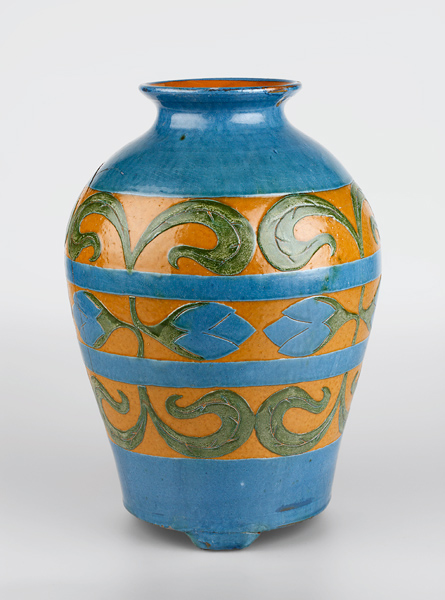
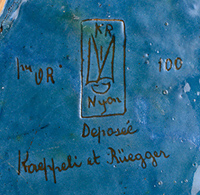
The similarities between Kaeppeli’s products and those made by the Richard brothers – in terms of both the technique and the aesthetic – is concerning, to put it mildly, and led Pelichet to speculate that Hermann Kaeppeli and “Monsieur Reusser [sic] made some pieces for the Richards” (Pelichet 1985/2, 44). The fact is that Kaeppeli called himself a “factory owner” and that the duly registered factory mark cannot therefore be seen just as the mark of an employee who was carrying out jobs on behalf of the Richard brothers. Moreover, the Indicateur vaudois listed Kaeppeli as a factory owner until 1923, while the “Richard Frères” pottery had already declared bankruptcy by 1921.
In March 1918, Kaeppeli applied for planning permission for a building on Rue Nicole, where he would set up a business and storerooms (ACN, Bleu A-76, meeting on 25th March 1918). A few weeks later, he wrote to the city council informing them of his intention to install a kiln to fire pottery (“glazes and clay”) at the premises. The Department of Health raised concerns about the smells and vapours that could emanate from a piece of equipment such as this (ACN, Bleu A-76, meeting on 15th April 1918). We did not find any trace of the “business and storerooms”, unless they were perhaps part of the “laboratory” project, which began to appear in official records around the same time. On 12th April 1918, Kaeppeli applied to the authorities for permission to build a small kiln in a “technical” room in the backyard of his shop. He described his project thus: “To gain experience, I plan to build a muffle kiln to fire glazes and ceramics, but in the first instance, these will be merely scientific experiments.” In December he was granted permission to install an electric motor in his laboratory to power a potter’s wheel and a colour mill, a mixer and an extruder to prepare clay.
The documents in the municipal archive of Nyon included a plan of the facility which showed that the area equipped with a small kiln and a potter’s wheel measured 6 m by 4.8 m in total (ACN, Bleu K-315.46). It is hard to imagine how a production worth its name would have been able to thrive within such a small space and with such limited equipment. Given the small number of objects in the collection of the museum in Nyon, it is thus quite likely that Kaeppeli’s production was never particularly extensive. Moreover, a comparison with the products from the Richard workshop shows that they had a number of technical weaknesses, such as irregular and sometimes runny glazes. Is it still possible, however, that these pieces were made – or at least decorated – in Kaeppeli’s laboratory?
In his work notes, which are housed at the Nyon Castle Museum, Pelichet wrote that, according to the widow of Auguste Richard, the company was taken over by Hermann Kaeppeli (see below) in 1923. The minutes of the council meetings, however, tell us that Gustave Besson, the “new owner of the Richard Frères workshop in the En Prélaz area”, had applied to postpone the due date for his real estate acquisition taxes because “the factory has only become operational in recent days” (Bleu A-79, meeting on 29th April 1923). However imprecise the information may have been that Madame Richard gave Pelichet, does it not at least suggest that there were some points of contact between the two businesses? There are remarkable similarities between a fish vase made by the Richard workshop (MHPN MH-2015-432) and one decorated – and signed – by Rüegger (MHPN MH-FA-4729). It should be noted that the latter has no workshop mark and both objects have the number “16” incised on their bases.
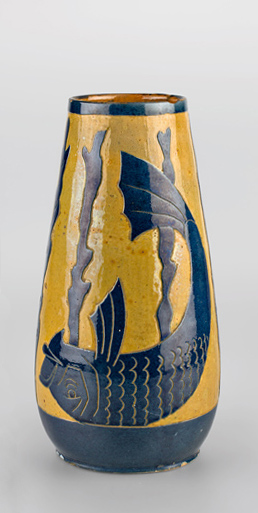
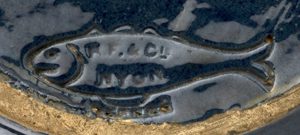
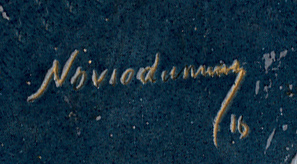
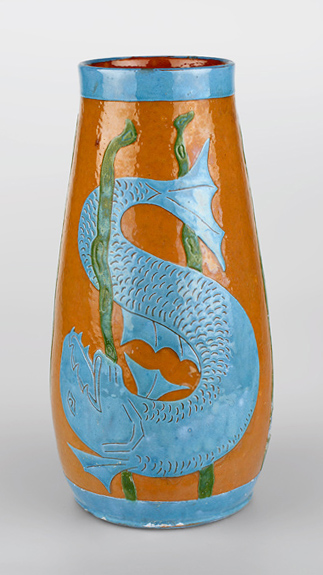
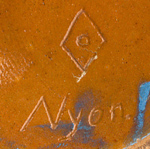
This small production remains a mystery with many unanswered questions. Was it completely independent? Did Kaeppeli and Rüegger decorate objects that were made and fired by the workshop of the Richard brothers or their successor, or did Rüegger work for the Richard brothers’ workshop before forming his partnership with Kaeppeli? Did Kaeppeli actually produce pottery up to 1923?
Translation Sandy Haemmerle
Sources:
Communal Archives of Nyon [ACN], Séries, Bleu A, Registres de la Municipalité – Bleu K.
Newspapers and almanacs from the Canton of Vaud, accessed via the Scriptorium website of the Cantonal and University Library of Lausanne.
Swiss Official Gazette of Commerce, accessed via the website e-periodica.ch
References:
Blaettler 2017
Roland Blaettler, CERAMICA CH III/1: Vaud (Nationales Inventar der Keramik in den öffentlichen Sammlungen der Schweiz, 1500-1950), Sulgen 2017, 63-64, 436.
Pelichet 1985/2
Edgar Pelichet, Les charmantes faïences de Nyon. Nyon 1985.

