Roland Blaettler 2019
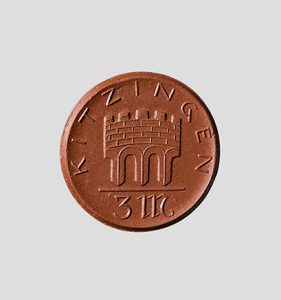
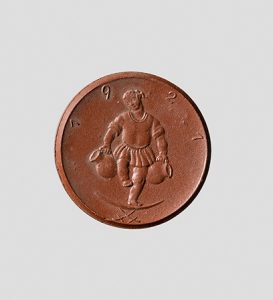
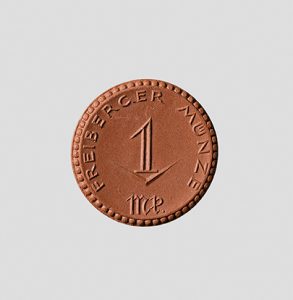
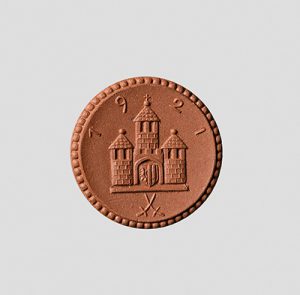
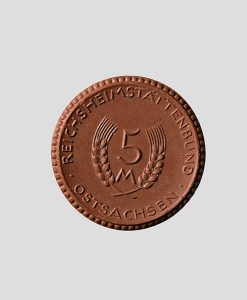
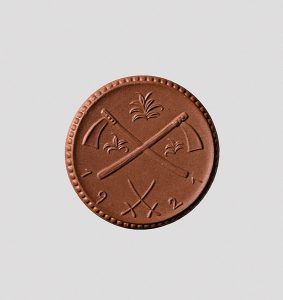
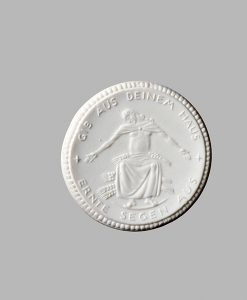
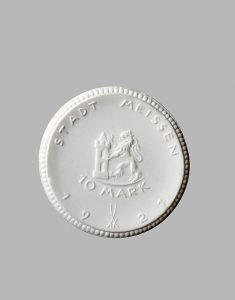
Due to a lack of small change in the years following the First World War, Notgeld (emergency money) made from various materials was issued in Germany by states, districts, cities and municipalities and even by banks and trade organisations. Meissen biscuit porcelain and even more so Böttger red stoneware, which was less prone to getting dirty, were also used for this specific purpose (HMO 8854 to HMO 8883). The highpoints of manufacture for this rather unusual item were between 1921 and 1924.
The Free State of Saxony was the first to issue Meissen emergency money in 1921 (HMO 8872; HMO 8861). Not all coins produced in Meissen had a monetary value. In fact, although Saxony issued 5-, 10- and 20-mark pieces, by decree of the Treasury Department, they had a “collector’s value only” (Scheuch 1995). Almost all Meissen coins were based on designs by Paul Börner (1888–1970), who started his career with the manufactory as a pottery painter in 1910. Two years later, he was promoted to modeller and from 1930 to 1937 he acted as director of the arts department (Marusch-Krohn 1993, 40–44).
Translation Sandy Haemmerle
References:
Blaettler/Schnyder 2014
Roland Blaettler/Rudolf Schnyder, CERAMICA CH II: Solothurn (Nationales Inventar der Keramik in den öffentlichen Sammlungen der Schweiz, 1500-1950), Sulgen 2014, 388.
Marusch-Krohn 1993
Caren Marusch-Krohn, Meissener Porzellan 1918–1933. Die Pfeifferzeit. Leipzig 1993.
Scheuch 1995
Karl Scheuch, Münzen aus Porzellan und Ton der Staatlichen Porzellan-Manufaktur Meissen und anderer keramischer Fabriken des In- und Auslandes. Gütersloh 1995.

