Roland Blaettler, 2019
Pottery made by Henri Terribilini in CERAMICA CH
Born in Montreux, Henri Terribilini (1898–1982) was orphaned at the age of three and, together with his sister and two brothers, taken in by a family who lived in Noville near Villeneuve. He attended the Swiss School of Ceramics in Chavannes-Renens (probably in 1913/14, as, according to information provided to the Museum of Nyon by family members, Paul Bonifas was one of his class mates), before moving to the School of Decorative and Applied Arts in Lausanne founded by his tutor, Nora Gross (1871–1929).
In 1917 and 1918, he decorated shallow refined white earthenware dishes with stamps that included the name “Nyon” (MHPN MH-FA-10010; MHPN MH-1998-140). Contrary to what some researchers believe (Pelichet 1985/2, 36; Desponds 1999, 80), it should not automatically be assumed that Terribilini was already working at the Manufacture de poteries fines at that time. He would certainly have been linked to the manufactory, probably because of his association with Nora Gross who was collaborating with the company at the time (see the chapter on Nora Gross) but in our opinion, the work he did there was sporadic in nature and purely for his own personal use. As the chapter on the Manufacture de poteries fines shows, the company regularly made its facilities available to independent decorators.
In 1920, Terribilini was asked by Georges Vallotton to come to Nyon and work at his Manufacture de porcelaines décorées as a master decorator and shop floor supervisor (see the chapter on Georges Vallotton). He was, in fact, listed for the first time in Nyon’s register of residents in May 1920 as a porcelain decorator. It also states that he had come from Langenthal, where he had worked at the porcelain factory. According to the residents’ registration office, Terribilini travelled to Paris in June 1921. Following in the family tradition, he probably attended courses in the history of art at the École du Louvre.
In the spring of 1922, he was hired by the Grand Council as a temporary technical instructor to teach practical skills at the Swiss School of Ceramics (Gazette de Lausanne, 4th May 1922, p. 2). In June of that year, he exhibited two refined white earthenware vases “with underglaze painted decoration” at the Exposition nationale d’art appliqué (National Exhibition of Applied Arts), which ran from 6th May to 25th June in Lausanne (Cat. nos. 222 and 223). His address at that stage was given as Lausanne. The 1923 Indicateur Vaudois lists Terribilini as a “technical instructor at the Swiss School of Ceramics in Renens”.
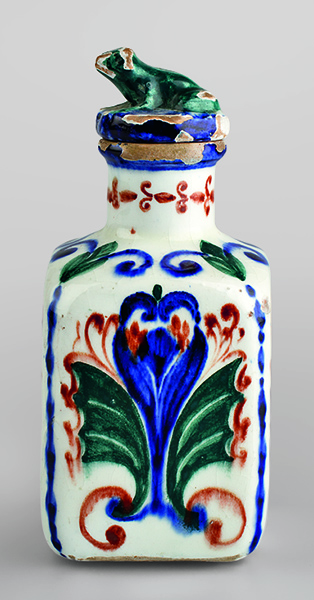
The only object that can be associated with Terribilini’s work at the School of Ceramics is a small perfume bottle from 1923 (MHPN MH-FA-10008). In 1924, he was in France, where he extended his technical knowledge and skills at several different factories, in particular in Givors (MHPN MH-FA-10007; MHPN MH-FA-10001; MHPN MH-FA-10003).
Having been hired by Louis Michaud to run the decoration workshop at the Manufacture de poteries fines, Henri Terribilini made Nyon his permanent home in 1925. In November of that year, the residents’ register of Nyon listed him again, only this time as a “ceramicist”.
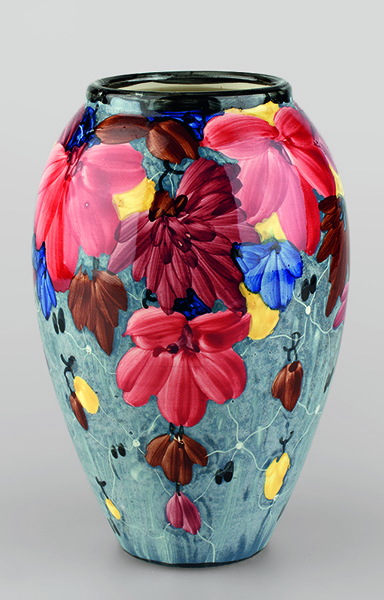
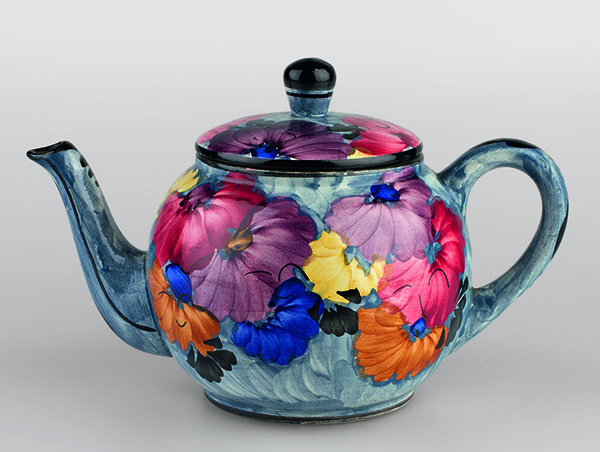
He was probably the main person responsible for the fact that painted decorations became increasingly popular among the Manufacture’s range of products at the time (see the chapter Manufacture de poteries fines de Nyon S. A.). The vase MHPN MH-FA-10006 may have been a prototype for the “Cataneo” motif, which became one of the factory’s best-known decorative schemes (see e.g. MHPN MH-2003-110; MHPN MH-2003-109; MHPN MH-2015-408; MHPN MH-2003-108).
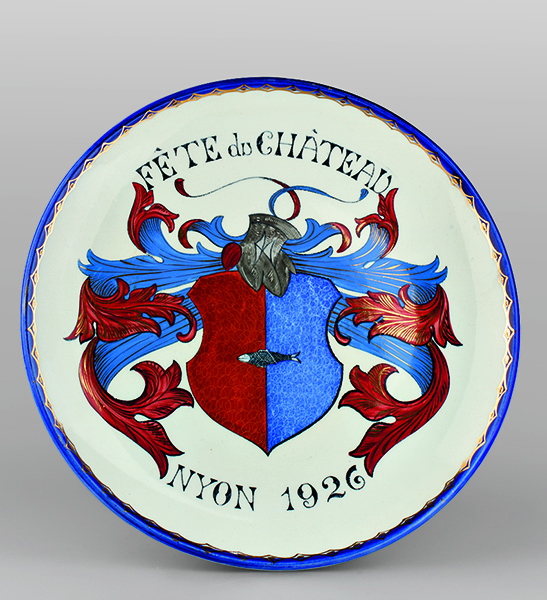
Apart from the vase shown above, only a small number of pieces from the manufactory bear Terribilini’s signature (MHPN MH-FA-10011; MHPN MH-FA-10005). A few unsigned designs are rather innovative and could therefore also have been created by him (e.g. MHPN MH-FA 4037; MHPN MH-FA-4039; MHPN MH-FA-4648; MHPN MH-2014-18; MHPN MH-2000-75).
Henri Terribilini left the company in 1928 and set up his own workshop at the “Villa Saint-Jean”. That same year he offered a “Cours breveté de peinture sur porcelaine par correspondence” (certified correspondence course in porcelain painting) (La Revue dated 11th July 1928, p. 6, advertisement). According to a family member, the enterprise was not particularly successful. In 1930 he moved to the Villa “La Primevère” at 15 rue du Canal, where he lived until his death in 1982.
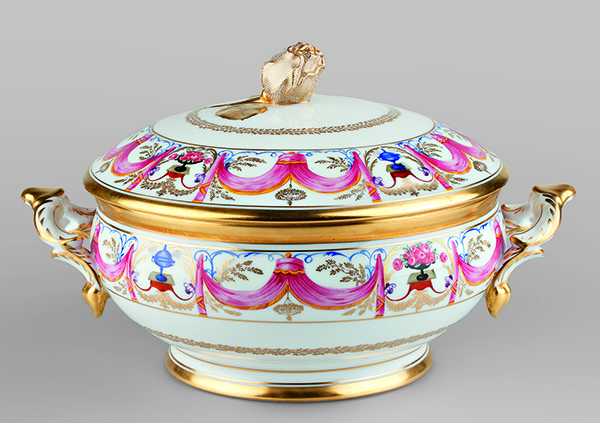
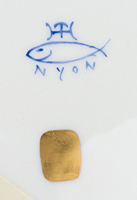
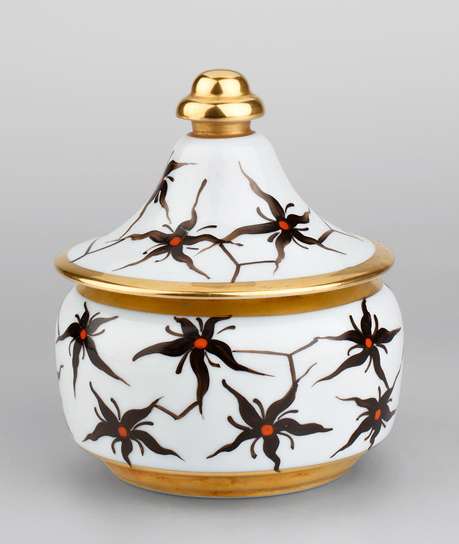
Terribilini devoted over thirty years of his life to porcelain painting, using white pieces from manufactories in Germany or from Langenthal. On 4th January 1930 he registered his workshop mark which consisted of his initials, the fish symbol that had been used by the porcelain factory and the word “Nyon” (SOGC, Vol. 48, p. 349). The original factory marks on his pieces are usually hidden beneath a patch of gold paint (MHPN MH-PO-4033; MHPN MH-PO-4036). The mark was re-registered in 1950 and remained in use until the workshop closed its doors.
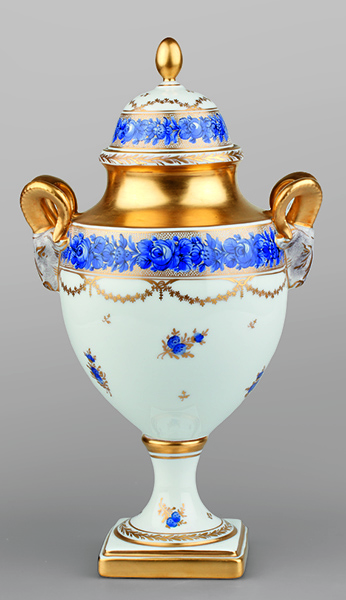
Over time, Terribilini increasingly refrained from creating his own pieces (MHPN MH-PO-10028; MHPN MH-PO-10029; MHPN MH-PO-10024; MHPN MH-2000-227E), and mainly focused on preserving the decorative schemes from the 18th century range of Nyon porcelain (MHPN MH-PO-4036; MHPN MH-PO-4033).
Many of the independent and more or less professional decorators from the Nyon region followed his example, though none ever achieved Henri Terribilini’s renown. In 1957, he was even tasked with decorating the official state service for the Grand Council of Vaud. Decorated with a “Louis XVI”-style pattern of “red roses and purple scrolls”, the series of 350 pieces was reserved for state banquets at Chillon Castle (Nouvelle Revue de Lausanne dated 10th September 1957, p. 5 – idem, edition dated 25th March 1965, p. 15).
Translation Sandy Haemmerle
Sources:
Swiss Official Gazette of Commerce from 1883 (accessed via the website e-periodica.ch)
Annuals and press from the Canton of Vaud, accessed via the “Scriptorium” website of the Cantonal and University Library in Lausanne.
References:
Blaettler 2017
Roland Blaettler, CERAMICA CH III/1: Vaud (Nationales Inventar der Keramik in den öffentlichen Sammlungen der Schweiz, 1500-1950), Sulgen 2017, 67-68, 444.
Desponds 1999
Liliane Desponds, Terre d’argile et mains agiles. La poterie de Nyon 1860-1978. Collection Archives vivantes. Yens-sur-Morges 1999.
Pelichet 1985/2
Edgar Pelichet, Les charmantes faïences de Nyon. Nyon 1985.

