Roland Blaettler, Andreas Heege 2019
There were two faience manufactories that began to produce their wares in the 1830s in Rüschlikon, near Kilchberg-Schooren, albeit probably on a somewhat more limited scale than Scheller or Nägeli in Kilchberg-Schooren. Jakob Fehr’s manufactory was in operation from 1832 to 1866, that of the Abegg brothers from 1836 to 1842 (Matter 2012, 17).
Faience from Kilchberg and Rüschlikon
It is still quite difficult to distinguish between the products from the four manufactories on Lake Zurich, particularly with regard to the basic shapes, which were rather simple and almost identical. The more complex shapes of the tureens, on the other hand, have formal details that allow us to attribute them to the individual factories. Rudolf Schnyder’s definitions for the typical shapes from the two main manufactories, Nägeli (HMO 8689; AF No. 28) and Scheller, (AF No. 25; AF No. 73; HMO 8149), are very convincing (Schnyder 1990). While this preliminary distinction using formal criteria allows us to compare the decorations on the products of the two rival companies, we cannot be entirely certain about which company produced each individual type. The question remains problematic because we know that the painters moved from one company to the other.
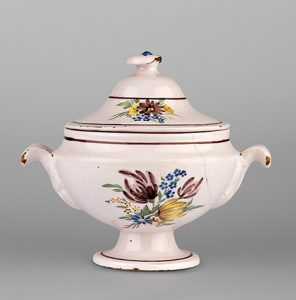
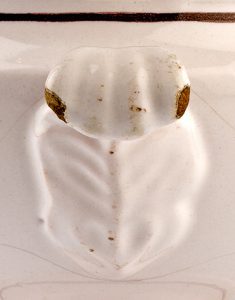
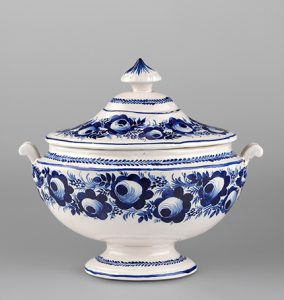
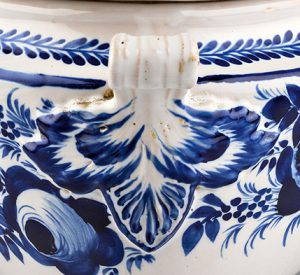
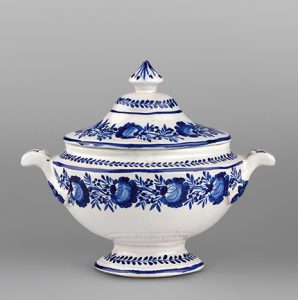
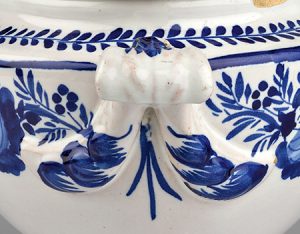
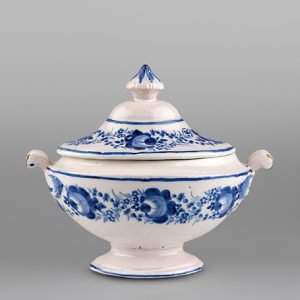
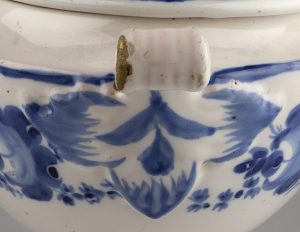
Schnyder also pointed out that some shapes could have been made by Fehr or Abegg in Rüschlikon, though their products are more rarely found, and attributions are still largely hypothetical (KMM 225; MBS 1944.93; HMO 8141; SFM 113; SFM 111; SFM 112; AF Nr. 74).
We have refrained from offering comparisons and in-depth studies on the faience products from Kilchberg and Rüschlikon. The only vessels that we have attributed to a particular producer are the ones where it seems obvious which factory they originated from, but we have also added the Rüschlikon makers proposed by Rudolf Schnyder. The label “Kilchberg” has been used for pieces that were made either by Nägeli in the Schooren area or by Scheller in the Böndler area before he also moved his company to the Schooren area in 1835. The label “Kilchberg-Schooren”, on the other hand, has been used for objects made by Nägeli or by Scheller after 1835. It is indeed possible that some of the faience pieces that we have attributed to “Kilchberg” or to “Kilchberg-Schooren” will turn out to have been made in Rüschlikon at some time in the future.
Translation Sandy Haemmerle
References:
Blaettler/Schnyder 2014
Roland Blaettler/Rudolf Schnyder, CERAMICA CH II: Solothurn (Nationales Inventar der Keramik in den öffentlichen Sammlungen der Schweiz (1500–1950), Sulgen 2014, 42–43
Matter 2012
Annamaria Matter, Die archäologische Untersuchung in der ehemaligen Porzellanmanufaktur Kilchberg-Schooren. Keramikproduktion am linken Zürichseeufer 1763–1906. Monographien der Kantonsarchäologie Zürich 43. Zürich 2012.
Schnyder 1990
Rudolf Schnyder, Schweizer Biedermeier-Fayencen, Schooren und Matzendorf. Sammlung Gubi Leemann. Bern 1990.

