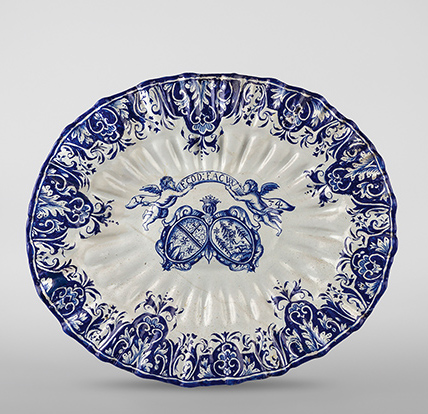
Pottery made by the Wysswald potting dynasty in CERAMICA CH
Roland Blaettler, 2019
Johann Wysswald (1655–1727) was the founder of a potting dynasty in Solothurn. He was first mentioned as a potter in archival records from 1697. All of his five sons learnt their father’s craft. We know that two of them, Urs Johann (1680–1753) and Johann Kaspar (1682–1742), worked together some of the time but had several disagreements and eventually ran separate businesses. Urs Johann Wysswald owned a kiln shed in the Vorstadt area at Dreibeinskreuz, which he extended in 1719. Johann Kaspar initially lived on Schmiedengasse lane before buying a house near the Berntor gate in the Vorstadt area in 1729.
Johann Wysswald’s three younger sons, Johann Jakob (1695–1746), Wolfgang (1697-?) and Urs Joseph (1700–1763) also worked as potters. The third generation included three cousins who were also potters: Dominik Wysswald (1709–1751), Johann Kaspar’s son, Urs Victor (1725–1765), Johann Jakob’s son, and Joseph Pankraz (1739–1772), Urs Joseph’s son.
The only signed stoves or stove tiles that are known to have survived were made by Urs Johann and Johann Kaspar. While the latter’s works were not of particularly good quality, Urs Johann’s works number among the most splendid examples of Swiss ceramic art from the first half of the 18th century. Worth mentioning, for instance, are two tower stoves dated 1723 from Beitenwil Château (Rubigen, Canton of Bern) that are now at Jegenstorf Castle (Brennpunkt 2013, nos. 4 and 5), and a third magnificent stove dated 1741, which was supposedly made for the Ambassadorenhof palace in Solothurn but is now in the town hall (Hochstrasser 1995, Figs. 10–12).
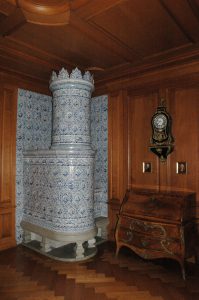
Apparently, Urs Johann Wysswald also sometimes made faience crockery, as attested to by four dishes donated by the family to the Museum Blumenstein.
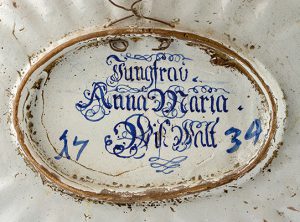
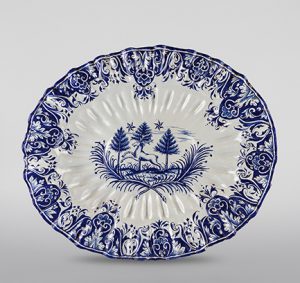
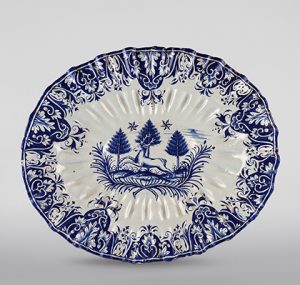
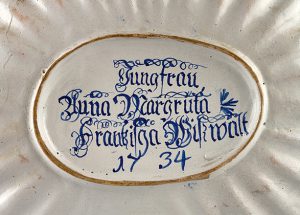
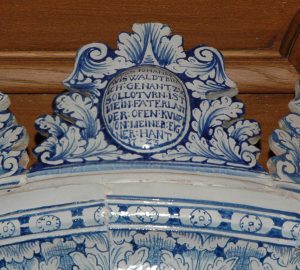
Three of them were presented as gifts to Wysswald’s daughters: Anna Katharina, who married Franz Carl Derendinger, bailiff in Solothurn, in 1729 (MBS 1962.13), Anna Maria (born 1707 – MBS 1962.12) and Anna Margaritha Franziska (1712–1747), who worked alongside her father as a paintress (MBS 2005.49). As confirmed by the inscription on the dome, it was she who decorated the tiled stove in the town hall. The shapes of the dishes are similar to German models from the late 17th and early 18th centuries (Hanau, Frankfurt). The stag rampant, three pine-trees and two stars that can be seen on the wells of MBS 1962.12 and MBS 2005.49 are all parts of the Wysswald coat of arms (Tatarinoff-Eggenschwiler 1939; Hochstrasser 1995).
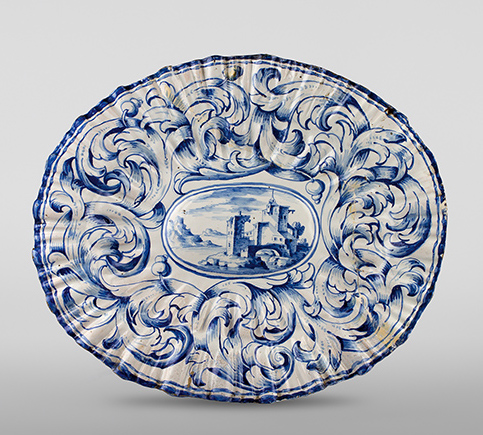
The dish MBS 1962.14 differs somewhat from the others, in terms of both its shape and its style of decoration.
Translation Sandy Haemmerle
References:
Blaettler/Schnyder 2014
Roland Blaettler/Rudolf Schnyder, CERAMICA CH II: Solothurn (Nationales Inventar der Keramik in den öffentlichen Sammlungen der Schweiz, 1500-1950). Sulgen 2014, 74–75.
Brennpunkt 2013
Schloss Jegenstorf (Hrsg.), Im Brennpunkt – die Sammlung historischer Kachelöfen Schloss Jegenstorf. Jegenstorf 2013.
Hochstrasser 1995
Markus Hochstrasser, Die Wysswald-Hafnereien in Solothurn. Jurablätter. Monatszeitschrift für Heimat- und Volkskunde, 1995, 33–46.
Tatarinoff-Eggenschwiler 1939
Adele Tatarinoff-Eggenschwiler, Die Familie Wisswald von Solothurn. Solothurn 1939.

