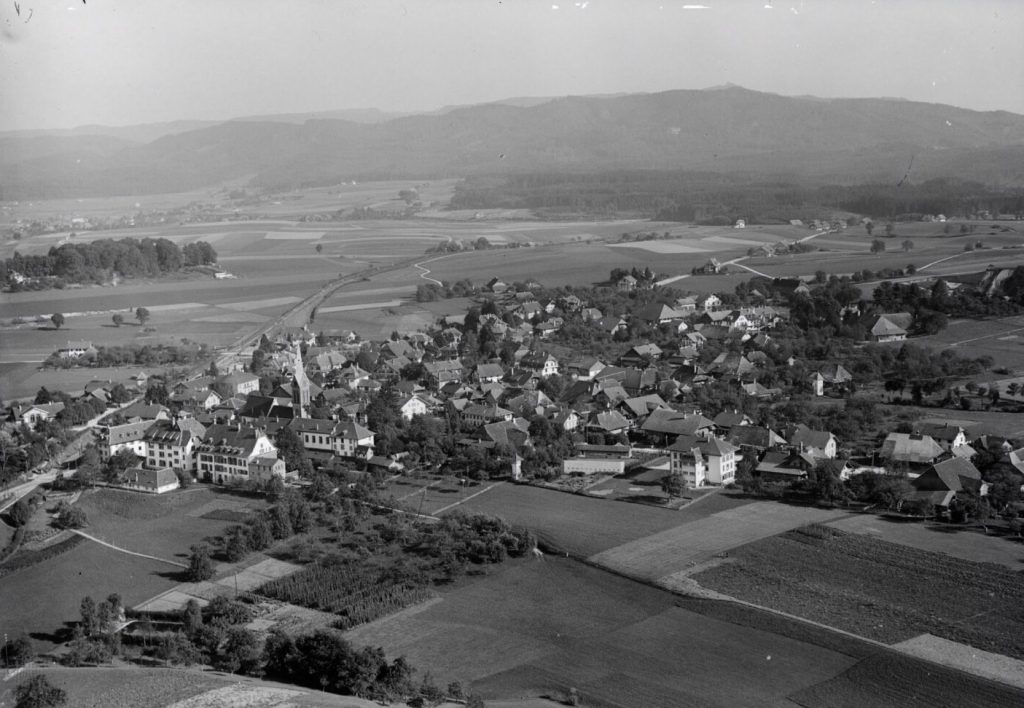
Münchenbuchsee, aerial photograph by Walter Mittelholzer, 1924, view towards the south-east.
Andreas Heege, Andreas Kistler, Alfred Spycher, 2025
While the only people with the surname Häberli prior to 1800 in the Bernese midlands were naturalised citizens of the municipalities of Krauchthal, Münchenbuchsee and Jegenstorf, there were many more in the Cantons of Lucerne, Thurgau and Zurich (Register of Swiss Surnames, online version). We have only partially succeeded in establishing a coherent and complete genealogy for the various potters called Häberli, as it was not possible to ascertain the links between some of the families. What we can say for now is that the genealogical investigations have not provided any evidence to show that the Häberli potters in 18th and 19th century Münchenbuchsee or Moosseedorf were in any way related to the Häberli potters from Hängelen. Nor were there any familial links between the latter and the Häberli potters that are known to have worked in Jegenstorf from 1861 to 1941; they can be shown to be part of the Häberli branch from Münchenbuchsee.
Häberli, Münchenbuchsee-Moosseedorf_genealogical data
Häberli, Münchenbuchsee-Moosseedorf, family tree
Johannes Häberli (1720-1796) was probably the second potter in Münchenbuchsee. His father, Johannes senior (Hans, 1693-?), is also likely to have been a potter, because a “potter Johannes Häberli” was actually mentioned in 1735 in the context of a Jakob Häberli building a new house (StAB Urbarien Fraubrunnen 60, 33-35, Buchsee Dopel Tom III. p. 22). Johannes junior was born in 1720 and had five siblings (see the family tree). On 26th August 1746, Johannes and Anna Katharina Reutlinger (1723-1749), the daughter of the Jegenstorf potter Abraham Reutlinger, were married in Jegenstorf (1673-1741; family tree; KRJ_27_126, KRJ = Jegenstorf Church Register. On Reutlinger cf. Boschetti-Maradi 2006, 210 fn. 1307; Heege/Frey/Spycher/Kistler 2023, 37-38). Her elder stepsister Anna Barbara Reutlinger (1699-1744) was married to the potter Hans Rudolf Marti (1691-1742) from Fraubrunnen. In September 1747, Johannes Häberli, with the consent of his mother-in-law, bought a “house, a shed with a kiln, a barn and an adjacent farmstead and garden at [München]Buchsee, approximately ¾ Juchart in total; adjoining Christen Häberli the bailiff in the east, Niclaus Häberli in the south, at the entrance to the lane, and adjoining Christen Ruffener the doctor in the north,” from Jacob Häberli, for the sum of 1800 pounds (StAB Bez Fraubrunnen A 272, 48-50). Anna Katharina Reutlinger’s death was recorded in the church register of Münchenbuchsee (KRM 14,39), which means that the childless couple probably lived there.
Johannes remarried on 7th February 1754 in Münchenbuchsee. His second wife was Margaritha Genfer (or Jenfer) from Bibern (1729-1784; marriage KRM 10, 3; birth KR Ferenbalm 3, 132, also StAB BXIII 559 Ausburg baptismal register no. VI 1721-1737 [city of Bern], pp. 283/2; Tod KRM 14, 95; see the family tree). This corresponds with a bond of 60 Kronen dated 1760 (StAB Bez. Fraubrunnen A 273_171). “Johannes Häberli, the potter at Buchsee”, had borrowed 60 Kronen from “Jsaac Äbersold, journeyman potter with Master Dittlinger, a native of Vechigen”. The bondsman in this transaction was “Jacob Genfer from Biberen, Parish of Ferenbalm” (an uncle or brother of Johannes’ wife perhaps?). From 1753 until 1763, Johannes’ mother-in-law from his first marriage, Elisabeth Reutlinger-Fankhauser, lived with him in Münchenbuchsee, with permission from the municipality of Mattstetten (life estate contracts: StAB, Bez. Fraubrunnen A 274,129 and A 322,49). In 1754 he bought a field in the “Guggerspühl” area (StAB Bez Fraubrunnen A 274,187) but was forced to sell it again in 1760 (StAB Bez. Fraubrunnen A 276, 170-172). The same year he also seems to have been compelled for economic reasons to sell his property for 2400 pounds or 720 Kronen (StAB Bez. Fraubrunnen A 273, 174-175). The contract, however, included the proviso that “If the seller or his heirs can raise the money within a 15-year period, they are entitled to buy it back for the same amount in cash.” He probably still lived in the house as a tenant, though no record has yet been found to show that he did repurchase the property. In 1772, he is still mentioned in records as “the potter Johannes Häberli” (StAB Bez. Fraubrunnen A 276, 170-172). However, the baptismal record of Anna Häberli (1774-?, father Daniel Häberli, schoolmaster, son), who was born out of wedlock, identifies him as a “schoolmaster” (KRM 5, 161). By the time of his death in 1796, he was named as “former schoolmaster” and his age was given as 76 years (KRM 14, 110).
Between 1749 and 1798, the annual accounts of Münchenbuchsee, Fraubrunnen and Aarberg list stove repairs carried out by Johannes Häberli, though it does not explicitly say whether this is Johannes senior (1720-1796) or Johannes junior (from c. 1779?). As a rule, Johannes worked at repairing stoves; rarely was he commissioned to create and install a new stove.
The marriage to Margaritha Genfer produced a daughter, Anna (1762-1763), and a son, yet another Johannes (1755-1821) (KRM 5, 67), who on 4th May 1779, married Elisabeth Hubacher (1757-1784) from Hub in the municipality of Krauchthal (KRM 10, 28 register of marriages, KRM = Münchenbuchsee church register). This marriage did not produce any children, nor have we any further information. Johannes’ second wife, Elisabeth Knuchel (1765-1834, married in 1786) bore him nine children. In the 1798 Helvetic Citizens’ Register he is listed as a master potter. Some of the entries in the Register of Journeymen for 1817 and 1818 can probably also be attributed to him.
At least two of his sons became potters. Niklaus Häberli (1789-1858) had his workshop “near the church” and was also a grocer. Numerous journeymen can be shown to have worked for him between 1822 and 1841 (Register of Journeymen). The workshop appears to have done very well. His elder brother, Johannes Häberli (1787-1835), ran his own workshop in neighbouring Moosseedorf from 1816 to 1835. Their younger brother Bendicht (1800-?) may also have been a potter, as there is one entry in the Register of Journeymen for 1826 that refers to him. (StAB B XIII 471).
The second line of Häberli potters in Münchenbuchsee began with another Johannes Häberli (1732-1792), whose profession is unknown. He married Anna Küenzi in Münchenbuchsee on 14th January 1763 (KRM_10_8; see the family tree). It is possible that Anna Küenzi came from the Heimberg-Steffisburg region, as all six of the couple’s children were baptised in Vechingen, Worb, Wichtrach or Steffisburg. When the youngest four children were born, the family was listed as living in Heimberg or Heimberg-Beumberg respectively (KRM 5, 100, KRM 5,108, KRM 5, 127, KRM 5, 152, KRM 5, 166, KRM 5, 182). Johannes therefore probably never worked in Münchenbuchsee. This is further confirmed by the fact that his first-born son, Samuel Häberli (1765-1830), is listed in records as a potter in Heimberg from 1785 until 1795. It was only Samuel’s youngest daughter, Maria (1797-1863), who was baptised in Münchenbuchsee in 1797 (KRM 5, 245, KRM 5, 267, KRM 5, 276, KRM 5, 294, KRM 6, 38, KRM 6, 57). It should therefore come as no surprise that we should find Samuel Häberli in the Helvetic Citizens’ Register for Münchenbuchsee in 1798. On 11th November 1802, he bought a small house and garden at some distance from the village centre (GBM 3, 284-286, GBM = Münchenbuchsee Cadastral Register). It still stands today at 102 Mühlestrasse. Four entries in the Register of Journeymen can be attributed to Samuel between 1816 and 1827.
Samuel Häberli had seven children; the eldest son, Jakob (1785-1831), was also a potter and his younger brother, Christian (1787-1857), was a crockery salesman (family tree). The moral conduct of Jakob and Christian does not appear to have been of a particularly high standard, as they were repeatedly summoned by the police to appear before the magistrate in Fraubrunnen. In 1823, 1827 and 1830, they were prohibited from “visiting the bars and taverns in the districts of Fraubrunnen and Bern” because of their “propensity for drinking and committing irresponsible acts” (StAB Bez Fraubr B 366, 104, 1820, StAB Bez Fraubr B 367, 117, 1823, StAB Bez Fraubr B 369, 97, 1830, StAB Bez Fraubr B 369, 130, 1839). It is very hard to tell how serious the problems really were. Between 1830 and 1833, there were, in fact, as many as eight entries in the Register of Journeymen initially for Jakob and then for his widow, Maria Kunz. His son, Johann Jakob (1814-1874), can be associated with three journeymen between 1857 and 1866.
Until 1875, the potter’s house at 102 Mühlestrasse was occupied and used by various descendants who were all potters. The last known potter “Johann Häberli Junior” was declared bankrupt in 1870 (Tagblatt der Stadt Biel, vol. 8, issue 272, 17th November 1870).
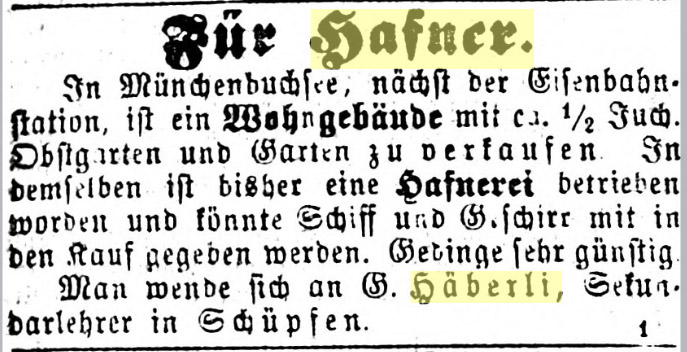
In 1875 the house passed to Gottfried Häberli (1845-1909), who was a teacher. He tried to sell it in 1876, but it was not until 1893, that it was finally sold to the carpenter Christian Hirt-Weibel (GBM 30, 98-102).
Translation Sandy Haemmerle
References:
Boschetti-Maradi 2006
Adriano Boschetti-Maradi, Gefässkeramik und Hafnerei in der Frühen Neuzeit im Kanton Bern (Schriften des Bernischen Historischen Museums 8), Bern 2006.
Heege/Frey/Spycher/Kistler 2023
Andreas Heege/Jonathan Frey/Alfred Spycher u.a., Keramik aus Blankenburg, Abraham Marti (1718–1792), ein bernischer Landhafner, Bd. 16 (Schriften des Bernischen Historischen Museums), Bern 2023.

