Roland Blaettler, 2019
The city of Nyon has always been home to many potters, tile makers and stove fitters. Obviously the best-known among them were the members of the Bezençon family: Samuel I (died in 1787), resident in Nyon since 1738, his son, Samuel II (died in 1802) and grandson, Isaac, who can be shown to have worked as a potter until 1832 (Pelichet 1985/2, 11 and 12; Kulling 2001, 238-240).
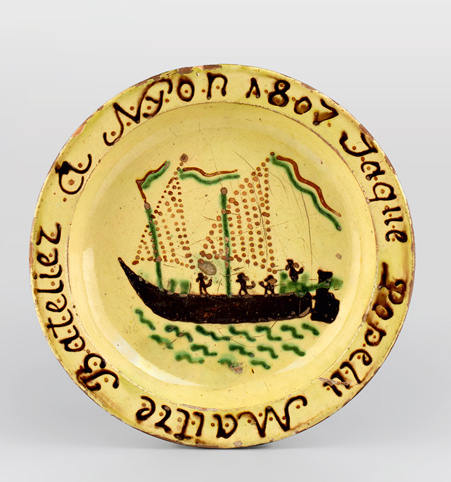
Pelichet attributed a series of slipped earthenware vessels to Isaac Bezençon: a jug dated 1796 (MHPN MH-FA-4061) and dishes and plates, made for a local skipper, Jacques Popelu, in the first decade of the 19th century (MHPN MH-FA-521; MHPN MH-FA-520; MHPN MH-FA-519; MHPN MH-FA-536).
In an article entitled “Nyon and its industries” published in the Conteur Vaudois on 2nd April 1881 (p. 1), “ordinary ceramic wares” were succinctly described as “plentiful”. That statement seems a little puzzling, as we know that, besides the Manufacture de poterie fine, there was another pottery business in the late 19th century at 7 Rue de la Poterie, but it did not actually produce any “ordinary ceramic wares”. The “Poterie commune” produced earthenware. It set itself apart even by its name from the Manufacture de poterie fine, which produced high-quality refined white earthenware. Pelichet believed that the Poterie commune was founded in c. 1896 by a man called Bœhler (Pelichet 1985/2, 43).
The widow Philippe, 1883-1885
The Swiss Official Gazette of Commerce (SOGC), however, lists a Poterie commune as early as 1883 under the company name “Veuve Philippe” [the widow Philippe]. At that time, it was run by Marie Madeleine Pauline née Musset from Moens in the Département Ain. She was the widow of Jean Christ Philippe. According to the Gazette of Commerce, the company made and sold everyday wares, i.e. slipped and glazed earthenware (SOGC Vol. 1, 1883, 355). We can assume that the workshop was originally run by the late Jean Christ, although the entry in the SOGC does not point to a name change but rather appears to be the first ever listing of the company. In any case, two years later, the widow Philippe married a man called Jean Bœhler, perhaps a former staff member, from Soufflenheim, a well-known centre of pottery making in the Alsace region. The business then continued to trade under the widow Philippe’s new husband’s name (SOGC, Vol. 3, 1885, 582).
Jean Bœhler, 1885-1902
In 1890, Bœhler was awarded a prize for his ceramics when he exhibited them at the Horticultural Show in Nyon (La Revue, 27th September 1890, 1). In 1893, he was among the prize winners again (La Revue, 22nd September 1893, 2). In 1896, he participated in the National Exhibition in Geneva (Genève 1896/1, 408, exhibitor number 4163). On that occasion he gave public demonstrations where audiences could watch him work free of charge (Courrier de la Côte dated 19th July 1896). The products on display were described as “glazed pottery, majolica type”.
Like many of his colleagues in the Lake Geneva region, who produced slipped earthenware, Bœhler mainly made undecorated pottery for everyday use. His signature can be found at the bottom edge of the “Tableau des mesures de poterie cuite adoptées par la Fédération des ouvriers tourneurs de la région de Genève, Ferney, Renens, Annecy et zones environnantes et de Messieurs les patrons soussignés” [Table of measurements for fired pottery adopted by the Federation of Potters in the region of Geneva, Ferney, Renens, Annecy and surrounding areas and by the undersigned employers] (reproduced in: Ferney-Voltaire 1984, 264-265). See also the chapter Lake Geneva region, slipped earthenware.
The term “majolica type” used by the journalist from the Courrier de la Côte suggests that Bœhler also created more elaborate ceramics, which he adorned with colourful glazes. He quite probably never marked his products. However, even in the absence of a mark, we believe we can attribute three decorated frusto-conical jugs with the same type of handle to Bœhler; all three bear the name “Nyon” as part of their decoration and two are dated. The first example, which is in the collection of the Nyon Castle Museum, has white and green marbling on a red-brown background. The jug bears the date “2nd October 1888” and the initials “E. M.” (MHPN MH-1996-73).
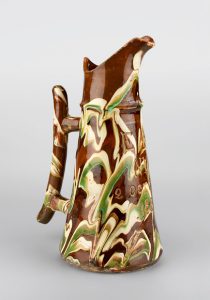
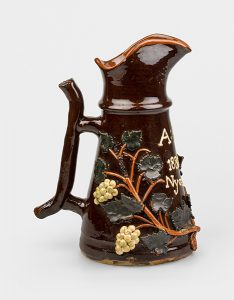
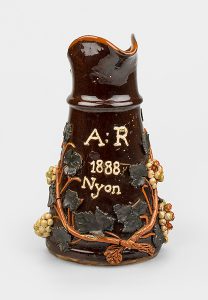
We originally attributed it to the Knecht workshop in Colovrex until we found a second example that was very similar in shape at the Vine, Wine and Wine Label Museum in Aigle. The difference is that it has an applied decoration of vine-branches in relief; it too has a date (“1888”) and initials (“A:R”) (MVVE 1515). The design is very similar to those on the famous “welcoming jugs” by the Knecht family from Colovrex (Canton of Geneva), though the production techniques used are quite different. On this jug, the leaves were moulded and the grapes and vines were free-formed by hand; in the Knecht examples, on the other hand, all the elements were moulded. The Amoudruz collection at the Anthropological Museum in Geneva contains the third jug, which appears to confirm our attribution to the workshop in Nyon: it bears the inscription “Nyon”, but no date, and it has the same shape and marbled design as the piece from the museum in Nyon (ETHEU 103238).
Jean Bœhler filed for bankruptcy in 1902 (Feuille d’avis de Lausanne dated 16th May 1902, 16 – SOGC, Vol. 20, 1902, 1042).
Poterie commune de Nyon S. A., 1905-1909
In 1902, the new owners of the company, Robert Matthey and Robert de Rham, submitted plans to the municipal council to rebuild the pottery (Communal Archives of Nyon [ACN], Bleu A-69, meeting on 19th November 1902). In December 1905, they set up a public limited company, the “Poterie commune de Nyon S. A.”, with the aim of “purchasing and running the company known under this name, to produce and sell ordinary pottery as well as any enterprise operating in or related to this field.” The board of directors had three members: Robert de Rham, president, residing in Lausanne, Robert Matthey and Georges André, both residing in Nyon (SOGC, Vol. 23, 1905, 2027)..
We do not know if the work that was announced in 1902 was actually carried out, but the public limited company presented new plans in 1906 (ACN, Bleu A-70, meeting on 5th February 1906). Between 1907 and 1909, the Manufacture de poterie commune was listed in the Indicateur vaudois at 7 Rue de la Poterie, with a man by the name of Billon identified as the company director. The company won a prize at the 1908 Horticultural Exhibition in Nyon (La Revue dated 10th September, p. 2). In the same year, the council noted that the “Société anonyme de la Poterie commune” would henceforth be subject to factory law, as it now employed 15 members of staff (ACN, Bleu A-71, meeting on 12th October 1908). Approximately one year later, the company was granted permission to liquidate its stock (ACN, Bleu A-72, meeting on 8th November 1909).
Henriette Morello, 1910-1912
Théophile Thomas-Morello, 1912-1916
In 1910, the Indicateur vaudois announced that the company had a new director: Jules Meylan. At its meeting on 7th October 1910, the parish council was informed that the “Poterie commune” would henceforth be called “Henriette Morello, poterie” (ACN, Bleu A-72). Marthe-Henriette Morello’s family hailed from Turin (SOGC, Vol. 28, 1910, 662); she was listed as the managing director in the Swiss Official Gazette of Commerce (ACN, Orange P-1). She probably rented the facilities which were still owned by the public limited company. A character reference was issued for “Mademoiselle Henriette Morello, born in Ferney-Voltaire on 31st January 1878, of Italian descent, potter, resident in Nyon since 1st January 1910 and previously spent an extended period of time in Nyon” (ACN, Bleu A-73, meeting on 19th February 1912).
A short while later, Henriette Morello married the Parisian citizen Théophile Thomas and in November 1912, the pottery was put in his name (SOGC, Vol. 30, 1912, 2060). The union did not last long; on 8th November 1914, the Gazette de Lausanne (p. 3) announced the sad news that “Monsieur Thomas-Morello, managing director of the Poterie commune de Nyon […] fell on the field of honour at the Battle of the Marne in early September”. Henriette continued to run the factory, apparently under the same name, until 1916. On 8th September 1916, the company name was permanently delisted (SOGC, Vol. 34, 1916, 1394). In May 1916, Henriette informed the authorities that she was planning to renovate her late husband’s house, most probably as a place to live when she retired (ACN, Bleu A-75, meeting on 8th May 1916).
According to the records of the residents’ registration office in Nyon, Henriette Morello was accompanied by her three brothers when she took up residence in Nyon in 1910: Abel, a trained potter, was born in Vanchy (Ain) in 1882, and eventually moved to Bonneville (Haute-Savoie) in 1921; Louis and Charles, who were listed as workers, were born in Renens (Canton of Vaud) in 1893 and 1894 respectively and left Nyon in 1920; Louis moved to Ferney-Voltaire, Charles to Marseille.
The Morellos were a typical example of a family of potters who had left their country of origin – in this case Italy – in search of work. At some stage, their father had settled in Ferney-Voltaire, where Henriette was born, and then a few years later moved to Vanchy, another place with a longstanding pottery-making tradition, where Abel was born. The Morellos ultimately found themselves back in Renens, where their youngest sons Louis and Charles were born. The story is of course reminiscent of the difficult lives of many uprooted people, but it also shows the inevitable personal links that were forged between the different pottery-making centres in what could be called the Lake Geneva region in the widest sense.
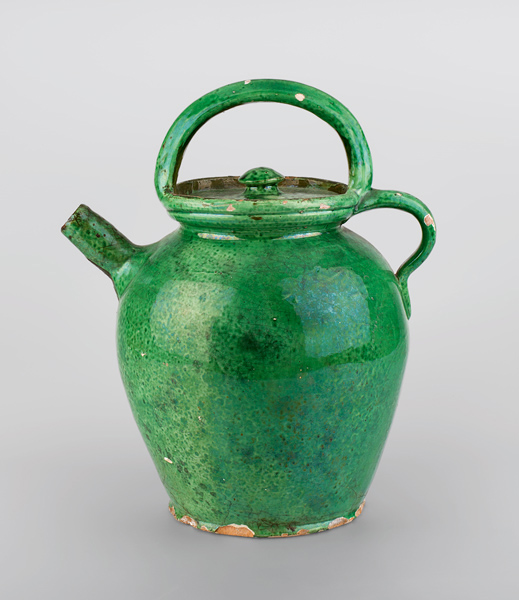
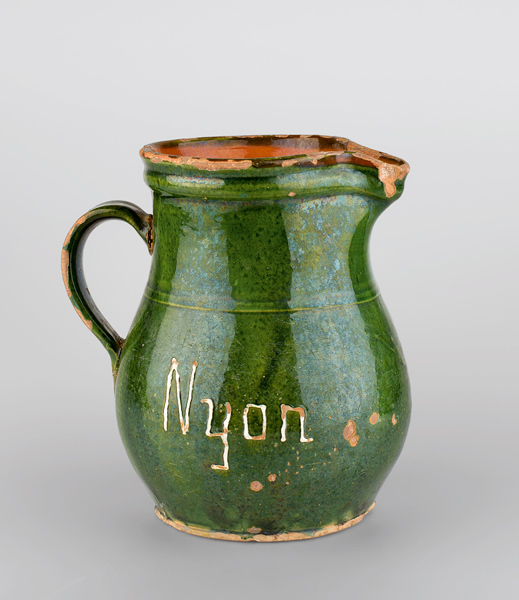
The Poterie commune participated in the 1913 Horticultural Exhibition in Nyon, exhibiting “art pottery and utilitarian wares” (Feuille d’avis de Lausanne dated 12th September 1913, 3). The latter must have consisted of the same undecorated and relatively standardised products that were being manufactured at the time by most of the workshops throughout the Lake Geneva region (e.g. MHPN MH-1996-78; MHPN MH-FA-4427A; MHPN MH-1996-77; MHPN MH-2013-32). But which pieces did the term “art pottery” refer to?
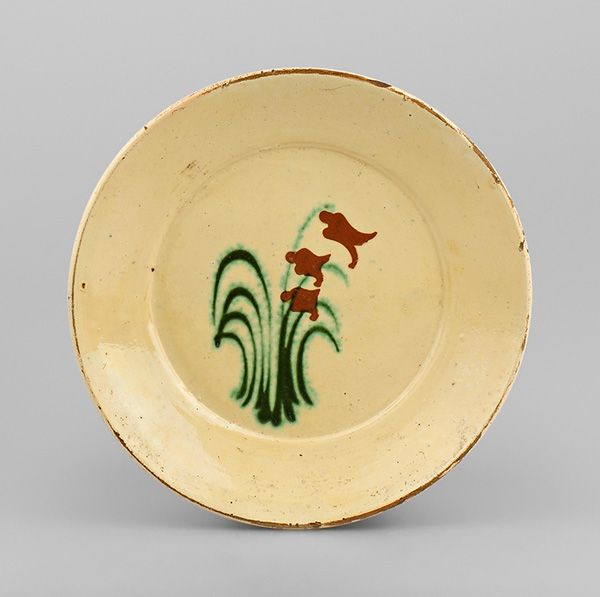
The Museum of the Pays d’Enhaut in Château-d’Œx houses a plate that is decorated with a very simple floral pattern and has the mark “Nyon 1913” on its underside (MPE 2995).
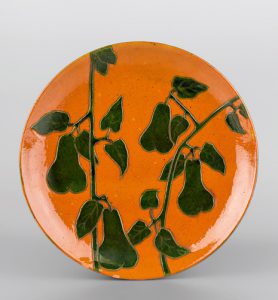
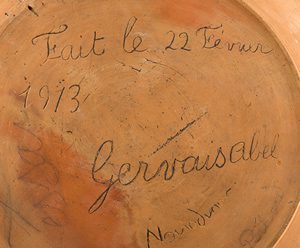
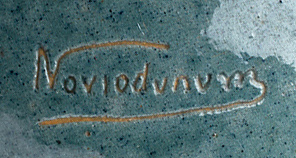
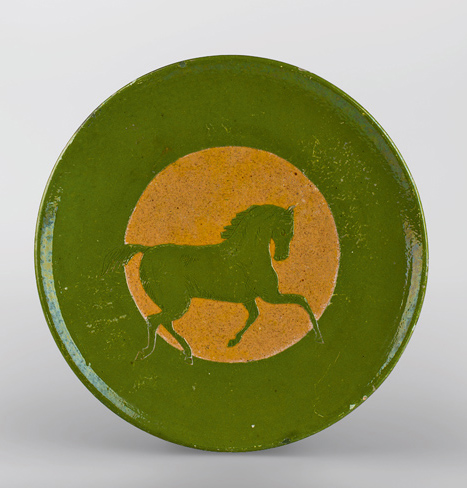
The term “art pottery” would actually be more appropriate for this shallow dish from the Nyon Castle Museum; it has a cameo-type sgraffito decoration and attests to a modernism not otherwise seen in Nyon (MHPN MH-2011-30). It also dates from 1913 and has an incised mark “Gervais Abel – Noviodunum (the Roman name of the town of Nyon; this mark would be used by Régis Richard a few years later)”.
According to Pelichet, the Morello brothers worked for their sister’s successors, the Richard brothers, for a period of time (Pelichet 1985/2, 43). Did Abel Morello perhaps have the middle name Gervais? The records of the residents’ registration office have no such entry. In this case, the name “Gervais” appears, rather, to have been a surname; the name was quite common in France and was also represented in the Canton of Geneva, not least by the long-established branch of the Gervais family in Cartigny. The museum in Nyon has two other pieces that were decorated using the same technique as the 1913 dish, both of which bear the incised mark “AG” (probably the initials of Abel Gervais): a dish with two further incised marks – “Noviodunum” and “Lebrane L” (MHPN MH-1999-105) and a vase with the mark “Nyon” (MHPN MH-2015-348).
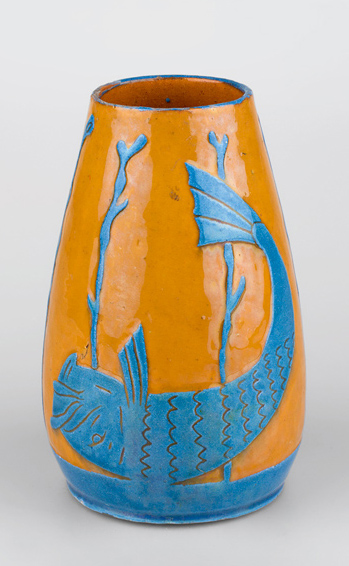
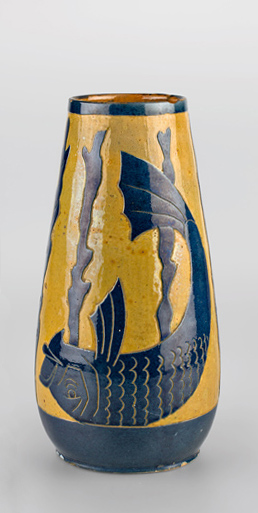
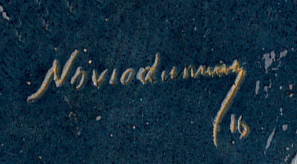
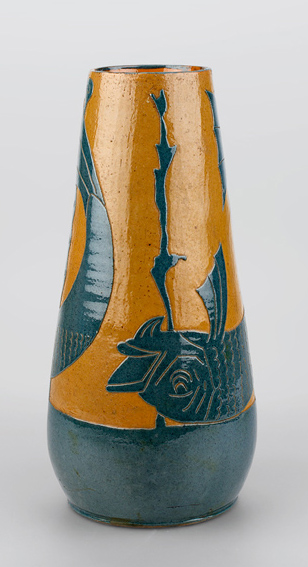
With its shape and design the vase was a clear forerunner of a type that would become characteristic of the wares produced by the Richard brothers, who succeeded Henriette Morello in 1916 (MHPN MH-2015-432; MHPN MH-FA-4041, HPN MH-2015-432; MHPN MH-FA-4041).
The press at the time (see below) reported that Régis Richard had already begun to experiment with this new design in 1915. It is possible that the two objects marked with the initials “AG” date from an experimental phase, during which Richard collaborated with the potter Abel Gervais at the Morello workshop. As for the 1913 dish, it is probably too early in date for it to be attributable to Richard, even though it has his name carved into it. We would therefore like to put forward a different hypothesis: Abel Gervais, a particularly talented potter, introduced an innovative style when he worked for the Thomas-Morellos, which was subsequently further developed by the Richard brothers. The same potter Gervais (or else his boss, Théophile Thomas) also initiated the “Noviodunum” mark.
Richard Frères et Cie, 1916-1917 – Richard Frères, 1917-1921
The company name “Richard Frères et Cie” was registered in the Swiss Official Gazette of Commerce on 29th May 1916; the same entry tells us that Régis and Auguste Richard (at that stage the third brother Albert did not yet feature) formed a partnership with Camille Schultz from Geneva (SOGC, Vol. 34, 1916, 870). On 5th September the SOGC announced that Régis had left the company and had been replaced by his brother Albert (SOGC, Vol. 34, 1916, 1383). It was not until 19th September that the town authorities acknowledged a notification from the prefecture to say that the former Thomas-Morello workshop would henceforth be known as the “Poterie de Nyon – Richard Frères et Cie” and that the company would be subject to factory law (ACN, Bleu A-75). On the same day, Régis Richard applied to use the function room on the second floor of the Lancaster building to stage an exhibition of paintings, ceramics and goldsmithing works in collaboration with “Professor [Georges] Vallotton and M. Monod, watercolourist” from 1st to 15th October.
Louis-Régis Richard (1893-1940) appears to have been the one with the artistic talent among the young siblings from the very beginning (the youngest was barely 20 years of age). He was registered in the residents’ office as a “painter decorator”. Albert (born in 1895) was registered as an industrialist, as was Auguste (1896-1938). The Richards originally came from Nyon and Coinsins, Canton of Vaud.
Under the new management, the company remained true to the traditional technique of producing slipped earthenware while striving to achieve a more refined style and exhibiting artistic ambition with its rather modernist sgraffito designs. In the early period of the business, we can distinguish between two lines of production: the technically and aesthetically more refined objects were probably Régis’ own designs fired at the company workshop. These products were usually marked with the monogram “RR” (MHPN MH-2015-347; MHPN MH-2015-412; MHPN MH-FA-251A; MHPN MH-FA-251B; MHPN MH-2000-113; MHPN MH-2015-184; MHPN MH-2015-352; MHPN MH-2015-351; MHPN MH-2015-185).
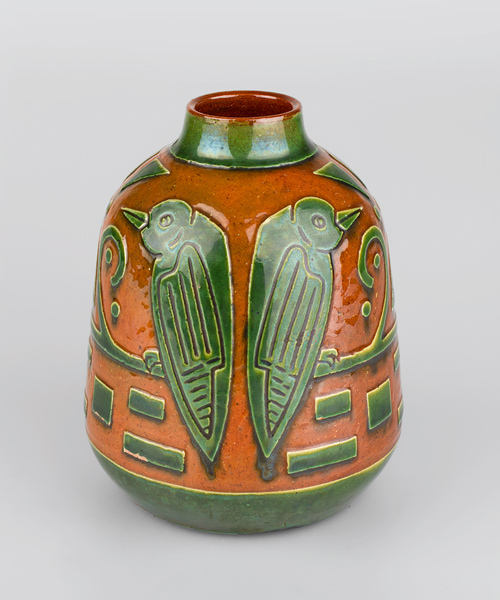
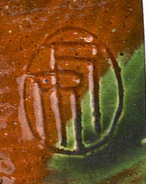
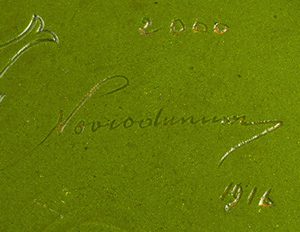
In their first year, the Richards published two kinds of advertisements, which made a very clear distinction between their basic range and their more personal production line. It was Régis’ desire that this distinction should become engrained in people’s minds. One advertisement was for the “Poterie de Nyon – Richard Frères & Cie – Spécialité de poterie artistique – Poterie commune et fantaisie” [specialising in art pottery – common wares and decorative pottery] (e.g. in the Lausanne artistique newspaper dated 17th June 1916). The other one advertised the “Poteries artistiques Novio Dunum – Régis Richard, céramiste, Nyon – Spécialités de vases, cache-pots, bibelots, suspensions, plats décorés” [specialising in vases, flowerpots, ornaments, flower-lamps, decorated dishes] (Lausanne artistique, 9th July 1916). Régis evidently used the “Noviodunum” mark for some time. Surprisingly, however, it rarely occurs in conjunction with the monogram “RR” (MHPN MH-FA-251A; MHPN MH-FA-251B) but does sometimes appear alongside the impressed mark “Richard Frères et Cie” (MHPN MH-1999-106; MHPN MH-2015-432; MHPN MH-2015-346). In those cases, the double mark could perhaps point to pieces that Régis designed for the company.
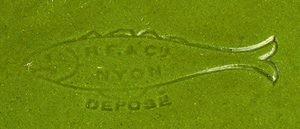
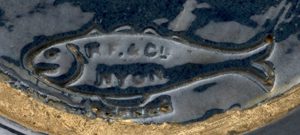
As for the company’s “collective” production, it originally used a stamped, impressed mark in the shape of a fish and the shortened company name of “R. V. & Cie” and the term “Déposé” (registered trademark, protected by law) (MHPN MH-199-106; MHPN MH-2015-432; MHPN MH-2015-401; MHPN MH-FA-4248). It should be noted that this mark continued to be used until 1920, despite the fact that the change company name was changed in 1917 (see below and MHPN MH-1998-94). Furthermore, there were several variations of marks consisting only of the surname “Richard”, either incised (MHPN MH-2015-519; MHPN MH-2015-399; MHPN MH-2015-395; MHPN MH-2015-180; MHPN MH-FA-4040) or stamped (MHPN MH-2011-25).
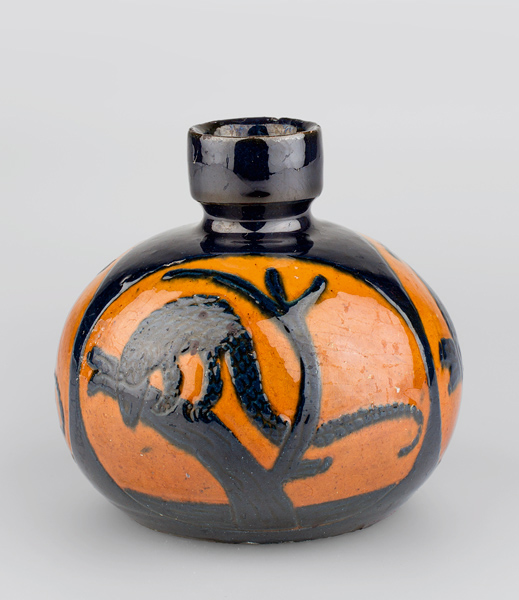
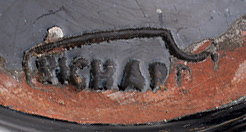
While Régis initially presided over the newly founded company, he quite quickly distanced himself from it to concentrate on his own creations. As part of the “Exposition des arts du feu” staged by L’Œuvre from May to November 1916 in Geneva, La Chaux-de-Fonds, Neuchâtel, Zurich and Lausanne, Régis Richard appeared in the catalogue under his own name without any mention of the company. He was described as a “ceramicist, 3 av. Viollier in Nyon”. He exhibited 29 pieces, including large and medium-sized urns (costing 54 and 35 francs respectively); a vase with a fish design (7 francs); a vase, stork and fox (7.50 francs); vases with green and blue stars (6.50 francs); a vase, bull (5 francs); a vase, flying storks (4.50 francs); a vase, squirrel (4 francs); a vase, heron (4 francs); bonbonnières, Greek or Renaissance design (2 francs); vases, greyhounds (7 francs); a vase, smoky black (7 francs); “Pétronelle” (1.70 francs) and decorative vessels (Les arts du feu 1916, p. 42). In his newspaper column on the exhibition, the art critic and then general secretary of L’Œuvre, Paul Perret, mercilessly criticised the creations: “The strange process used by Monsieur Régis Richard, which involves slip-decorating his ceramics and then scratching the slip off again to expose the fabric underneath, is a rather dry and miserable technique which seems to me to ignore the best qualities of the material. This deficit is not always compensated for by the solid draughtsmanship” (Gazette de Lausanne dated 27th May 1916, 3).
That same year, the Richards took part in the “Comptoir d’échantillons de Lausanne”. In a report for the Lausanne artistique newspaper (22nd July 1916, 1), the journalist emphasises the “scratched pieces” made by Régis: “This process is completely new to Switzerland […] His first experiments date from 1915, and after a difficult patch, Monsieur Richard ultimately managed to create pieces that are in good taste and not too expensive. They are manufactured by the company Richard Frères et Cie […] He makes art pottery of all kinds to order. His decorating workshops are located in Nyon, at 26 rue de Rive, where visitors will always find an interesting selection of his products.”
In November 1916, the company applied for permission to install an electric motor and an extruder in the “premises of the Société anonyme de Poterie commune”. The document also tells us that the company had a retail outlet at 34 Rue de la Gare (ACN, Bleu A-75, meeting on 27th November 1916). When Camille Schultz, one of the partners, left the company in May 1917, its name was changed to “Richard Frères” (SOGC, Vol. 35, 1917, 962).
The 1917 Indicateur vaudois still lists both company names at the same address: “Poterie Noviodunum – Régis Richard” and “Richard Frères”. The distinction was dropped in subsequent years and never appeared in the Swiss Official Gazette of Commerce.
In reality, Régis Richard was in the process of leaving Nyon and setting up a new business. In October 1917, he teamed up with Oscar-Joseph Bairiot, a Belgian citizen living in Nyon, to establish a general partnership headquartered in Geneva (2 rue de la Tour-Maîtresse) creating and trading in art pottery and utilitarian wares (SOGC, Vol. 35, 1917, 1749). To set their plans in motion, Richard and Bairiot took over the well-known pottery from the sons of Alexandre Liotard in Ferney-Voltaire in January 1918 (Ferney-Voltaire 1984, 287 – Clément 2000, 71; the author describes Richard as a “deplorable ceramicist”). By December, Bairiot had already left the business and sold his shares to René Nicole from Geneva. The headquarters of “R. Nicole et R. Richard” was subsequently moved to Nicole’s house at Plainpalais (SOGC, Vol. 36, 1918, 1986). In February 1920, Régis Richard sold his own shares to Nicole, making him the sole owner of a company which would enjoy a certain degree of success until the beginning of the Second World War (Clément 2000, 71-75; Rivollet 1998).
Régis embarked on his final adventure by forming a partnership with Henri Miège, an architect from Ferney to build up “La Grande Poterie artistique R. M. C. de Ferney-Voltaire”; this was to be an ambitious and grandiose project, which would never again be heard of … (Ferney-Voltaire 1984, 287).
In the meantime, back in Nyon, Auguste and Albert Richard had submitted plans to set up a new factory in the district of En Prélaz in Martinet on the road to Saint-Cergue (ACN, Bleu A-76, meeting on 23rd September 1918). However, the work was halted by the cantonal authorities in January of the following year (ACN, Bleu A-77, meeting on 6th January 1919); despite this setback, it was subsequently completed and, in August, the owners were granted permission to move their electric motor to the new premises (ACN, Bleu A-77, meeting on 18th August 1919). The Communal Archive of Nyon houses plans from the new factory, which show a layout with two large kilns (ACN, Bleu K-315.52). The premises were intended for approximately twenty workers. The factory’s period of upswing, however, would not last long: on 5th September 1921, the city council noted in the minutes of its meeting that Richard Frères had gone bankrupt (ACN, Bleu A-78); according to the Swiss Official Gazette of Commerce, the company had been delisted in August that same year (SOGC, Vol. 39, 1921, 1611).
In 1922, Albert Richard emigrated to France and Auguste left the shores of Lake Geneva to move to Compiègne. He returned to Nyon in 1929 and stayed there until his death. Régis left Nyon in 1924 and moved to Marseille but later died in Vence.
Pelichet’s work notes in the collection of the Nyon Castle Museum state that, according to Auguste Richard’s widow, the company was taken over by Hermann Kaeppeli in 1923. The minutes of the city council, however, tell us that Gustave Besson, the “new proprietor of the pottery Richard Frères En Prélaz” applied to have his property taxes deferred, as “the factory has only become operational in recent days” (Bleu A-79, meeting on 29th April 1923). In the Swiss Official Gazette of Commerce, Besson was listed as the manager of the pottery factory on route de Trélex on 12th May (Vol. 41, 1923, 976). The following month, the prefecture noted that Besson’s business employed eleven workers and was thus subject to factory law (Bleu A-79, meeting on 14th May 1923). On 2nd October 1924 the Feuille d’avis de Lausanne (p. 8) announced that the company was bankrupt. The Indicateur vaudois listed it for the last time in 1925. On 6th April 1925, the building “which is relatively new and includes a potter’s workshop, living quarters and offices” was put up for sale (SOGC, Vol. 43, 1925, 502).
A year later, the Swiss Official Gazette of Commerce mentioned a potter called E. Besson on rue de la Poterie (probably in the premises of the former Poterie commune) for the first and last time.
The “Noviodunum” mark – this time without any other factory marks – also appears on a production line that we have found difficult to connect to anyone in particular. It is a type of refined white earthenware with a very white fabric covered with a coloured layer (perhaps some kind of slip?) and decorated using the same sgraffito technique of scratching the design into the slip to reveal the body beneath (MHPN MH-2015-393; MHPN MH-2012-60; MHPN MH-2015-394; MHPN MH-2015-396; MHPN MH-FA-4045; MHPN MH-2015-470; MHPN MH-FA-4632).
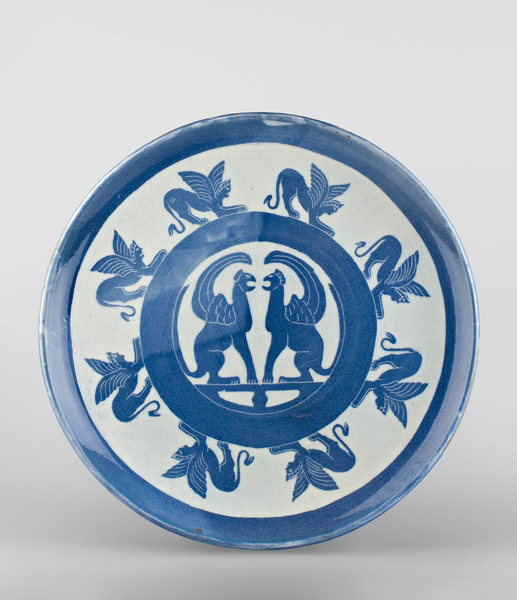
Certain stylistic similarities between these pieces and the slipped earthenware production of the Richard brothers have prompted us to associate this production line with them, although we cannot be absolutely certain. The same technique can also be found on objects that bear the “Kaeppeli et Rüegger” mark, although both the designs and the craftsmanship are of a lower standard (see MHPN MH-2015-405; MHPN MH-2015-494; MHPN MH-2000-85A and the chapterl «Nyon, Canton of Vaud, Kaeppeli, Hermann, art pottery, 1917-1923»).
Sources:
Communal Archives of Nyon [ACN], Série Bleu A, Registres de la Municipalité – Série Bleu K – Orange P1, Registre des commerçants
Press and annuals from the Canton of Vaud, accessed via the Scriptorium website of the Cantonal and University Library of Lausanne
Translation Sandy Haemmerle
References:
Blaettler 2017
Roland Blaettler, CERAMICA CH III/1: Vaud (Nationales Inventar der Keramik in den öffentlichen Sammlungen der Schweiz, 1500-1950), Sulgen 2017, 60–64.
Clément 2000
Alain Clément, La poterie de Ferney: deux siècles d’artisanat. Yens-sur-Morges/Saint-Gingolph 2000.
Ferney-Voltaire 1984
Ferney-Voltaire. Pages d’histoire. Ferney-Voltaire/Annecy 1984.
Genève 1896/1
Exposition nationale suisse Genève 1896. Catalogue de l’art ancien. Groupe 25. Genève 1896.
Kulling 2001
Catherine Kulling, Poêles en catelles du Pays de Vaud, confort et prestige. Les principaux centres de fabrication au XVIIIe siècle. Lausanne 2001.
Pelichet 1985/2
Edgar Pelichet, Les charmantes faïences de Nyon. Nyon 1985.
Rivollet 1998
Karin Rivollet, La poterie René Nicole à Ferney-Voltaire, 1919-1939. Genève 1998.

