Roland Blaettler, 2019
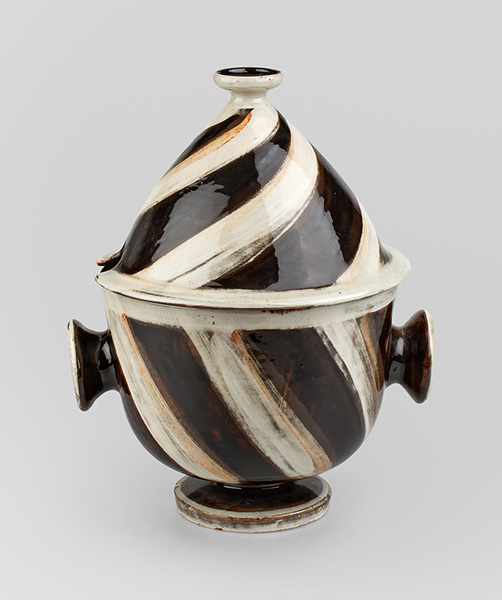
Pottery made by Margrit Linck-Daepp in CERAMICA CH
Margrit Linck-Daepp (1897–1983) served her apprenticeship as a potter at Johann Gottfried Moser’s workshop in Heimberg from 1916 to 1920. Having studied at the School of Ceramics in Bern for a year, she attended a private ceramics school in Munich for further training in 1922/23.
In 1927, Margrit Daepp married the sculptor Walter Linck (1903–1975). Before that, they spent time in Berlin in 1924/25 and then moved to Paris where they lived from 1927 to 1930, being introduced to and inspired by all the new art movements. They were a firm part of the young artists’ circle at the time. Upon their return to Switzerland, Margrit Linck, as she was now called, found her vocation. The couple initially lived in Zurich and later moved to Wabern in the Canton of Bern. In 1941, they settled permanently in Reichenbach-Zollikofen, Canton of Bern, where Margrit immersed herself in the world of pottery production (Messerli 2017, 159–221).
Linck’s imaginative early works attest to her bold attempts to breathe new life into the well-established technique of traditional Bernese slipware by developing a new vocabulary of forms in utility ware (for early examples see L’Œuvre, Vol. 24, 1937, issue 12, Figs on pp. 357–359).
With great freedom of expression, she began by creating items of everyday use (MHL AA.MI.1954; MHL AA.MI.1869; MHL AA.MI.1868; MHL AA.MI.1921). From 1943 onwards, she turned her attention to producing more sculptural objects, some of which were inspired by surrealist art (MHL AA.MI.2581).
In 1957, she opened a second studio in the village of Saint-Romain in Burgundy, where she concentrated on developing sculptural objects. In the studio in Bern, on the other hand, she focused on throwing and then reshaping vessels made of pure white faience, which she left completely undecorated so as not to distract the viewer from seeing the form (MHL AA.MI.1910).
Drawing on centuries of traditional pottery making in her place of origin, Linck continuously strove to take inspiration from the most innovative movements in contemporary art and to incorporate them freely into her ceramic creations. This position earned her a level of international renown that only a small number of ceramicists have ever achieved. In 1949 her ceramics were exhibited at the Kunsthalle in Bern alongside the paintings of Oskar Dalvit and Joan Miró. In the 1950s she began to receive invitations to show her works, mainly in Germany, but also in Italy, the US and France.
After her death, her daughter-in-law, Regula Linck, took over her studio in Reichenbach and continued to produce Margrit Linck’s creations in white faience. The company Linck Keramik is still active today and has been located in Worblaufen in the Canton of Bern since 2015.
Online sources:
Translation Sandy Haemmerle
References:
Altorfer 1981
Max Altorfer (éd.), Margrit Linck. Keramische Skulpturen – Weisse Vasen. Berne 1981.
Buchs 1988
Hermann Buchs, Vom Heimberger Geschirr zur Thuner Majolika. Thun 1988.
Dictionnaire historique de la Suisse (article Margrit Linck, par Michèle Baeriswil-Descloux – article Walter Linck, par Michael Baumgartner)
Messerli 2017
Christoph Messerli, 100 Jahre Berner Keramik von der Thuner Majolika bis zum künstlerischen Werk von Margrit Linck-Daepp (1987-1983). Hochschulschrift (Datenträger CD-ROM), Bern 2017.
Schnyder 1985
Rudolf Schnyder, Vier Berner Keramiker: Werner Burri, Benno Geiger, Margrit Linck, Jakob Stucki, Ausstellungskatalog im Rahmen der 10. Spiezer Keramik-Ausstellung, Schloss Spiez. Bern 1985.
Wismer/Kries 2021
Beat Wismer/Regula Linck von Kries, Margrit Linck – Vogelfrauen und Vasenkörper – Bird women and vase-shaped bodies, Berlin 2021.

