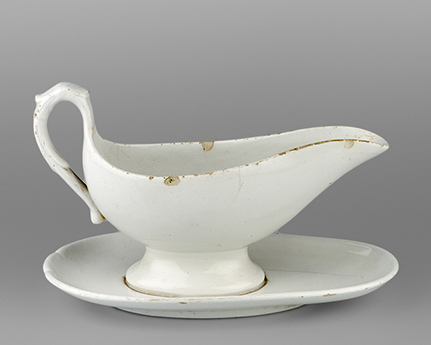
Roland Blaettler and Andreas Heege, 2020
Pottery from Möhlin in CERAMICA CH
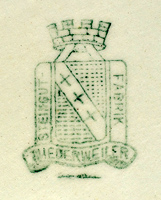
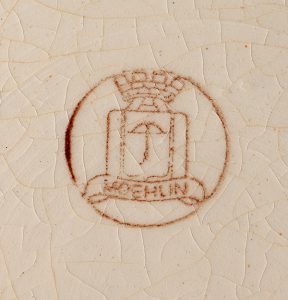
As the name of the company and its factory marks (a motif derived from the Lorraine coat of arms: MWH H 478; HMO 8416; HMO 8324; HMO 8162; HMO 8772) suggest, the Niederweiler Steingutfabrik A.G. refined white earthenware factory was founded by a family of entrepreneurs from the region of Lorraine.
In 1827, Louis-Guillaume Dryander bought the historical faience and porcelain manufactory in Niderviller (Moselle). In 1830, he decided to abandon porcelain making and to focus exclusively on the more lucrative production of refined white earthenware. In 1886, the manufactory became a public limited company whose management remained in the hands of the family until 1944 (on Niderviller and its refined white earthenware see: Soudée-Lacombe 1984; Hassenforder 1990; Heckenbenner 2002; Maggetti/Heege/Serneels 2015).
In 1906, the descendants of Louis-Guillaume Dryander decided to set up a subsidiary in Switzerland with its headquarters in Rheinfelden and a production plant in Möhlin and called it Steingutfabrik Niederweiler A.G. (Niederweiler Refined White Earthenware Factory). It was represented by the Alsace attorney Julius Hermann (Swiss Official Gazette of Commerce [SOGC], vol. 24, 1906, 1802). From 1918 to 1937, Herrmann, now known as Jules, was the director of the factory in Möhlin (SOGC, vol. 36, 1074 – vol. 55, 1937, 2709). In 1937, Louis Dryander, one of the main shareholders of the company and a resident of Rheinfelden, took over as manager of the subsidiary (SOGC, vol. 56, 1938, 851). In 1946, a department of studio pottery was set up. In November 1955, the Möhlin subsidiary closed down, and the associated company name was taken off the register (SOGC, vol. 73, 1955, 2839).
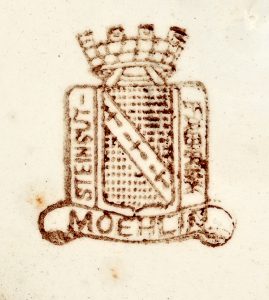
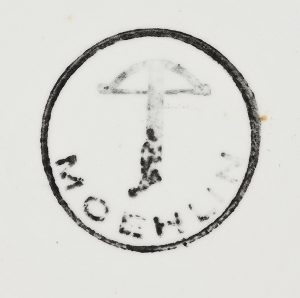
The original company mark (MWH H 478) was changed over the course of the company’s history, initially by adding the word “MOEHLIN” to the Lorraine coat of arms. Examples of this mark have been found in brown (KM-SMP 051) and in teal (MPO 10924-01).
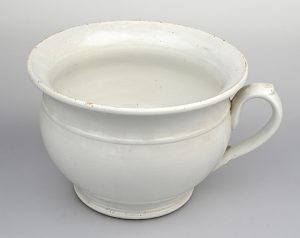
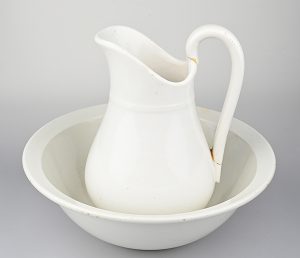
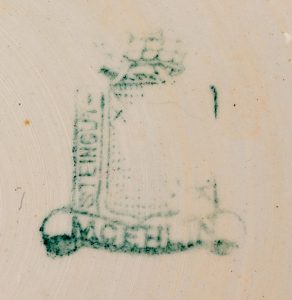
After 1931, a crossbow was added to the mark (HMO 8772; RMC H1999.786). The crossbow was officially launched as a symbol by the Verband für Inlandsproduktion (Association for Domestic Production) as a collective mark in April 1931 (SOGC, vol. 49, 1931, 1086).
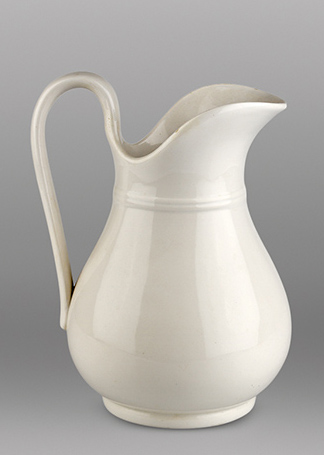
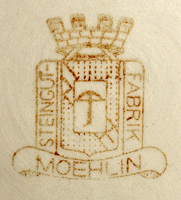
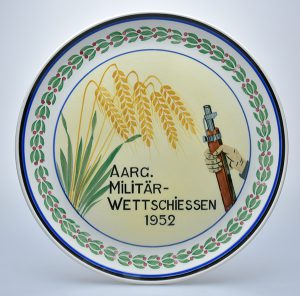
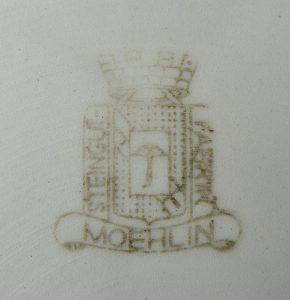
Several different marks with crossbows were subsequently used but their dates are not yet clear (RMC H1985.507, KM-SMP 011, KMDis 2020-47, KM-SMP 059, HMO 8070, HMO 8554).
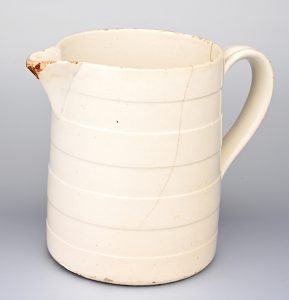
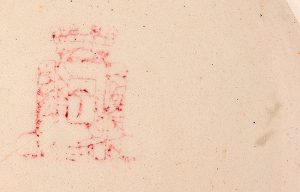
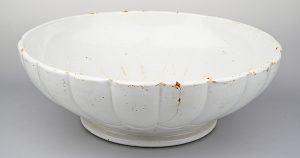
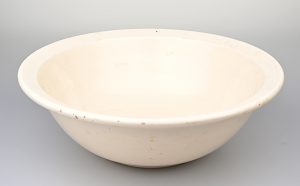
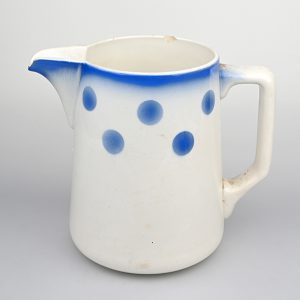
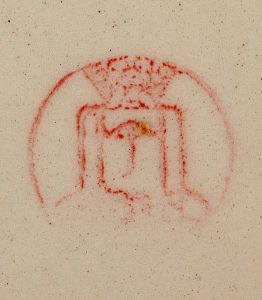
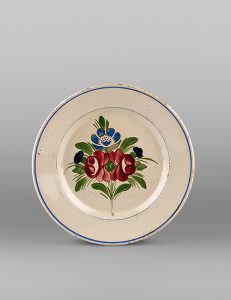
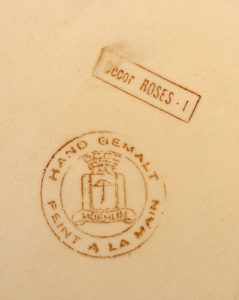
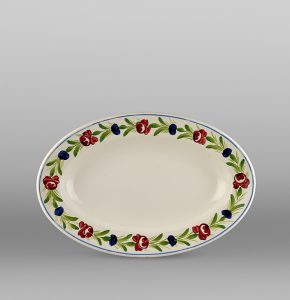
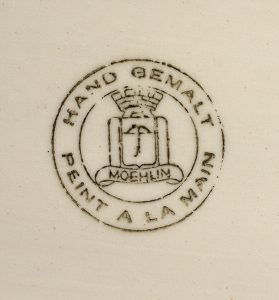
The estate (consisting of documents and products of the manufactory) of the association of former pottery workers, which has since been disbanded, is housed at the Village Museum Melihus in Möhlin. No monographic or systematic study of the company history and of the products and decorative designs has yet been undertaken.
Translation Sandy Haemmerle
References:
Blaettler/Schnyder 2014
Roland Blaettler/Rudolf Schnyder, CERAMICA CH II: Solothurn (Nationales Inventar der Keramik in den öffentlichen Sammlungen der Schweiz, 1500-1950), Sulgen 2014, 372.
Hassenforder 1990
Martine Hassenforder, Les faïenciers de Niderviller, Sarrebourg 1990.
Heckenbenner 2002
Dominique Heckenbenner, Faïences de Niderviller, Sarrebourg 2002.
Maggetti/Heege/Serneels 2015
Marino Maggetti/Andreas Heege/Vincent Serneels, Technological Aspects of early 19th c. English and French white earthenware assemblage from Bern (Switzerland). Periodico di Mineralogia 84, 2015, Heft 1 (Special issue: EMAC 2013, Inside the pottery: composition, technology, sources, provenance and use), 139–168.
Soudée-Lacombe 1984
Chantal Soudée-Lacombe, Faïenciers et porcelainiers de Niderviller au 18e siècle. Le Pays Lorrain, 65. Jahrgang, 1984, 1–76.

