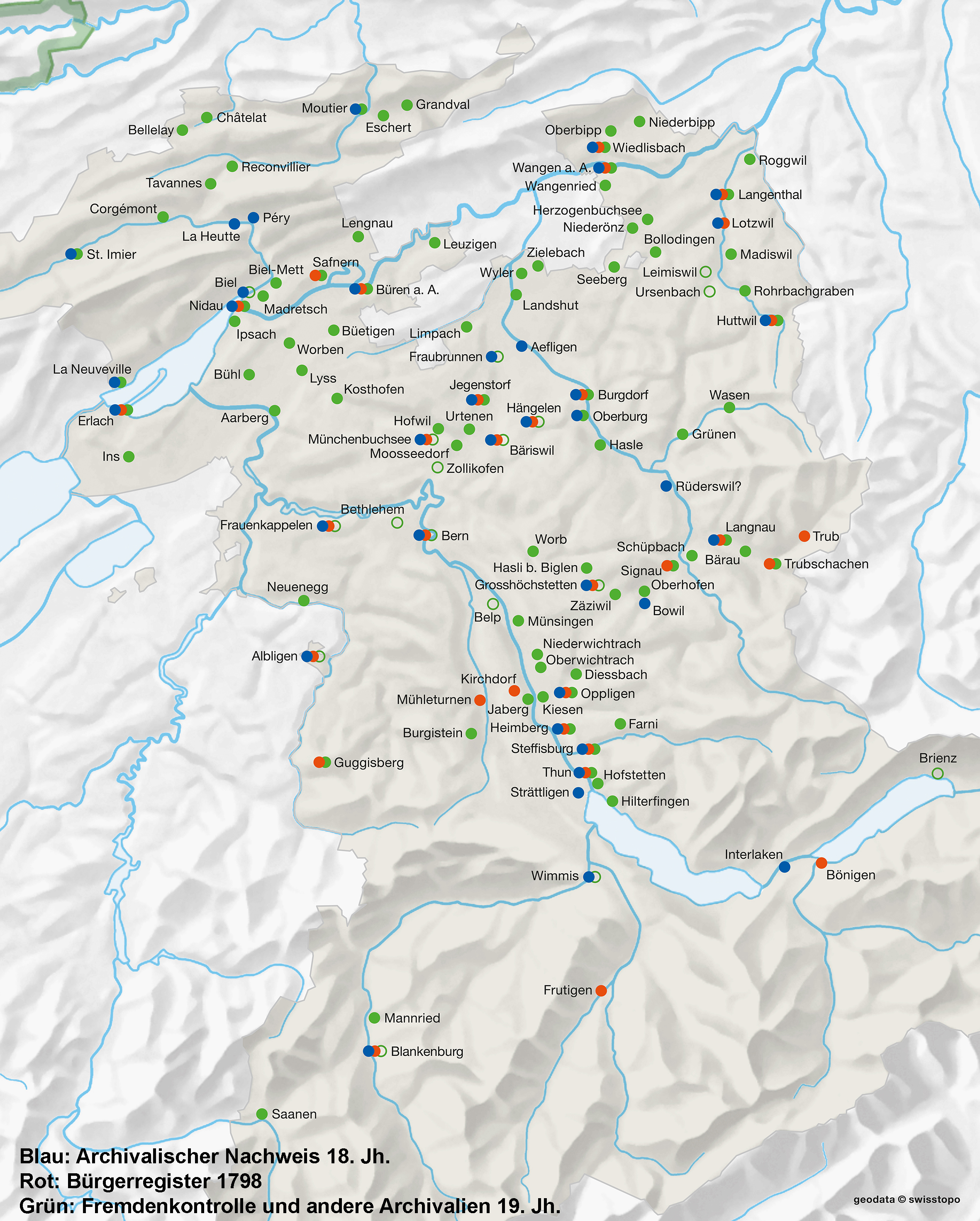
Map of pottery manufacturers in the Canton of Bern, 18th-19th centuries
Andreas Heege, Alfred Spycher, Andreas Kistler, 2024
Situated at the entrance to the Simmental valley, Wimmis, whose castle served as one of the seats of the bailiwick of Bern (until 1798), is one of the places about which we have a dearth of information when it comes to its pottery production because there are hardly any sources. The bailiff’s accounts show that he almost exclusively hired stove setters from Thun to fit or repair the stoves at the castle and at the surrounding prebend houses and rectories (Hans Ulrich and Hans Rudolf Hürner: 1733; Heinrich Engimann: 1734, 1736, 1752; Abraham Engimann: 1735, 1743, 1744, 1747, 1748, 1749; potter Engimann: 1765, 1766, 1792; Johannes Engimann: 1769; Johannes Baumann: 1778, 1784, 1789; Caspar Ziro: 1795). There are also references, however, to Melchior Flückiger from Grosshöchstetten (1718, 1719, 1721, 1728, 1729), Abraham Marti from Fraubrunnen and later Blankenburg (1748, 1766) and Johannes Fruting from Bern (1794).
Jacob Kräuchi, who set up a workshop in his hometown of Bäriswil in 1758 at the latest, appears to have lived and worked as a non-citizen in Wimmis for a considerable period of time, as we can see from his daughter Salome’s baptismal record dated 16th February 1755 (K Wimmis 5th baptismal register 1724-1784. Page 73) and was hired by the bailiff to repair a stove on 10th May 1756. Further stove repairs for the Interlaken bailiwick (at the castle, the inn, the custom’s house, the bakery and in Unterseen-Neuhaus) in 1756 probably tell us that he was still resident in Wimmis at the time.
The first local potters in Wimmis mentioned in records are Johannes Stucki (1751, 1753), Conrad Habicht or Habik (from Schaffhausen but living in Wimmis at the time, 1758-1762), Johann Caspar Vogel (freeholder, 1759-1793 attested as living in Wilderswil throughout that entire period, and in 1770, apparently in the district of Kapf between Wimmis and Reutigen; according to the register of the Canton of Bern’s citizens, he lived in Frutigen “aufem Wyde” in 1798) and Andreas Schrot (1781).
Astonishingly, the 1798 register of Bern citizens (Rohrbach 1999) lists no potters for Wimmis.
Thanks to the Wimmis baptismal records, however, we know that the potter Johannes Kunz from Wimmis (1771-1835) had eight children baptised there between 3rd March 1799 and 22nd March 1810 (KRWimmis_6_49.55.61.64.68.71.77.83). He had married Katharina Stucki (1766-1838), who was also from Wimmis, on 26th November 1798 in Zweisimmen, where he was working as a journeyman for the Blankenburg potter Johann Jakob Hächler (Rohrbach 1999, No. 1404) (KRZweisimmen_14_127). Katharina’s father’s name was Johannes. Could it be that she was a daughter of the potter Johannes Stucki (see above)? All the baptismal records for the couple’s children list the Wimmis district of “Brodhüsi” as their place of residence. We can only assume that the Kunz workshop was in operation until Johannes Kunz died in 1835.
In the first half of the 19th century, just one other potter, Johannes Fischer from Brienz, was recorded living in Wimmis as his bankruptcy notice appeared in the Thuner Wochenblatt newspaper in 1846 (Thuner Wochenblatt, Vol. 9, No. 86, 27th October 1846).
There is no further mention of potters in Wimmis until 1862. On 16th September 1862, the church register of Wimmis (KRWimmis_13_71) lists a child that was stillborn to the potter Johann Jakob Loosli from Sumiswald (died on 17th January 1897) and his wife, Maria Tanner from Langnau (died on 9th September 1909). At that stage, the couple were living in the “Bodenmatte” area of Wimmis. They had only married a few months before that in Bümpliz (28th June 1862; KRSumiswald:31_9 register of marriages). They lived (and perhaps worked) in Heimberg at the time, as is probably supported by a record in the register of foreign citizens, according to which the potter Jakob Loosli from Sumiswald, Canton of Bern, had begun working for the potters Niklaus Frei, Johann Küenzi and Christian Tanner in the Dornhalde area of Heimberg on 13th February 1859. Maria Tanner was probably the daughter of Christian Tanner and worked in her father’s workshop as a pottery paintress. We do not know if Johann Jakob’s father, Jakob, or any of his ancestors had been potters before him. We should, however, mention that the 1798 register of citizens lists a potter called Hans Loosli (born in 1765) from Sumiswald living in (Mühle)-Thurnen, Canton of Bern. The genealogical link between him and Johann Jakob Loosli, however, is unclear for now.
Johann Jakob and Maria had seven more children who were all born in Wimmis (Maria 4th July 1864, Jakob Robert 5th October 1866, Alfred 4th July 1868, Karl Friedrich 19th March 1870, Anna Bertha 1872-12th January 1888, Johann Jakob 8th August 1883, stillborn child 6th August 1888).
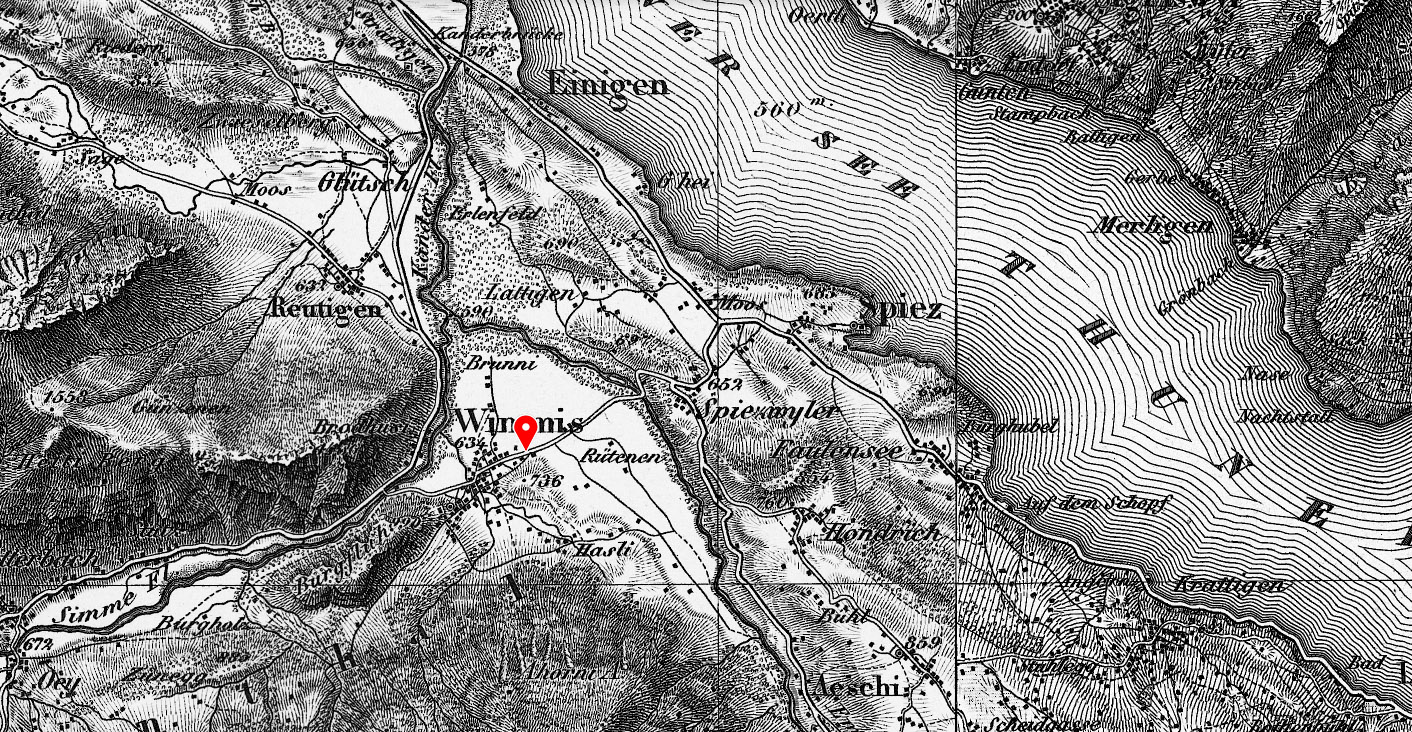
The Bodenmatte area is located on the eastern edge of Wimmis. We do not know, however, in which property the potter’s workshop was set up in 1862. It is not until 1892 that we are told of a potter’s workshop at 7 Bodenmattstrasse. It was built by the local magistrate and mayor David Ast from Wimmis sometime between 1851 and 1892 (GBWimmis_8_499-501; GBWimmis_20_412-424).
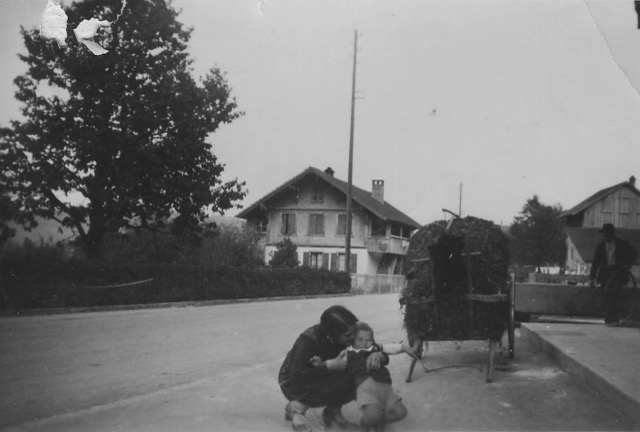
7 Bodenmattstrasse in 1934.

7 Bodenmattstrasse in 1963.
In the middle of the 20th century, the potter’s workshop still existed, but it has since been demolished and replaced with a new building.
The next records pertaining to a potter date from 1880. On 7th August that year, the Geschäftsblatt für den obern Teil des Kantons Bern (Volume 27, Number 63) announced that the potter Samuel Tanner from Langnau had died in Wimmis. Was this perhaps a brother or uncle of Maria Tanner, who had joined her and Johann Jakob Loosli to work in Wimmis?
On 29th January 1881, the potter Fr. Rüfenacht from Walkringen in Wimmis froze to death in the Oberdorf area as he was travelling home from Thun (Geschäftsblatt für den obern Teil des Kantons Bern, Vol. 28, No. 9, 29th January 1881). He died without issue. Could he have worked for Loosli?
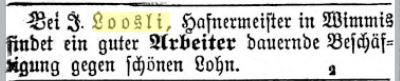
In 1891, Loosli advertised a position for a capable worker (Geschäftsblatt für den obern Teil des Kantons Bern, Vol. 38, No. 20, 11th March 1891).

In 1892, Alfred Loosli, Johann Jakob’s son got married. In the announcement he is also identified as a potter in Wimmis (Thuner Wochenblatt, Vol. 55, No. 84, 19th October 1892). He had obviously taken over the workshop after his father’s death had occurred on 17th January 1897 (Geschäftsblatt für den obern Teil des Kantons Bern, Vol. 44, No. 47, 12th June 1897).
In 1912, Alfred Loosli, master potter in Wimmis, submitted honey to the Nidersimmental Beekeepers’ Association for inspection (Geschäftsblatt für den obern Teil des Kantons Bern, Vol. 59, No. 71, 4th September 1912).
1921 The final piece of information about the Loosli potters is provided by Fernand Schwab (Schwab 1921, 106, fn. 72) when he describes, albeit not entirely accurately, the Heimberg pottery with cobalt blue painting and purple-brown writing: “We have been able to pinpoint the origin of this type of decoration to a potter named Loosli who worked in Heimberg for many years and had brought the technique with him from a manufactory in Neukirch. Loosli later set up a workshop in Wimmis, which is still being run by his descendants.” It is probably true that Johann Jakob Loosli encountered this type of pottery in Heimberg and may have brought it to Wimmis from there. The reference to Neukirch, however, is not plausible, nor was Loosli the originator of the technique or the only potter to ever use it.
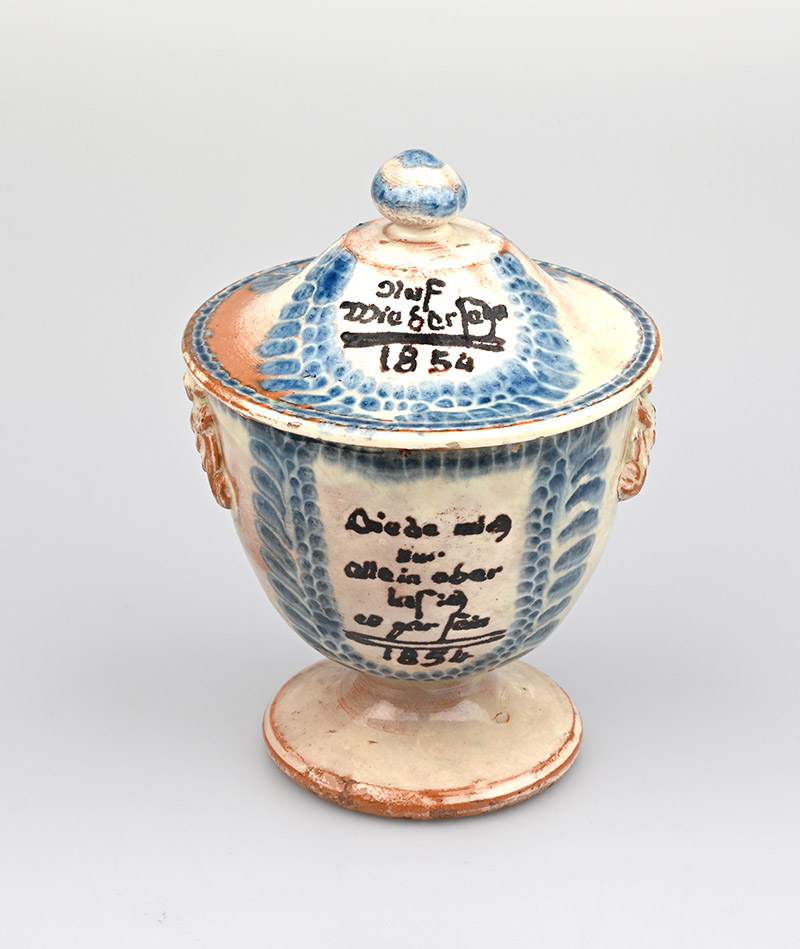
The earliest firmly dated Heimberg-type objects decorated with cobalt blue painting only and dark-brown writing are from 1854. Based on a signed shaving basin (SST 649), this style, sometimes combined with polychrome slip trailing is often attributed to a single workshop and to potter David Andres in Heimberg (1810–1873; Buchs 1988, 94; Wyss 1966, 40; Messerli-Bolliger 1991, 47–48; Roth-Rubi/Schnyder/Egger/Fehr 2000, 6–10; Boschetti-Maradi 2007, 58–59).
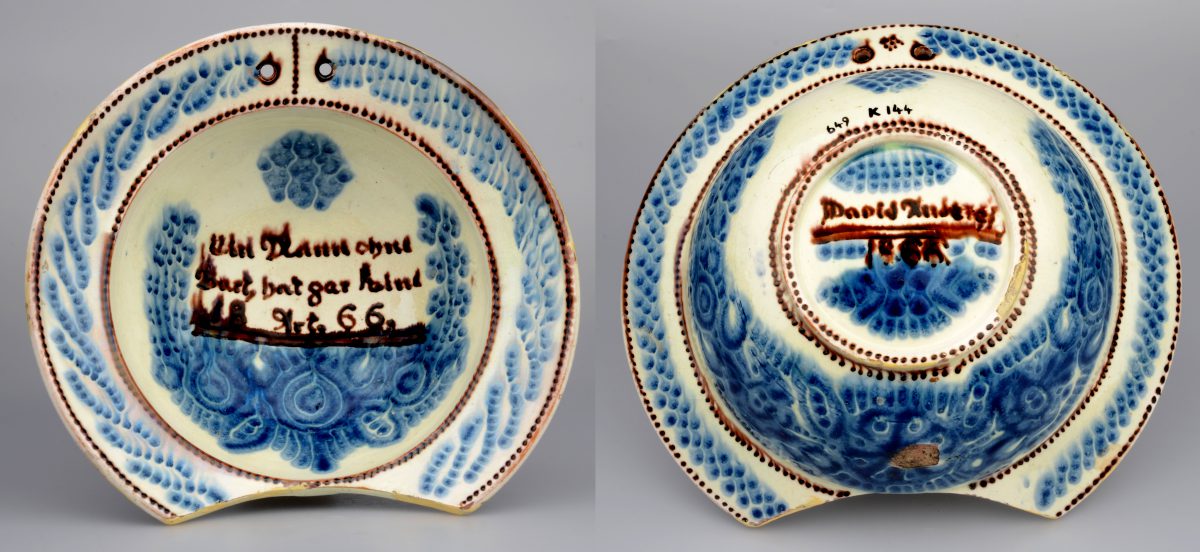
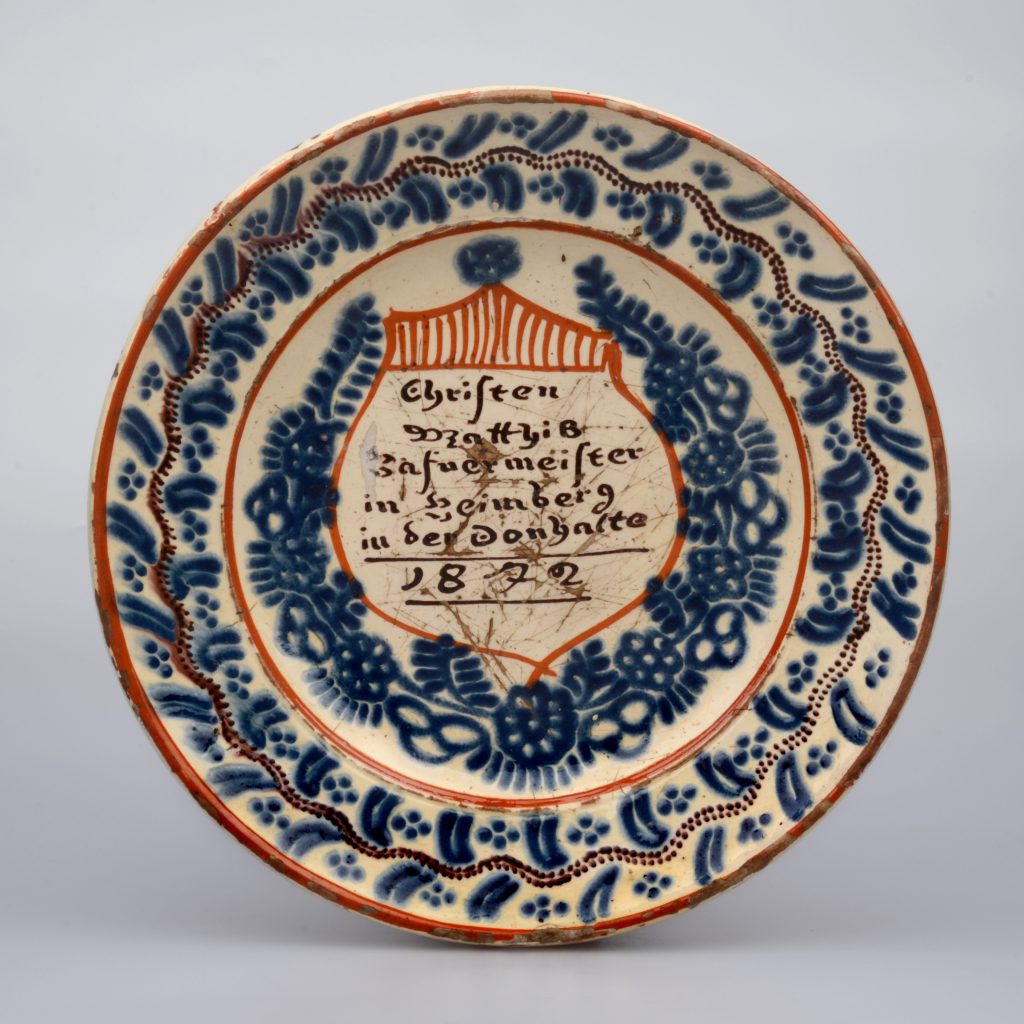
However, given that some of these objects are dated to periods more than 11 years after David Anderes’ death (up to 1884), this is no more convincing than attributing them all to the Loosli workshop in Wimmis as proposed by Fernand Schwab (Schwab 1921, 106 fn. 72). There is no evidence to suggest that only one workshop in Heimberg produced blue painted vessels. Master potter Christian Matthys in Heimberg, for instance, created very similar wares in his workshop on Dornhalde in 1872 (MKB VI-3919).
Ceramic fragments with a coat of white slip and partial blue decorations dating from the first half of the 19th century are known to have been produced by a workshop in neighbouring Steffisburg (Heege 2012, Fig. 12; Frank/Heege 2027). And finally, after 1840 (Heege/Kistler 2017b, 117 Fig. 138), and particularly after the mid-19th century (Heege/Kistler 2017b, 173), potters in Langnau also made intensive use of runny blue slip trailing.
As it stands, the Loosli workshop’s range of production is unknown, as no marked vessels have so far been found.
Translation Sandy Haemmerle
References:
Boschetti-Maradi 2007
Adriano Boschetti-Maradi, Geschirr für Stadt und Land. Berner Töpferei seit dem 16. Jahrhundert (Glanzlichter aus dem Bernischen Historischen Museum 19), Bern 2007.
Buchs 1988
Hermann Buchs, Vom Heimberger Geschirr zur Thuner Majolika, Thun 1988.
Heege 2012
Andreas Heege, Drei neuzeitliche Grubeninventare von Jegenstorf, in: Archäologie Bern/Archéologie bernoise. Jahrbuch des Archäologischen Dienstes des Kantons Bern, 2012, 159-196.
Heege/Kistler 2017
Andreas Heege/Andreas Kistler, Keramik aus Langnau. Zur Geschichte der bedeutendsten Landhafnerei im Kanton Bern (Schriften des Bernischen Historischen Museums 13), Bern 2017.
Messerli Bolliger 1991
Barbara E. Messerli Bolliger, Der dekorative Entwurf in der Schweizer Keramik im 19. Jahrhundert, zwei Beispiele: Das Töpfereigebiet Heimberg-Steffisburg-Thun und die Tonwarenfabrik Ziegler in Schaffhausen, in: Keramik-Freunde der Schweiz, Mitteilungsblatt 106, 1991, 5-100.
Rohrbach 1999
Lewis Bunker Rohrbach, Men of Bern: The 1798 Bürgerverzeichnisse of Canton Bern, Switzerland, Rockport 1999.
Roth-Rubi/Schnyder/Egger u.a. 2000
Kathrin und Ernst Roth-Rubi/Rudolf Schnyder/Heinz und Kristina Egger u.a., Chacheli us em Bode… Der Kellerfund im Haus 315 in Nidfluh, Därstetten – ein Händlerdepot, Wimmis 2000.
Wyss 1966
Robert L. Wyss, Berner Bauernkeramik (Berner Heimatbücher 100-103), Bern 1966.
Schwab 1921
Fernand Schwab, Beitrag zur Geschichte der bernischen Geschirrindustrie (Schweizer Industrie- und Handelsstudien 7), Weinfelden/Konstanz 1921.

