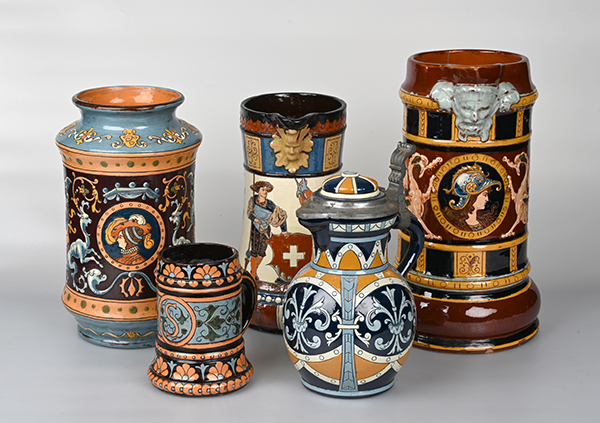
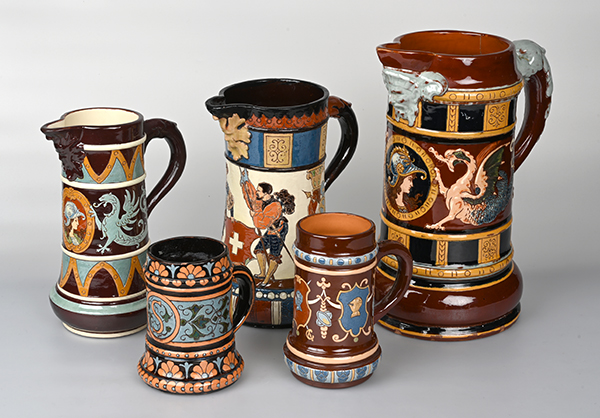
Hanhart pottery from a Swiss private collection.
Andreas Heege, 2021
Hanhart pottery in CERAMICA CH
The information that we have been able to find about the pottery factory set up by (railway) engineer Heinrich Hanhart (15th October 1844-29th June 1889; obituary, see also Schweizerische Bauzeitung 14, No. 1, page 6) in Winterthur, which was in operation from 1878 until c. 1887, is rather limited (Messerli-Bolliger 1991, 18; Messerli 1995, 7-9). Together with his cousin, the architect and later instructor at the Winterthur School of Engineering Jakob Pfau (1st November 1846-23rd August 1923), Hanhart set up a pottery factory, which was extended for the first time in 1879, on Geiselweidstrasse road (later 1 Bäckerstrasse, Winterthur Mattenbach) (Frascoli 2004, Pl. 7). Both men were from Winterthur families that had a great interest in the arts (see Heinrich Hanhart’s own newspaper articles: Hanhart 1876, 1877, 1881). Matthäus Pfau, Jakob Pfau’s father, was president of the Winterthur Art Society.
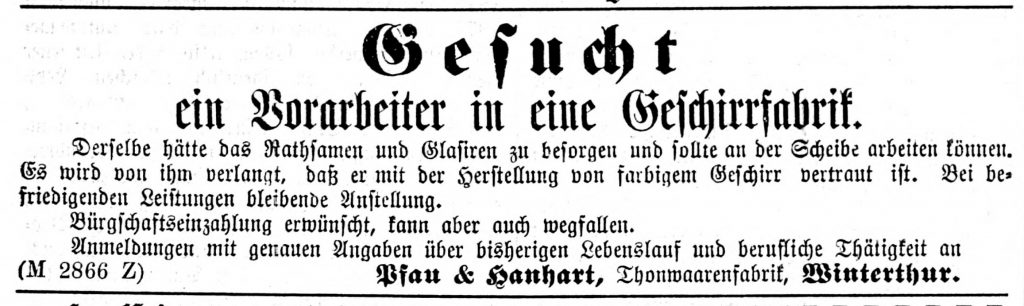

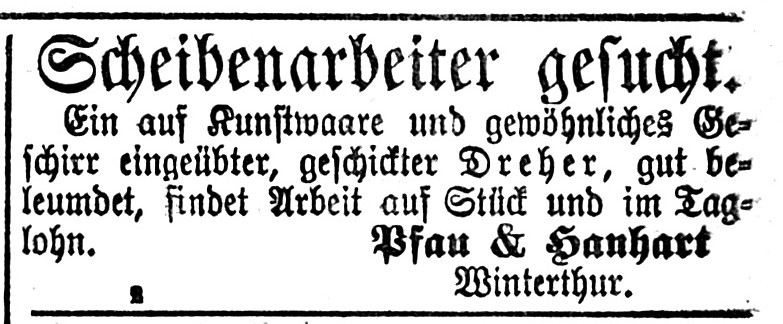
Apparently it was difficult to find suitably skilled workers in the Winterthur-Zurich region in 1879/1880, which led Pfau & Hanhart to place advertisements in the Täglicher Anzeiger für Thun and in the Geschäftsblatt für den oberen Teil des Kantons Bern; in other words, they were hoping to find workers in the Heimberg-Steffisburg region.
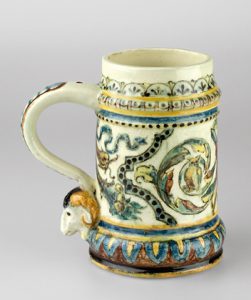
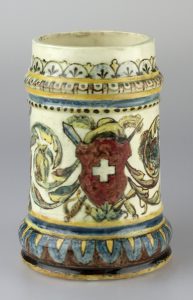
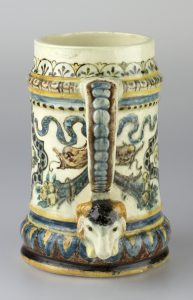
In 1882 or 1883, the two decided to go their separate ways and Hanhart continued to run the business on his own. Jakob Pfau may have run a faience studio in Winterthur for a short while, supplying tiled stove designs. Both men had their own booths at the Swiss National Exhibition in Zurich in 1883 (catalogue of the 1883 Swiss National Exhibition, 109 No. 1399; Messerli Bolliger 1991, 17 and 18).
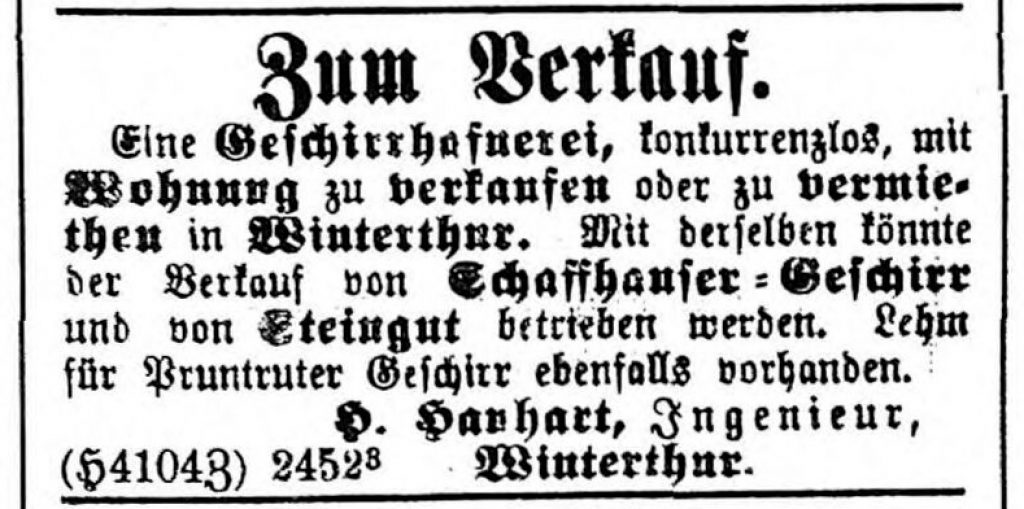
On 4th September 1886, Hanhart attempted to sell the factory placing an advertisement in the magazine “Der Grütlianer”.
In the end, Jakob Pfau served as liquidator for the factory in 1889; we know that he offered “models” from the factory for sale to the Keiser workshop in Zug, though we do not know if he was successful in doing so (Schnyder/Felber/Keller et al. 1997, 38 fn. 57).
Welche Keramiker oder Keramikmalerinnen die beiden in der Keramik ungelernten Firmeninhaber beschäftigten, entzieht sich weitgehend unserer Kenntnis. Belegen lässt sich allerdings, dass in Hanharts Betrieb auch ausgebildet wurde. So absolvierte Elisabeth Meier (1866-1938) dort nach der Sekundarschule ab 1879 ihre Lehre als Keramikmalerin und hatte das “Malen auf Ton nach Heimberger Manier” erlernt. Ausserdem war sie laut Zeugnis von Heinrich Hanhart “befähigt, brauchbar und im Zeichnen nach Vorbild geschickt”. 1885 wechselte sie zur Hafnerei Keiser in Zug, heiratete 1894 den Betriebsinhaber Josef Anton Keiser und führte den Betrieb allein als Witwe von 1923-1938. Sie war eine hochtalentierte Keramikmalerin (Schnyder/Felber/Keller u.a. 1997, bes. 38).
The products of the pottery factory of Heinrich Hanhart, “maker of decorated faience and majolica objects”, received a comprehensive review in a report on the 1883 National Exhibition by the architect Alexander Koch (see also Messerli Bolliger 1991, 18-20):
“Among the pottery with purely painted decoration, the objects exhibited by Hanhart in Winterthur are by far the best. They can be divided into three main groups:
- Painted decoration on a partially visible white background;
- Painted decoration that covers all of the white background;
- Painted decoration using enamel colours in the Heimberg technique, covering all of the background.
The first and second groups consisted of motifs in the Italian Renaissance style, while the third group was more akin to the German Renaissance style.
The vessels from the third group have already been mentioned in the previous chapter. They can be used as models by those who would like to employ the Heimberg technique to generate true works of artistic endeavour, not just in terms of the overall impression, but also in terms of the detail. In these objects, the technique has been used with great skill and awareness and has been combined with highly accurate drawings.
The vessels from the other two groups also deserve high praise, as all the objects from this factory can indeed hold their own against the products of rival companies abroad. The only thing that is regrettable is that the style overall, while not a copy, is nevertheless not very original nor does it seem in any way indigenous. The objects are all exceedingly well designed and executed, and the materials are impeccable in every respect, but they could have been made pretty much anywhere, as they have no specifically Swiss attributes. This is regrettable, as it will make it more difficult for the wares to be a success, despite their excellence, as they have been rather unnecessarily placed in a field that is already quite heavily populated. The vessels in the third group are the most independent in this respect, which is why they were presented with a special award by the jury.
To avoid any misunderstanding, it should be expressly added that “specifically Swiss” does not refer to the depiction of Alpine herdsmen or cows etc. Individuality does not even necessarily have to lie in the painting style but can also be found in the materials and techniques. If all three factors are original in style, all the better. In the case of the Winterthur factory, however, which is forced to import all its raw materials from abroad, the main source of originality will obviously have to lie in the drawings.
Moreover, the factory cannot avoid the criticism that its patterns have seen very little variation since its inception and show little diversity, which is all the more regrettable as the close kinship between the products cannot be denied either. This shortcoming may be due to a limited scale of production, and it would be desirable for the business to expand as soon as the foundations for sound progress can be found, and, once this is achieved, that the opportunity is also taken to expand the artistic aspect accordingly.
In addition, the Winterthur products provide us with an excellent opportunity to study two completely different styles of painting expertly executed. The vessels in the third group were almost exclusively painted in opaque colours, whereas the objects from the other two groups were decorated using transparent colours. Both types have their place, of course, but their use is subject to a stringent set of rules. While the transparent slips are perfectly suited to blending and shading, thus allowing every possible colour effect to be reproduced without the brilliance and transparency of the colours becoming a distraction from the overall impression, the use of opaque colours is necessarily limited to the smooth and monochrome application. The only possible exception is an extremely discreet use of a translucent glaze on an opaque colour. Opaque and transparent colours can also be used alongside each other, as has been shown by the Heimberg-type ware, where blues, in particular, are always transparent on the better-quality products. If, on the other hand, the opaque colours are mixed either with each other or with transparent colours to achieve shading, or if opaque colours are applied unevenly to introduce texture, the effect is really rather un-ceramic and the result is reminiscent of a poor-quality oil painting. On the one hand this approach destroys the translucent and delicate nature that we so admire in the transparent ceramic colours, while on the other, the depth and lusciousness we seek in oil painting is by no means achieved.”
The number of ceramics from the Pfau & Hanhart or Hanhart companies in Swiss museum collections is rather limited. The Museum of Art and History in Neuchâtel holds the largest collection, which has also been published (Blaettler/Ducret/Schnyder 2013, 496–499: MAHN AA-1776, AA-1777, AA-1778, AA-2246 to AA-2253, AA-3290, AA-3291). Two objects are listed in the collection catalogue of the Swiss National Museum (SNM LM-75481; LM-95464). The Museum of Applied Arts in Winterthur has five objects in its collection (Messerli 1993, 161; Messerli 1995, 76-78, Inv. 555, 556, 572, 575 and 1559).
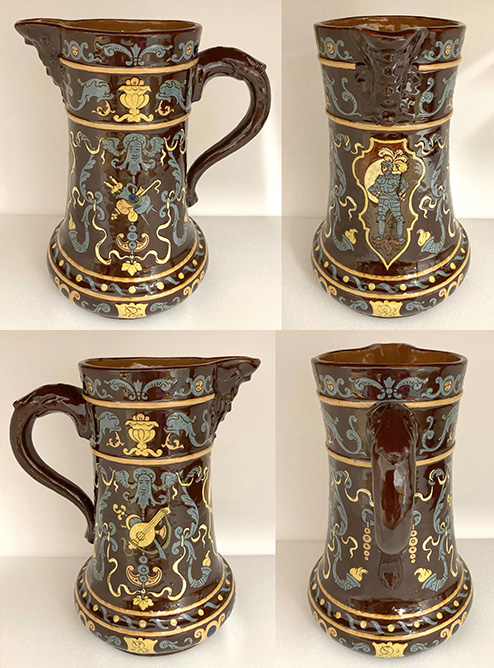
Recently, a very pretty jug has been acquired by the Museum Allerheiligen in Schaffhausen (Inv. 61070).
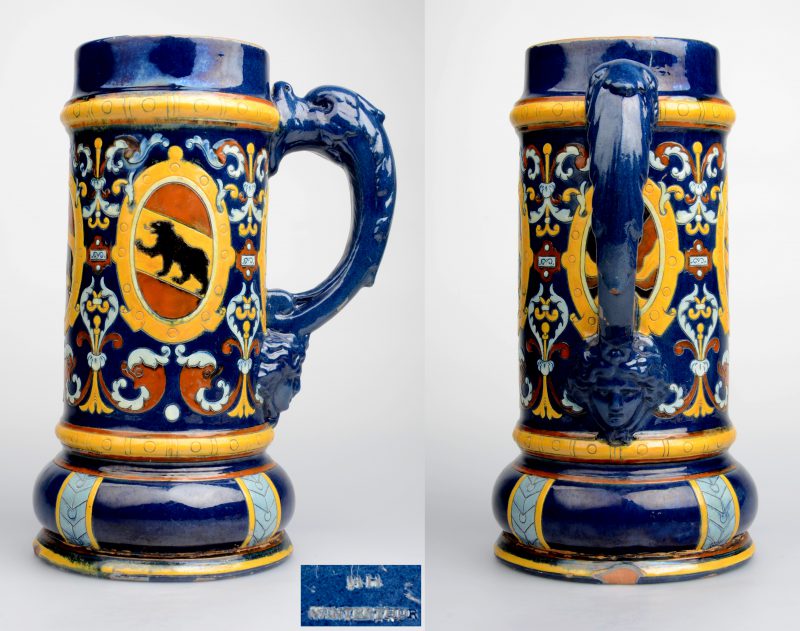
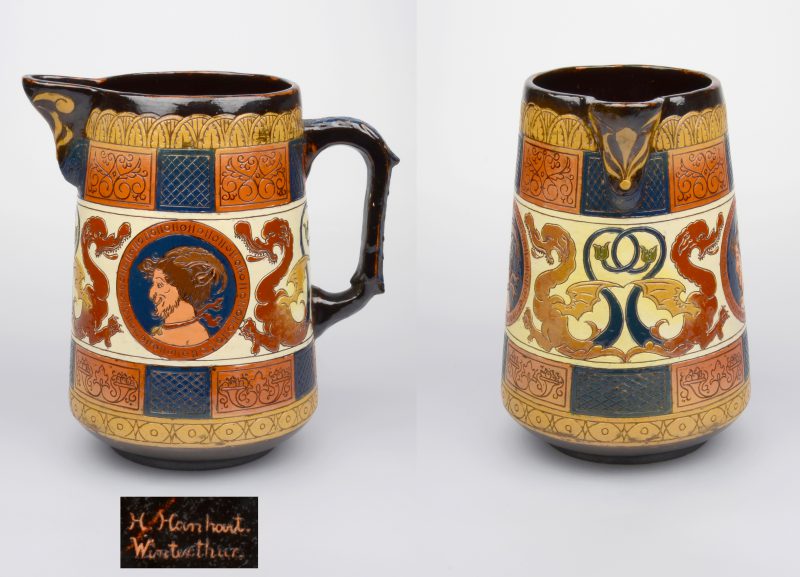
It is possible that the pieces in the collection of the Museum of Art and History in Neuchâtel date mainly from the period after 1882/83 and prior to 1887, as they either bear the stamp “H H WINTERTHUR” or the incised signature “H. Hanhart Winterthur”.
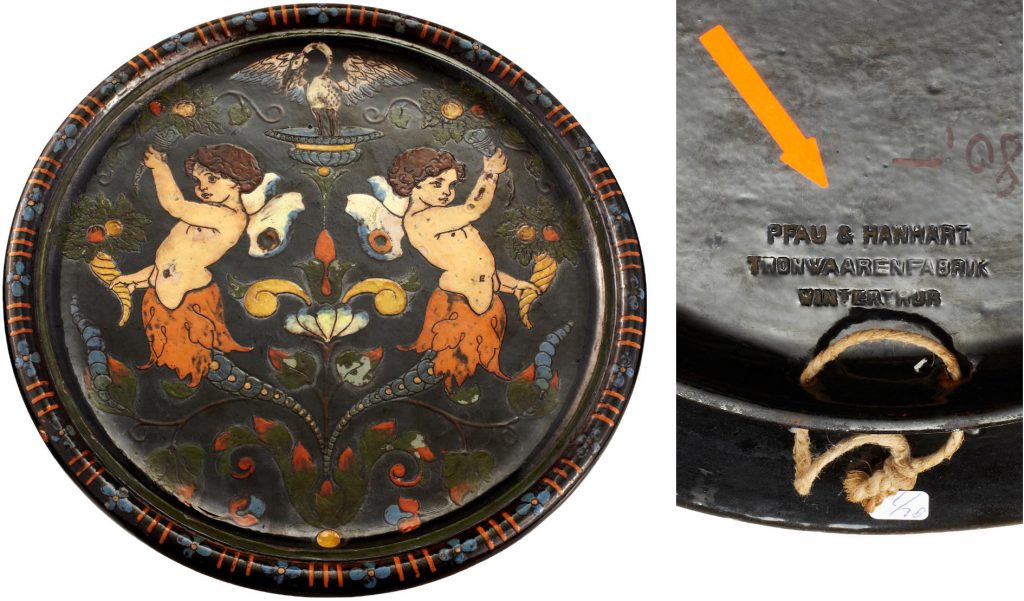
So far only one marked plate has come to light from the early phase of the factory’s production; it was sold at auction by the Aktionshaus Zofingen in 2012 (48th auction, lot 1685). The mark reads “PFAU & HANHART THONWAARENFABRIK WINTERTHUR”.
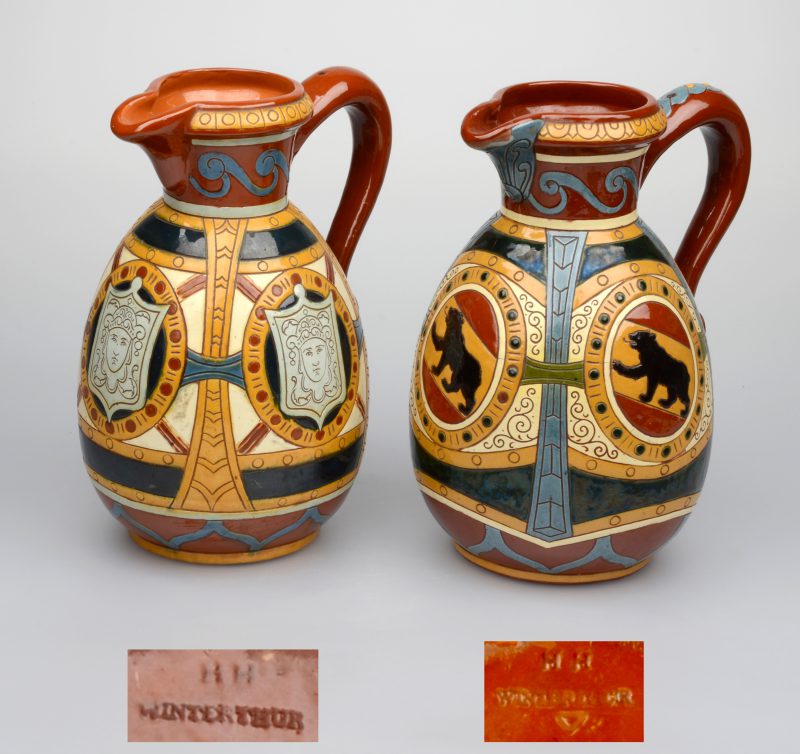
Archaeological excavations carried out at the former factory site, which has since been destroyed by modern development, yielded a small assemblage of earthenware, refined white earthenware and stove tiles, some of which were marked, and most of which came to light in a waste pit. They give us a limited glimpse into the production range (Frascoli 2004, Pl. 34-38). The earthenware objects include pieces with horizontal stripes typical of the second half of the 19th century as well as pottery with a coat of red slip, both inside and out, and “Heimberg-type” slip trailing, as well as jugs with speckled, splashed and chattered decoration. Other pieces have manganese glaze on both sides.
Hanhart pottery on the Internet
Staatliche Kunstsammlungen Dresden (Dresden State Art Collections)
Hanhart pottery in the collection of the Swiss National Museum
Translation Sandy Haemmerle
References:
Blaettler/Ducret/Schnyder 2013
Roland Blaettler/Peter Ducret/Rudolf Schnyder, CERAMICA CH I: Neuchâtel (Inventaire national de la céramique dans les collections publiques suisses, 1500-1950), Sulgen 2013.
Frascoli 2004
Lotti Frascoli, Keramikentwicklung im Gebiet der Stadt Winterthur vom 14. -20. Jahrhundert: Ein erster Überblick, in: Berichte der Kantonsarchäologie Zürich 18, 2004, 127-218.
Hanhart 1876
Heinrich Hanhart, Die Förderung der Töpferkunst in der Schweiz, in: Schweizerisches Gewerbe-Blatt. Organ der Gewerbemuseen Zürich & Winterthur 1, 1876, 93-94.
Hahnhart 1877
Heinrich Hanhart, Fortschritte des Hafner-Handwerks und Wiederaufleben der Ofenmalerei in Winterthur. In: Schweizerisches Gewerbeblatt, Organ der Gewerbemuseen in Zürich und Winterthur 2, 1877, 149–151.
Hahnhart 1881
Heinrich Hanhart, Fortschritte des Hafner-Handwerks und Wiederaufleben der Ofenmalerei in Winterthur. In: Schweizerisches Gewerbeblatt, Organ der Gewerbemuseen in Zürich und Winterthur 6, 1881, 36–38.
Koch 1884
Alexander Koch, Schweizerische Landesausstellung, Zürich 1883 : Bericht über Gruppe 17: Keramik, Zürich 1884.
Messerli Bolliger 1991
Barbara E. Messerli Bolliger, Der dekorative Entwurf in der Schweizer Keramik im 19. Jahrhundert, zwei Beispiele: Das Töpfereigebiet Heimberg-Steffisburg-Thun und die Tonwarenfabrik Ziegler in Schaffhausen, in: Keramik-Freunde der Schweiz, Mitteilungsblatt 106, 1991, 5-100.
Messerli Bolliger 1993
Barbara E. Messerli Bolliger, Keramik in der Schweiz. Von den Anfängen bis heute, Zürich 1993.
Messerli 1995
Barbara E. Messerli, Durch Feuer geprüft. Sammlungskatalog Keramik des Gewerbemuseums Winterthur: Gefässkeramik, Keramikplastik und Fliesen, Winterthur 1995.
Schnyder/Felber/Keller u.a. 1997
Rudolf Schnyder/Friederike Felber/Rolf Keller u.a., Die Entdeckung der Stile. Die Hafnerei Keiser in Zug 1856-1938. Ausstellung vom 10. November 1996 bis 1. Juni 1997, Museum in der Burg Zug, in: Keramik-Freunde der Schweiz Mitteilungsblatt 109/110, 1997, 7-57.

