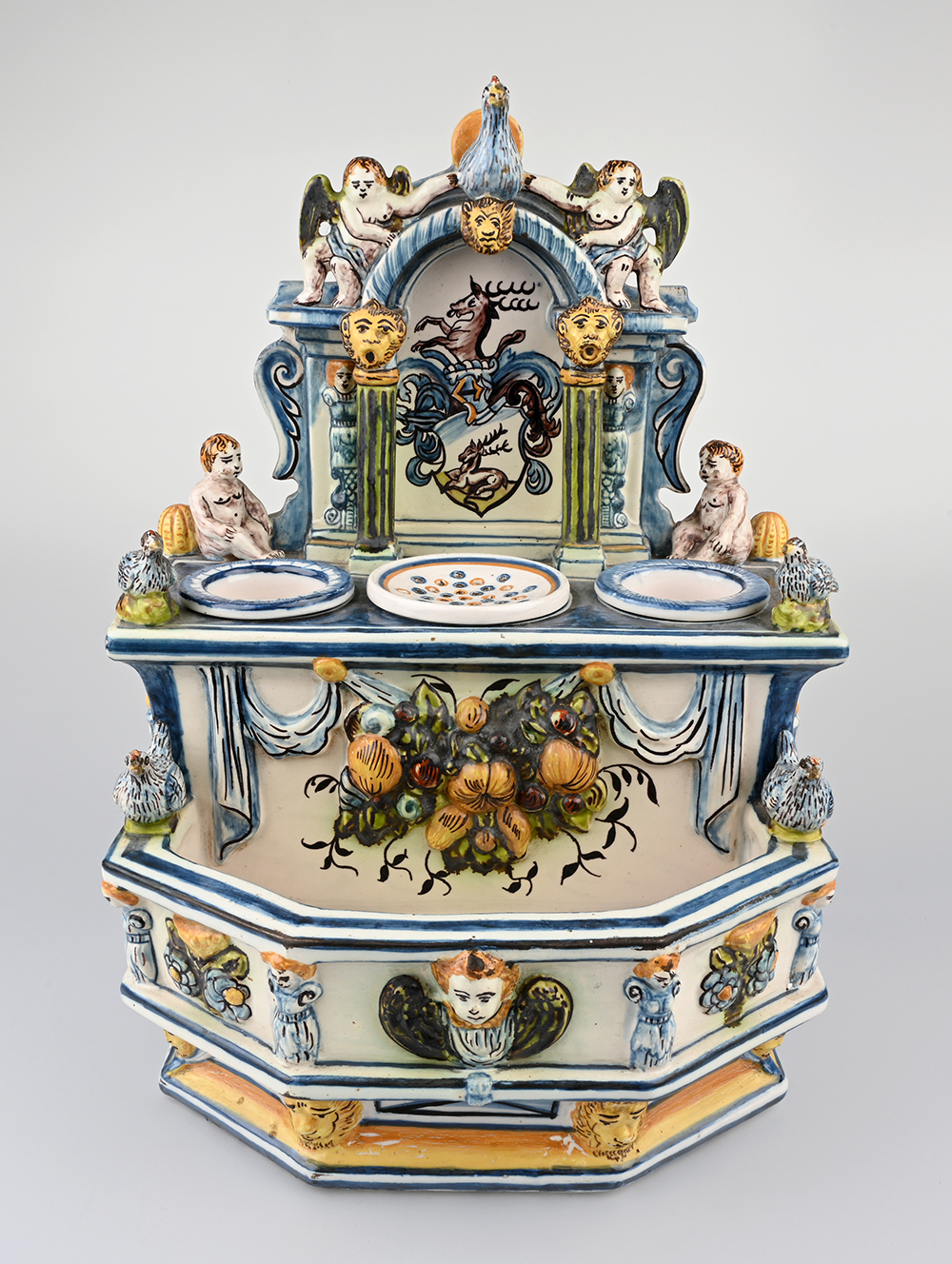
Ink stand modelled on examples from Winterthur, Keiser pottery, Zug. Swiss private collection.
Andreas Heege, 2025
The Keiser pottery in Zug was set up at 28 Arther Strasse in 1856. Before that time, a potter called Michael Schell and two workers had made pottery and probably tiled stoves at that address next to the municipal tileworks (the following information was taken from Schnyder/Felber/Keller et al. 1997). While the history of both the pottery and the potting family is very well documented and studied, no critical review has ever been compiled of the extant stoves and ceramic tableware (particularly plates with broad rims and ink stands in the Winterthur style which served as decorative pieces – always unmarked and unsigned!).
The workshop was run by the potter Josef Keiser (1827-1890) and his son, Josef Anton Keiser (1859-1923), and produced painted tiled stoves from the very beginning.
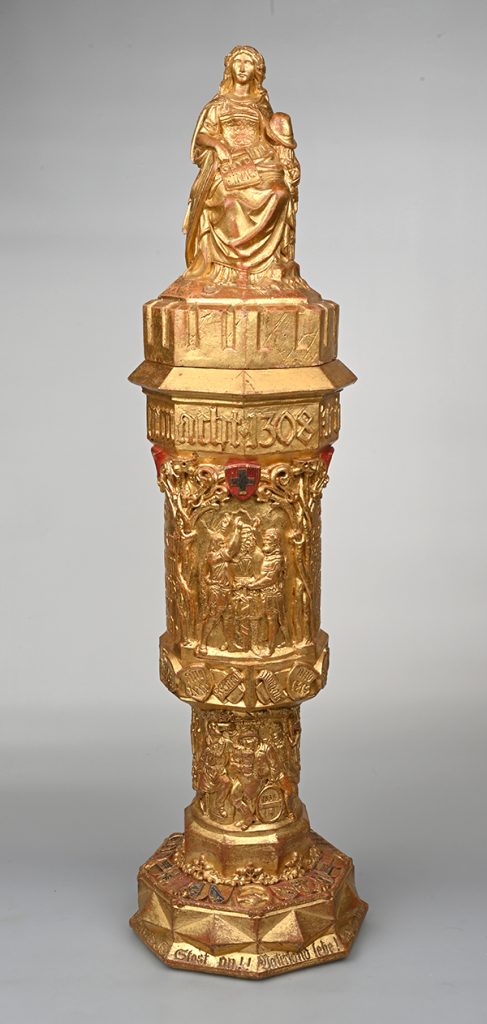
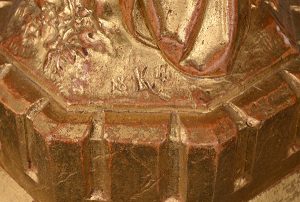
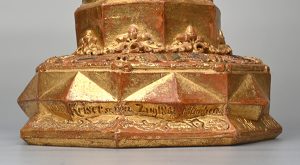
Josef Keiser’s brother, Ludwig (1816-1890), was an important Historicist sculptor and ceramicist. He made this gilt chalice dated 1844/1847 and signed it (Werner Gut Collection – KunstGut, Triengen).
The importance of the Keiser workshop, however, lies mainly in the objects created by Josef Anton Keiser and his wife, Elisabeth Keiser-Meier (1866-1938), who was a skilled stove paintress and thus had the job of decorating numerous Keiser stoves. She had learnt her craft at Hanhart in Winterthur. After Josef Anton’s death in 1923, she continued to run the workshop under the name “Josef Keiser’s heirs” until 1938, when it was converted into a tile store which traded until 1972.
In c. 1900, Keiser was considered the best fitter of Historicist tiles stoves in Switzerland, particularly when it came to making replicas of older models (Winterthur, Steckborn and Zurich stoves). This is also reflected in his commissions for institutions like the Swiss National Museum in Zurich under its founding director Heinrich Angst (Messerli-Bolliger 1989). One of Keiser’s early works from 1884 has survived.
In the years that followed, Keiser also received numerous commissions from abroad, including in 1908 for the Neo-Renaissance castle of King Carol I of Romania in Sinaia (Schnyder/Felber/Keller et al. 1997, 9). To this end he made a replica of the Seidenhof stove from 1620 which is at the Swiss National Museum today. The replica (albeit with only one seat) still stands in Sinaia; the model for it (Schnyder/Felber/Keller et al. 1997, 84 Cat. 5.10) is in the collection of the Museum Burg Zug.
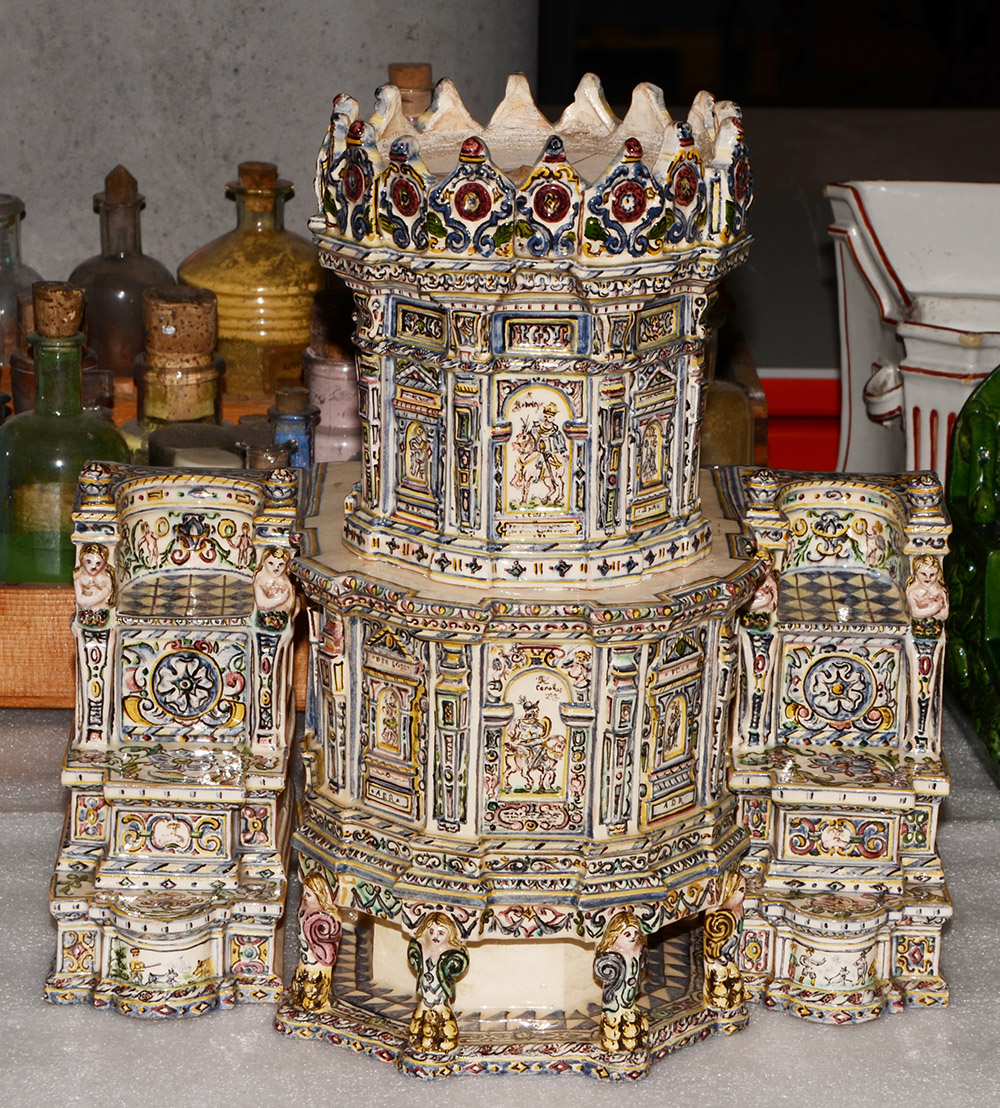
Why Keiser made a second replica of the stove (which is now disassembled in the tile collection of Bern’s Department of Heritage Management in Hofwil and was originally at Jegenstorf Castle, but never assembled there either), is not clear (Brennpunkt 2013, 78).
The Keisers maintained close working relationships with other, contemporaneous stove setters; the collaboration with the Basel stove setter Eduard Schaerer (1858-1934) is particularly worth mentioning (Higy 1999).
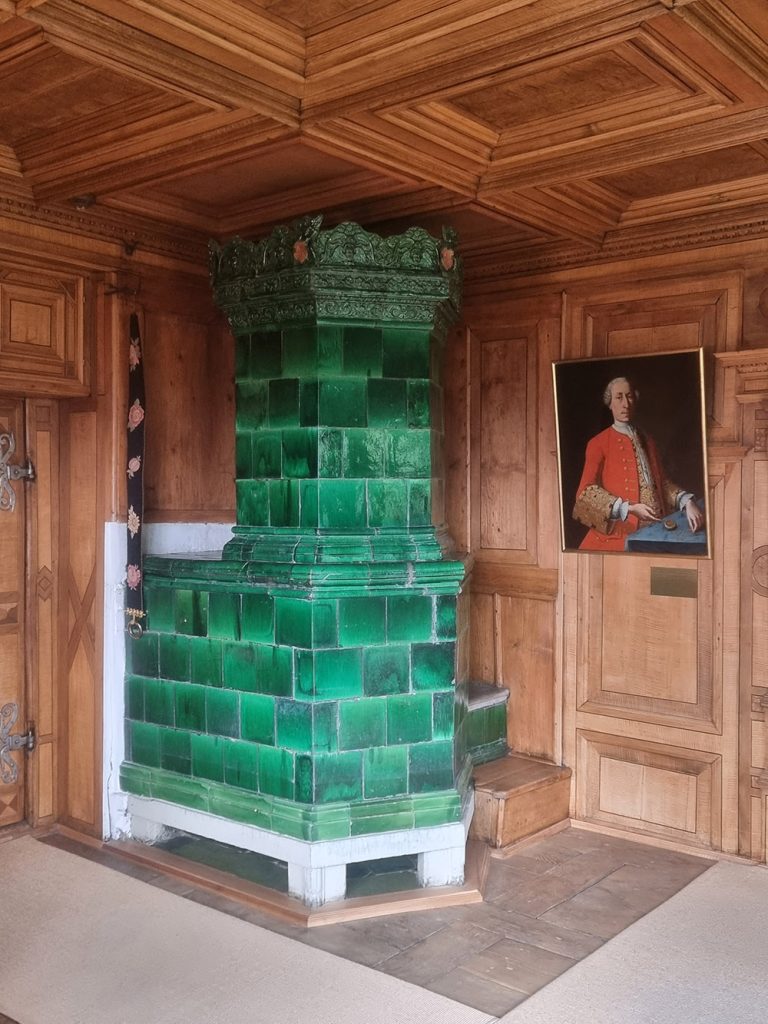
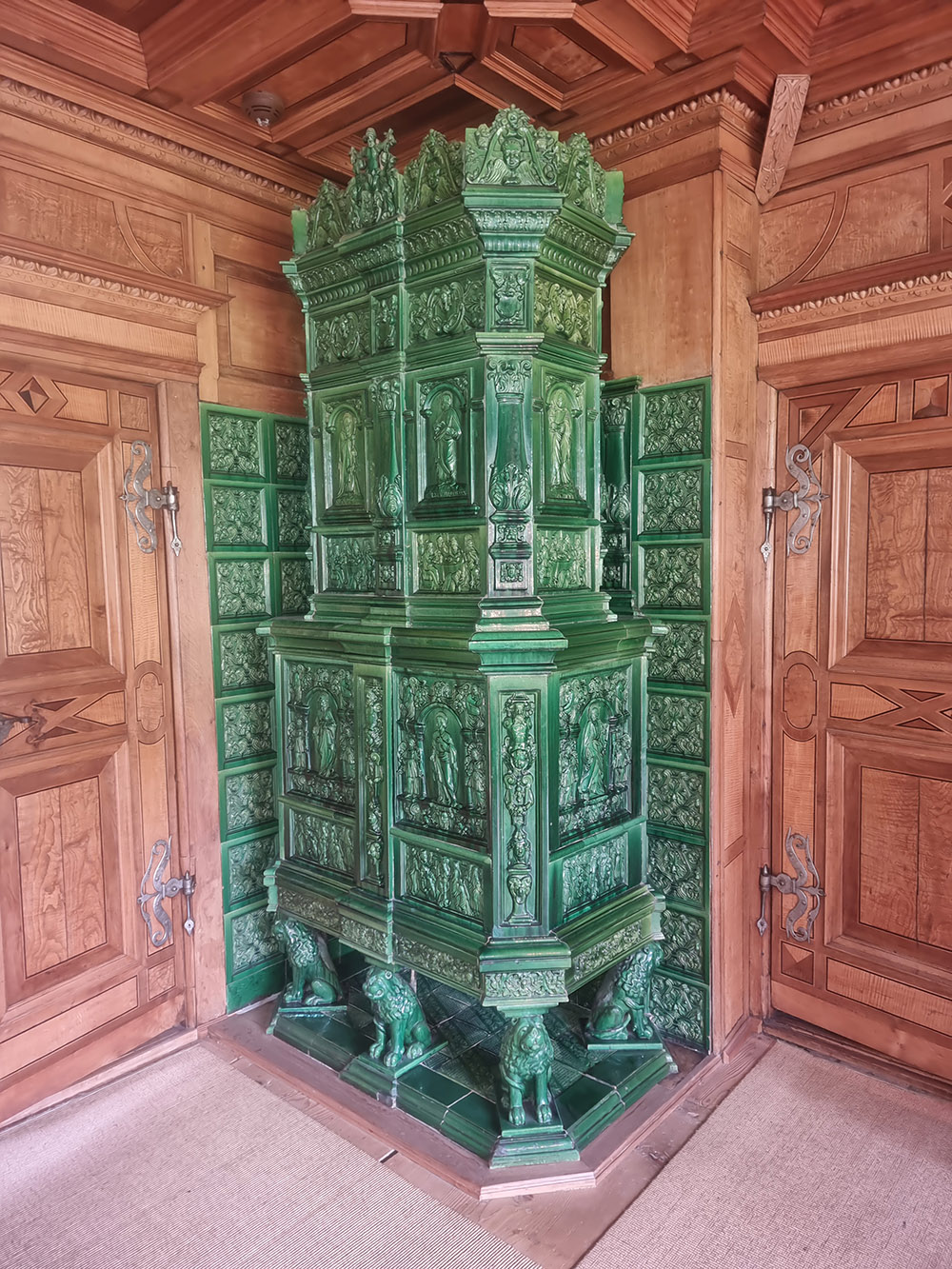
Keiser stoves at the Ital Reding House in Schwyz, commissioned in 1893 and 1897 respectively.
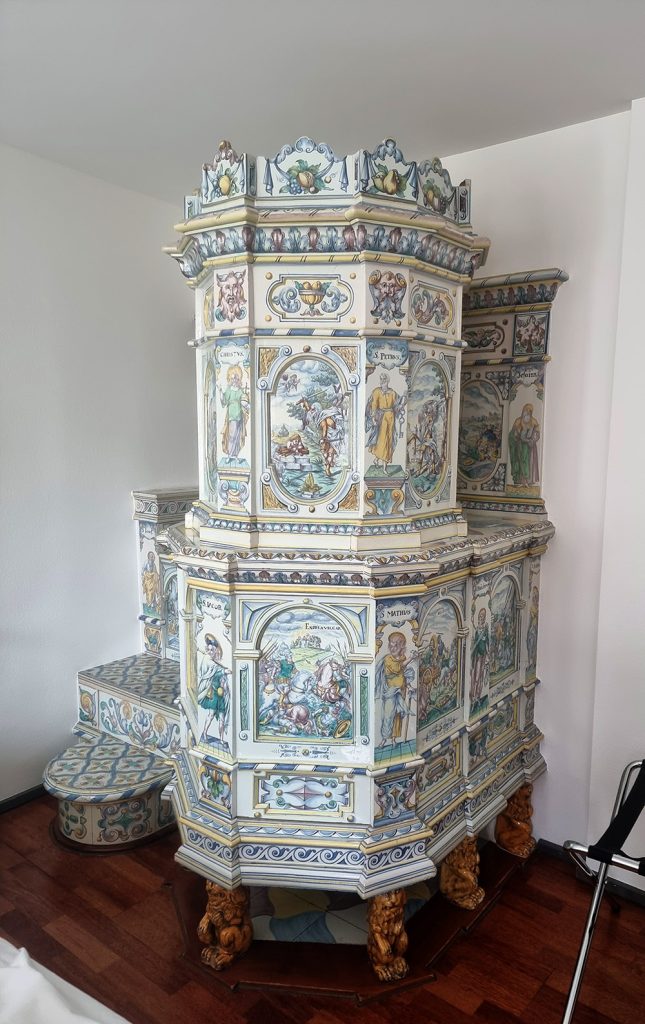
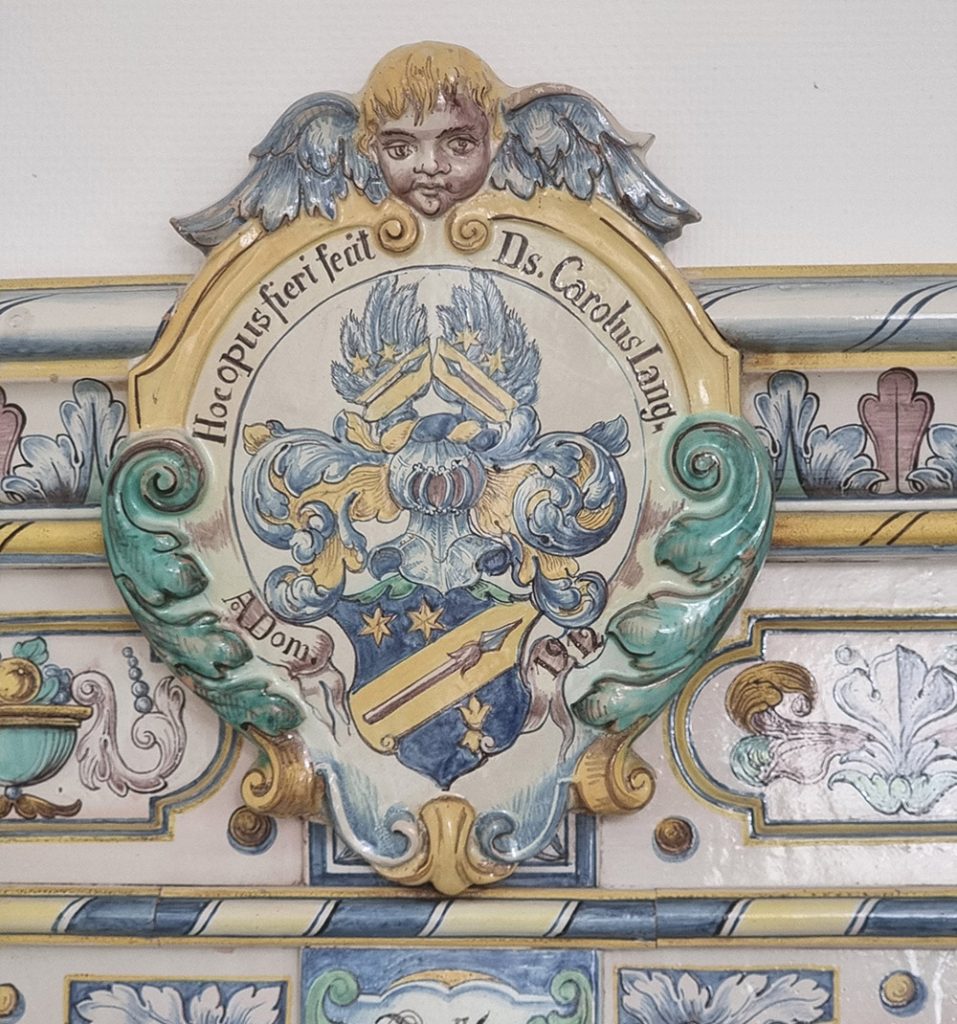
Keiser stove for Carl Lang, chaplain at the church of St Leodegar in Lucerne, commissioned in 1909, installed in 1912, CHF 1600.
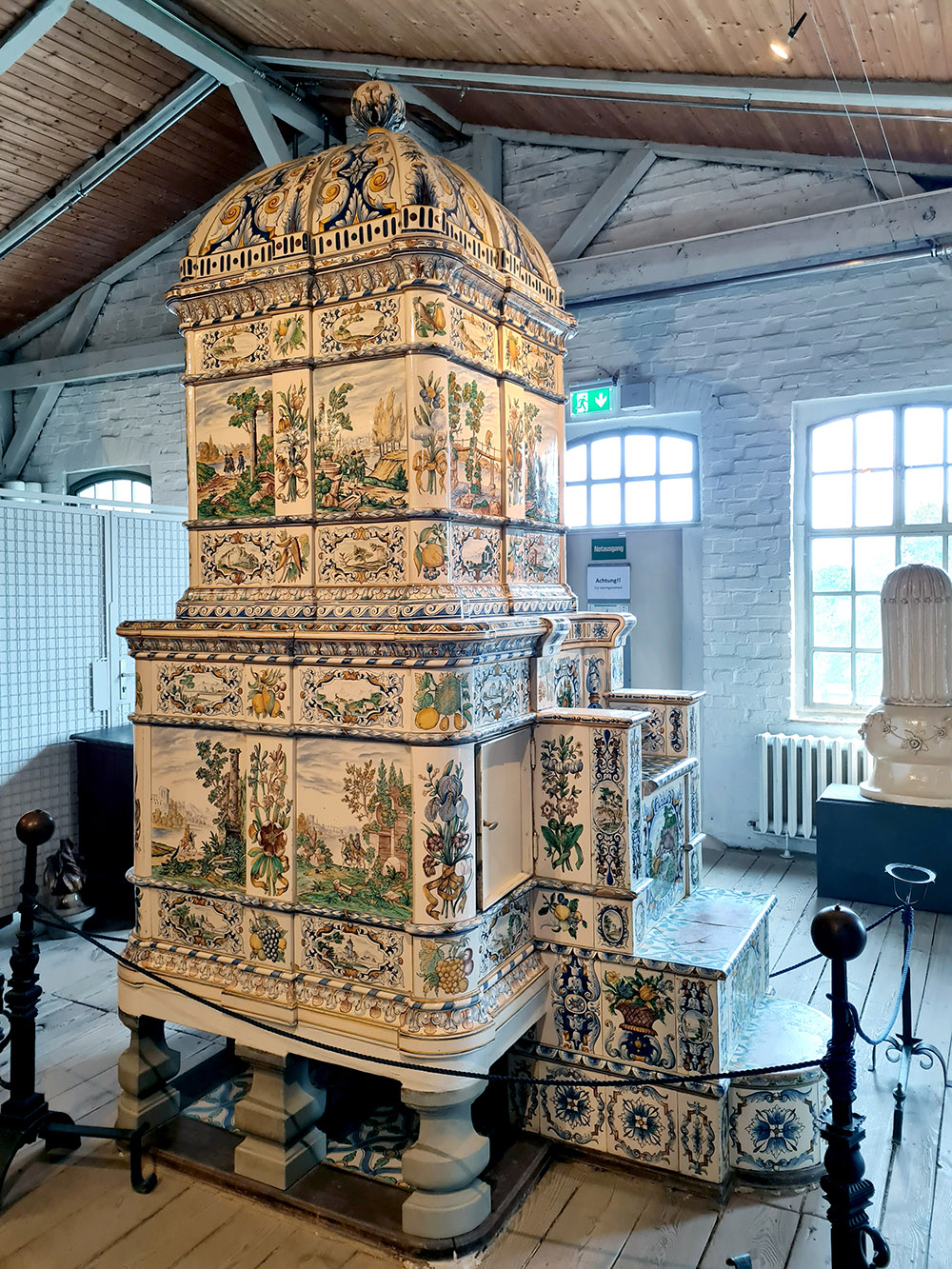
Keiser stove modelled on a Steckborn stove from 1749, commissioned in 1911 by Mewes & Bischoff, a Cologne architectural firm for the house of the Warburg family of bankers in Hamburg-Blankenese. Now at the Stove Museum in Velten near Berlin.
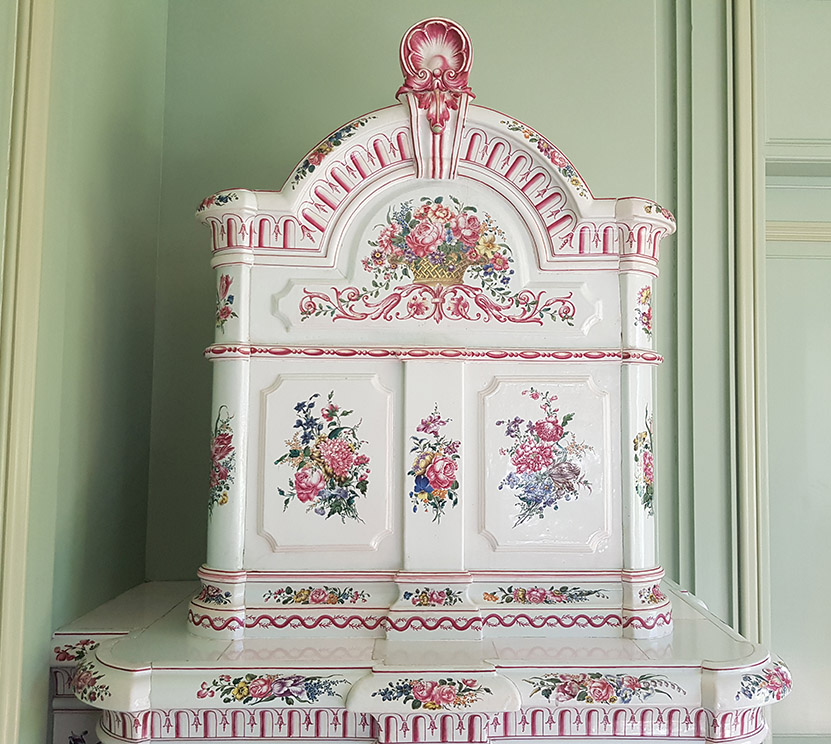
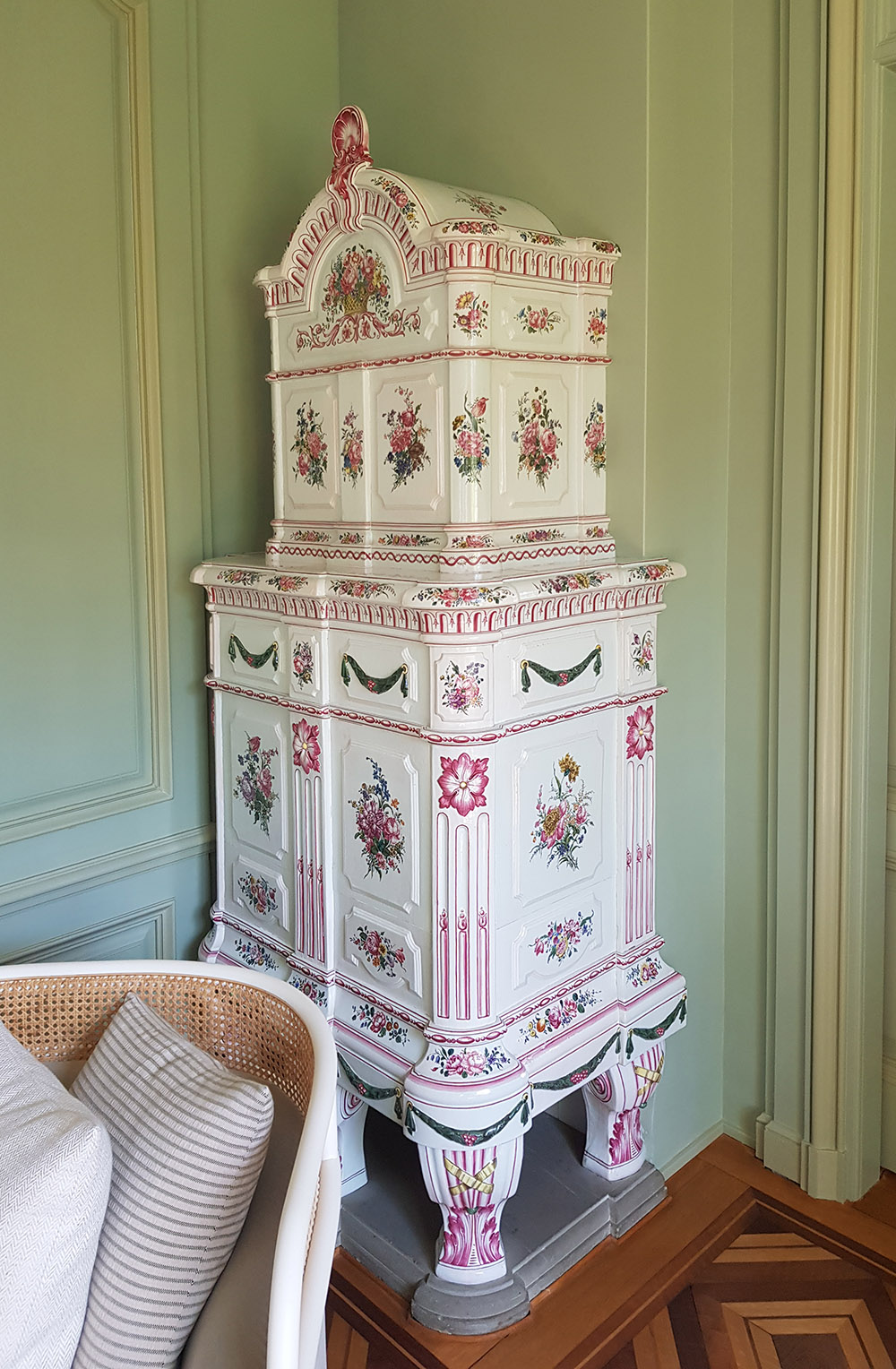
Keiser stove with German floral design (modelled on examples from Strasbourg and Bern), undated, now in Cham near Zug.
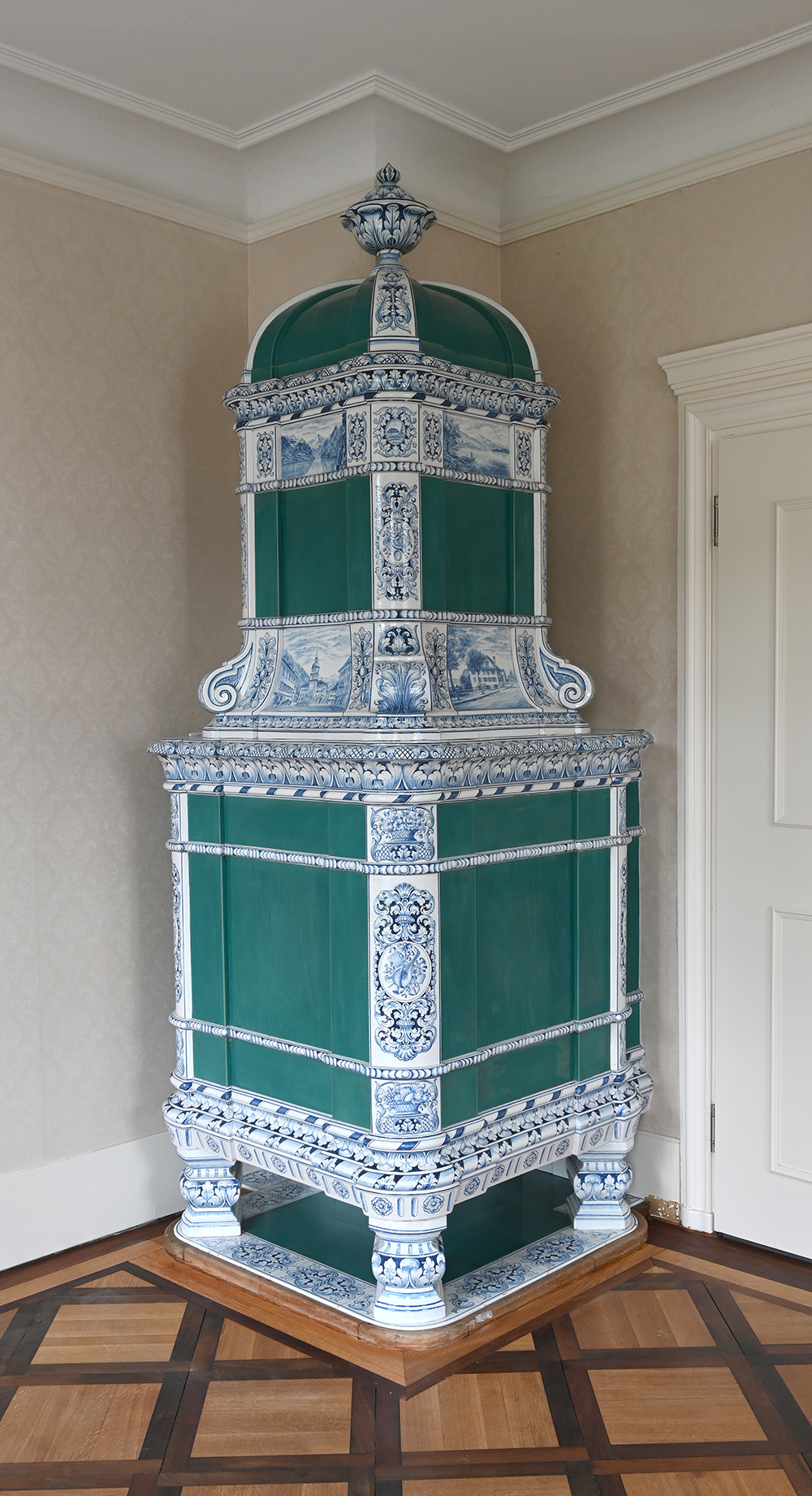
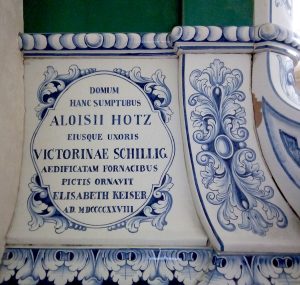
Keiser stove modelled on a Zurich example, painted by Elisabeth Keiser-Meier in 1928 for the Villa Hotz in Zug. Commissioned in 1928 for CHF 2000.
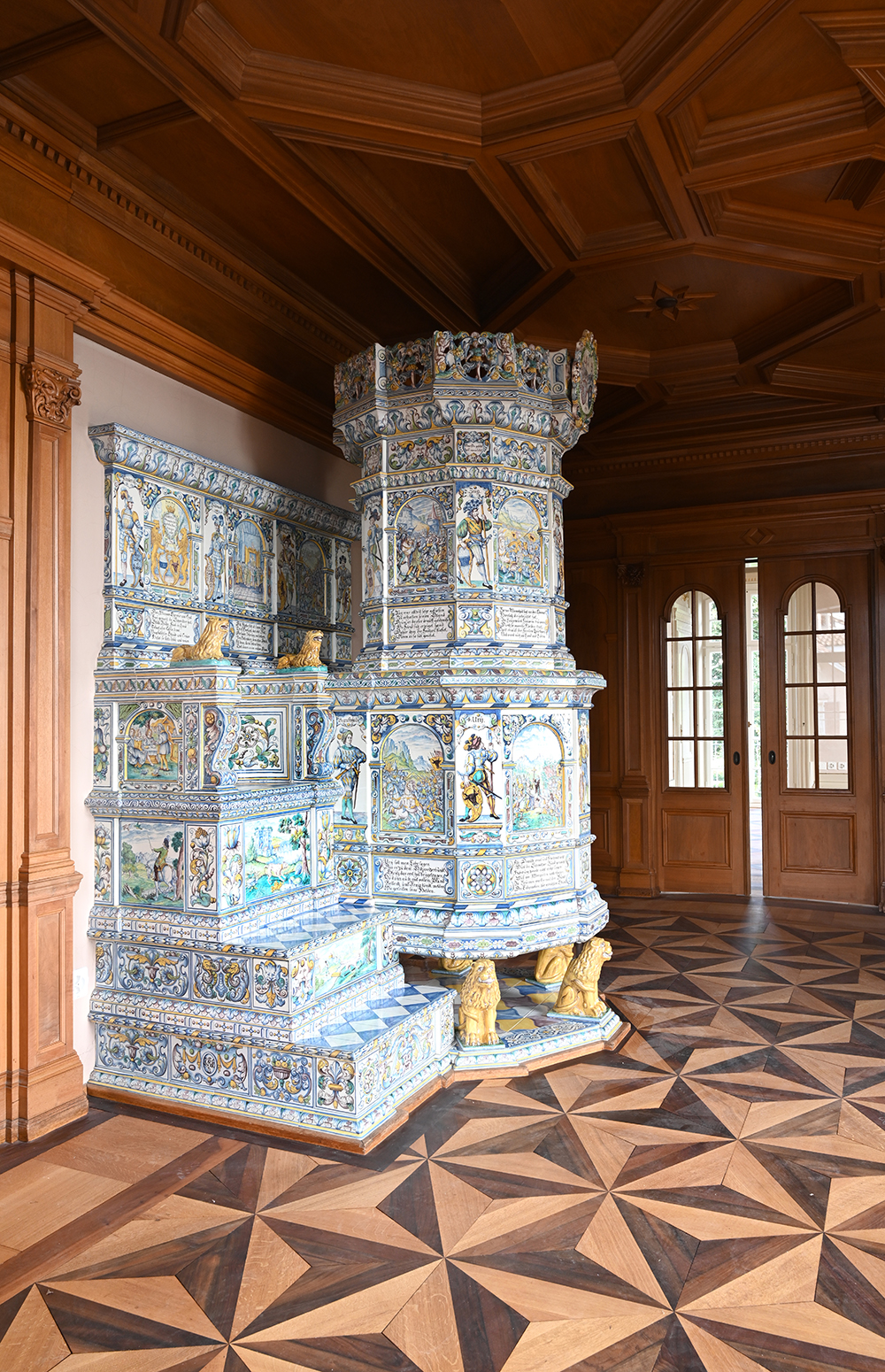
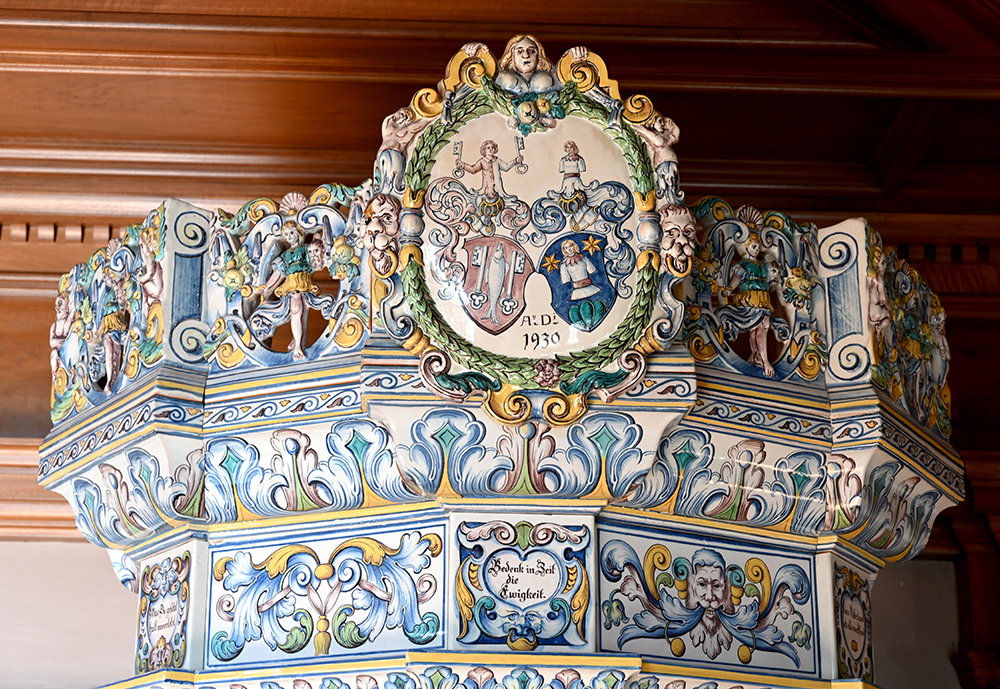
Keiser stove modelled on a Winterthur example for the Villa Hotz in Zug, painted by Elisabeth Keiser-Meier in 1930. Commissioned in 1927 for CHF 2000.
Translation Sandy Haemmerle
References:
Brennpunkt 2013
Schloss Jegenstorf (Hrsg.), Im Brennpunkt – die Sammlung historischer Kachelöfen Schloss Jegenstorf, Jegenstorf 2013.
Frei 1931
Karl Frei, Zuger Keramik II., in: Zuger Neujahrsblatt, 1931, 62-66.
Higy 1999
Walter Higy, Im Banne des Ofens. Der Ofensetzer Eduard Schaerer und das Hafnerhandwerk in der Stadt Basel, Basel 1999.
Keller/Tobler/Dittli 2002
Rolf Keller/Mathilde Tobler/Beat Dittli, Museum in der Burg Zug. Bau, Sammlung, ausgewählte Objekte, Zug 2002.
Messerli Bolliger 1989
Barbara E. Messerli Bolliger, Arbeiten der Hafnerei Keiser für den Gründungsbau des Schweizerischen Landesmuseums in Zürich, in: Zuger Neujahrsblatt, 1989, 65-84.
Messerli Bolliger 1989
Barbara E. Messerli Bolliger, Grünglasierte Reliefkacheln aus Winterthur (Schweiz), in: Joachim Naumann, Die Keramik vom Niederrhein und ihr internationales Umfeld. Internationales Keramik-Symposium in Duisburg, Düsseldorf und Neuss 1988 (Beiträge zur Keramik 3), Düsseldorf 1989, 78-82.
Messerli Bolliger 1994
Barbara E. Messerli Bolliger, Die ersten Arbeiten von Josef Anton Keiser (1859-1923): Skizzen, Zeichnungen, Kacheln und Öfen, in: Keramos 144, 1994, 25-36.
Schnyder/Felber/Keller u.a. 1997
Rudolf Schnyder/Friederike Felber/Rolf Keller u.a., Die Entdeckung der Stile. Die Hafnerei Keiser in Zug 1856-1938. Ausstellung vom 10. November 1996 bis 1. Juni 1997, Museum in der Burg Zug, in: Keramik-Freunde der Schweiz Mitteilungsblatt 109/110, 1997, 7-57.

