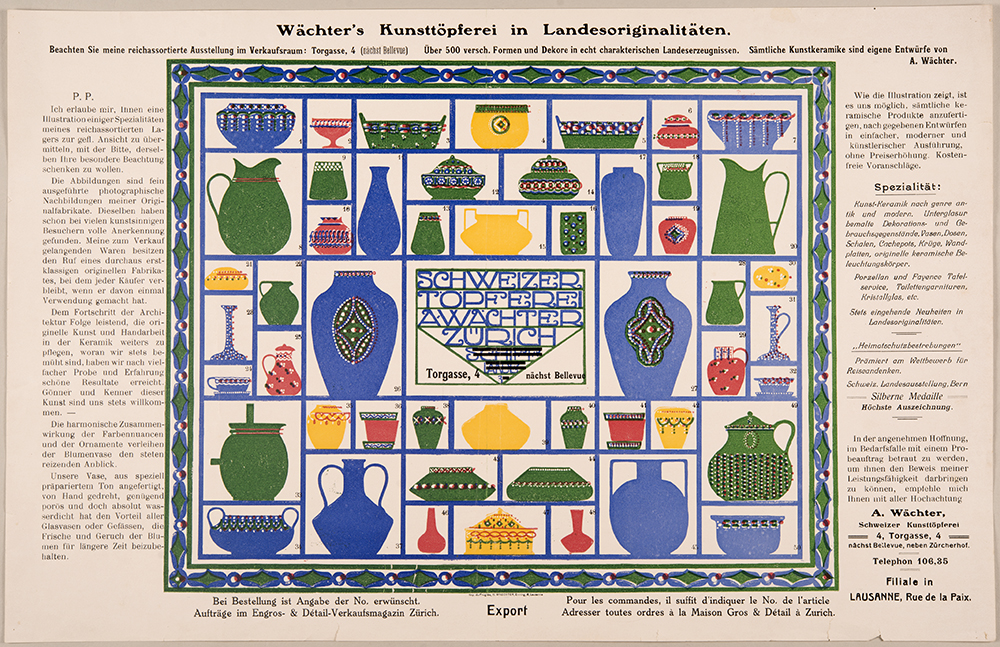
Poster, “Wächter’s Kunsttöpferei in Landesorginialitäten”, production: H. Wächter Printing Press Imp. du Progrès, Lausanne, c. 1917. 28.5 x 44.1 cm. Colour print (photo SNM, Inv. LM 61709).
Andreas Heege, 2020
Johann Albert Wächter (7th October 1873–3rd September 1938) is probably not very well known, even among Swiss pottery researchers, as most of the information about him and his workshop can only be found in rather obscure publications (unless otherwise indicated, the information provided here was taken from Welti 1976 with additional material from the Brugg Register Office and the Swiss Official Gazette of Commerce). The Wächters originated in Remigen in the Canton of Aargau. We do not know, however, where Albert Wächter spent his childhood. He was a trained printer and ran a printing press with his brother, Hans, in Lausanne until sometime before 1906, when he met Rosalia Reusser (22nd September 1878–8th August 1947), a potter’s daughter from Heimberg. The couple married on 21st July 1906. Rosalia or Rosa Reusser’s father was the potter Jakob Reusser (1853-1944, place of origin Aeschlen, Canton of Bern), who opened his own workshop at 2 Schulgässli in Heimberg in 1911. Prior to that he may have rented a second workshop in the house of his father-in-law Christian Michel (?-1904) (Buchs 1988, 109; see also the Steffisburg and Heimberg land register). Rosalia’s brother Adolf (1880 -?) probably continued to run that workshop until 1939.
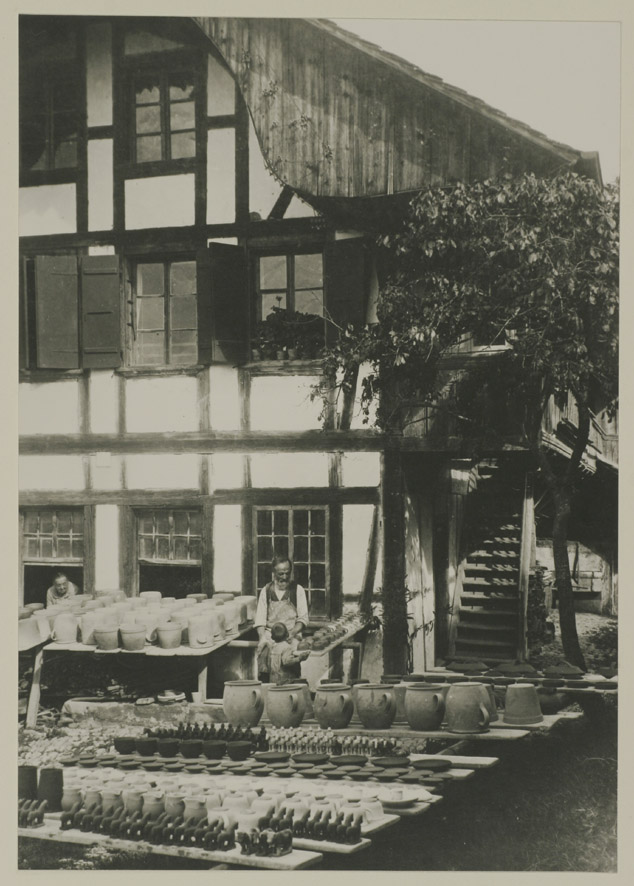
According to Ernst Hänni, a retired potter from Heimberg, this photo shows the workshop at 2 Schulgässli in Heimberg; it was taken by the photographer Hermann Stauder from Bern in 1917.
Apparently, Albert Wächter was so taken with the craft of pottery making that he decided to change his career and become a pottery manufacturer himself. We do not know if he actually learnt the craft, i.e. whether he served an apprenticeship, or if he simply used his own or his wife’s artistic talent to create pottery designs. In 1906, the young couple moved to Zurich because Albert felt the area would be an ideal location to sell his products.
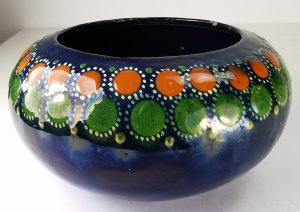
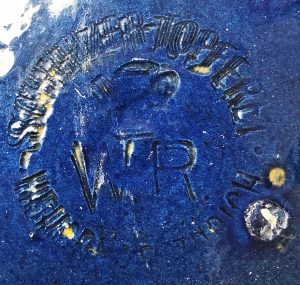
Production itself, however, remained in Heimberg, probably in the workshop of Albert’s father-in-law, which later led to the seemingly strange company mark “SCHWEIZER-TÖPFEREI WR HEIMBERG-ZÜRICH” [Swiss Pottery WR Heimberg-Zurich].
Initially, Albert Wächter and Rosa Reusser appear to have exclusively sold Heimberg-made pottery “under the arches on Rathausquai in Zurich” (Welti 1976, 100) from an outdoor market stall. They later moved to a shopping arcade in the area of what is today the Hechtplatz Theatre and then to a retail outlet at 3 Schifflände. This was the address that was given when Albert Wächter’s name first appeared in the Swiss Official Gazette of Commerce on 24th March 1911. The notice identified him as the owner of the company “A. Wächter-Reusser in Zurich I”. The purpose of the business was given as “pottery making” (SOGC 29, No. 77, 509).
On 6th May 1913, the Gazette of Commerce announced that Albert Wächter had changed the name of his business to “A. Wächter-Reusser, Swiss Pottery” (SOGC 31, No. 116, 831). This is consistent with a strikingly colourful printed advertising poster in the collection of the Swiss National Museum (SNM LM-61708). In the middle section it has the ornately written title “SCHWEIZER TÖPFEREI A. WÄCHTER ZÜRICH SCHIFFLÄNDE 3” [Swiss Pottery A. Wächter Zurich Schifflände 3]. The title is surrounded by what looks like shelves of vessels with a coat of yellow, green, red or blue slip and quite restrained ornamentation, as we would expect to see in the German-speaking part of Switzerland during that period. The poster was printed by the “Imprimerie du Progrès” (printing press, 6 Rue Enning) of Hans Waechter-Gutzwiller in Lausanne. This was probably Albert’s brother, who can be found in Lausanne records between 1900 and 1917 (SOGC 18, No. 318, 1276; SOGC 30, No. 148, 1066; SOGC 31, No. 223, 1586; SOGC 35, No. 165, 1161 – bankruptcy). A second, even more impressive advertising poster by the Zurich graphic designer Otto Bickel has only survived in the form of a black and white photograph (Welti 1976, 104). We can probably assume that these beautiful advertising media attest to Albert Wächter’s former love of printing.
In 1914, we find Albert Wächter at the National Exhibition in Bern. In a piece for “Die Schweiz –Schweizerische Illustrierte Zeitung” (Vol. 18, 1914, 377), Jacob Hermanns, instructor at the School of Ceramics in Bern, writes: “… The exhibitors from the Heimberg-Steffisburg pottery industry include the best-known companies: Karl Loder-Eyer, Emil Lengacher formerly of Wanzenried, A. Wächter-Reusser Zürich-Heimberg and many more…”. “Wächter-Reusser, Zürich” was also one of the suppliers of the “Bazar im Dörfli” bazaar at the National Exhibition (see also Conradin 1914). In the list of suppliers, he is mentioned alongside “Clara Eymann, Langenthal; A. Gerber, Langnau; Kaiser & Co. Bern; Emil Lengacher, Steffisburg; Loder-Eyer, Steffisburg; Loder Brothers, Heimberg; Albert Schmid, Thun, 44b Neufeld and Ziegler, Pottery Factory, Schaffhausen” (Heimatschutz Heft 9, 1914, 99). Wächter himself says in the advertising poster shown above that he has been “awarded a silver medal, highest honours, in the souvenirs competition at the Swiss National Exhibition in Bern”. The competition for “Group No. 49 Heritage Protection” was staged in 1913 in the hope of sourcing good-quality travel and exhibition souvenirs for the bazaar (Heimatschutz Vol. 8, 1913, 75–76, 95). In fact, on 27th October 1913, the jury had awarded him third prize of 25 Swiss francs for “No. 117, Motto ‘23018’, A. Wächter-Reusser, Schifflände, Zurich, 61 pieces of pottery” (Heimatschutz 8, 1913, 172).
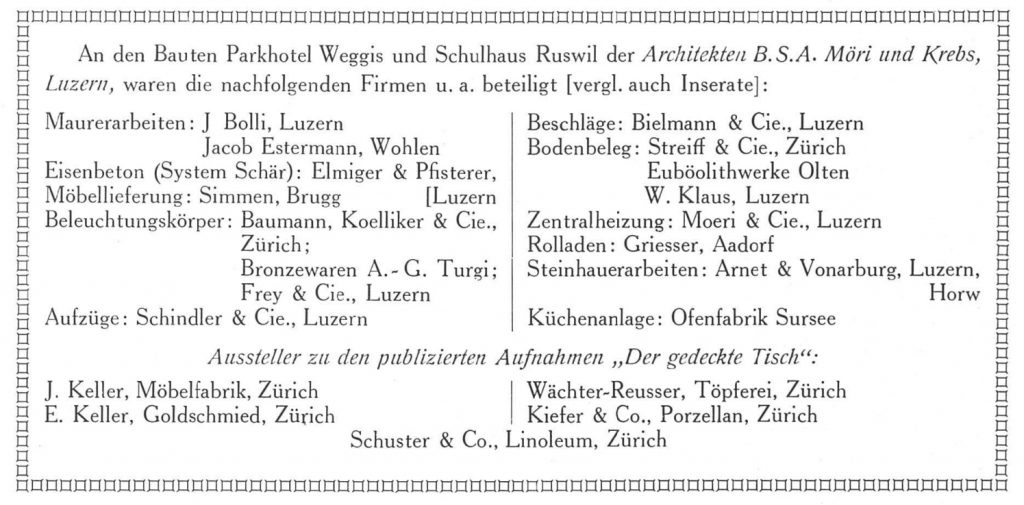
That same year, “Wächter-Reusser, Pottery, Zurich” was invited by the Schweizerischer Werkbund to participate in the exhibition “Der gedeckte Tisch” [The Table Is Set] at the Museum of Decorative Arts in Zurich (Das Werk, February Issue 1914, XIV and 26-30). In 1915, Wächter opened a second retail outlet in Lausanne at 1 Rue de la Paix (SOGC 35, No. 94, 672), which was run by Emma Wächter (place of origin Remigen, Canton of Aargau, probably his sister) and remained in business until December 1922 (SOGC 40, No. 281, 2268). On 22nd June 1916, “A. Wächter, Swiss Pottery” registered the pattern for an “electric lamp” in the commercial register using an address at 4 Torgasse in Zurich (SOGC 34, No. 144, 992). The business had obviously moved to new premises. On 27th August 1917, Albert Wächter changed the company name again, this time to “Schweizerische Kunsttöpferei” [Swiss Art Pottery] (SOGC 35, No. 202, S1393). It was probably in this context, that he had a number of old advertising posters overprinted with additional information and the new address (poster SNM Inv. LM-61709, see above). “Wächter’s Kunsttöpferei in Landesoriginalitäten” [Wächter’s Art Pottery in Indigenous Originals] advertised its “more than 500 different shapes and decorations in the typical Swiss style. All studio ceramics are A. Wächter’s own designs. As the illustration shows, we can produce any type of ceramic product according to the designs supplied in a simple, modern and artistic execution, without any surcharge.” The speciality of the company was advertised thus: “Genre pottery, antique and modern. Decorative and useful objects with underglaze painting, vases, boxes/lidded containers, bowls, flowerpot containers, jugs, wall tiles, original ceramic lamps… A steady supply of new indigenous originals.” The poster also informed its customers that the shop sold “porcelain and faience tableware, toilet sets, cut glass etc.”; in other words, the Wächters at that stage were already running what could be termed a homeware store with its own ceramic department. According to more recent sources, we know that Rosa Wächter-Reusser also sold refined white earthenware from Sarreguemines and from Zell am Harmersbach (Welti 1976, 103).
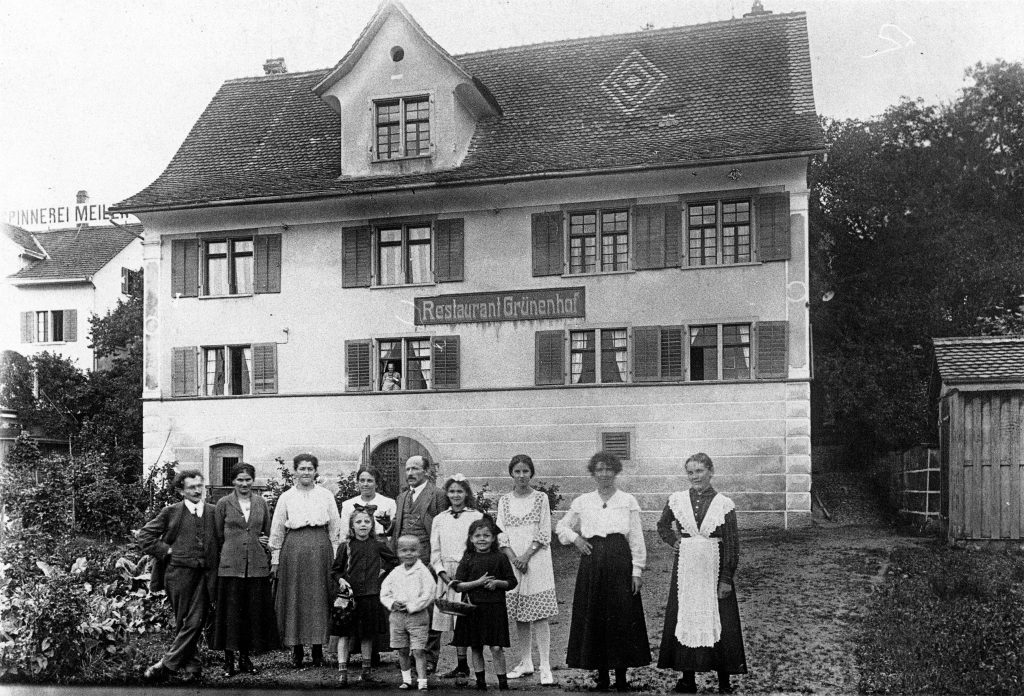
Albert Wächter with his family, employees and other people in front of the “Grünenhof Restaurant” in 1918 (photo by Kantonale Denkmalpflege Zürich, Dübendorf).
The business must have been doing very well, as Wächter was able to buy the “Grünenhof” on Seestrasse road in Feldmeilen in 1918 (SOGC 37, No. 144, 1062 dated 16th June 1919). It is today one of the most important historical monuments in the municipality of Meilen (Renfer 1976; General-Wille-Strasse 256, 8706 Meilen). He had a potter’s workshop with a large wood-fired kiln installed in the adjacent winepress building and moved his pottery production from Heimberg to Zurich. It is not known who worked there with him, but it is almost inconceivable that the workshop could have been run without additional help from skilled workers, perhaps from his wife’s side of the family in Heimberg.
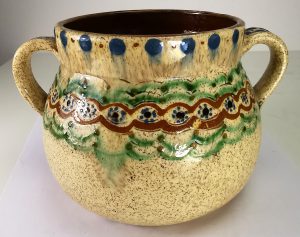
The use of iron manganese particles in the slip for decorative purposes (speckled decoration) is one of the elements that point to Bernese and Heimberg roots.
On the other hand, Wächter must have already had considerable experience in the production of pottery in 1918, since both Heinrich Meister and his business partner, the Hungarian Josef Kövessi, were interns in his workshop from 1919 to March 1920. Largely self-taught ceramicists, they opened their own pottery business in Dübendorf-Stettbach later that same year.
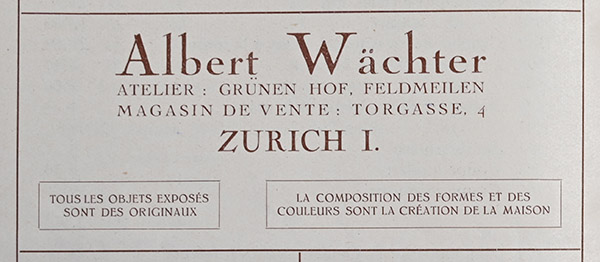
In 1927 Wächter participated in a large pottery exhibition entitled “Céramique Suisse” in Geneva.
After the move to Feldmeilen, Rosa continued to run the shop in Zurich, which was relocated to Waldmannstrasse sometime after 1933. In later years she was joined and eventually replaced by her daughter Anni. It goes without saying that by creating special window displays the business participated in the exhibitions during the so-called “Schweizer Woche” [Swiss Week] in 1932 and 1933, which mainly advertised Swiss products (NZZ 27th October 1932). On 26th October 1933, the NZZ newspaper wrote: “A. Wächter (on Torgasse) has on display monochrome utility ware and decorated vessels from various regions, as well as a range of products from the workshop “zum Grünen Hof” in Feldmeilen that are decorated with flowing glazes. The shop window also contains a selection of large garden vases.” This is consistent with accounts according to which Albert Wächter made an increasing number of experiments over the years with different clay mixtures and glazes and developed special ceramic forms such as colourfully painted ceramic casings for electric stoves with inbuilt water evaporation trays (Welti 1976, 101).
Albert Wächter’s objects in the collection of the Swiss National Museum and in the antiquities trade, together with the advertising posters show that he had the Heimberg workshop produce forms and decorations that were typical of the period (e.g. SNM LM 61707 – for the Swiss Marksmen’s Festival in Zurich in 1907) and reminiscent of those from the late production phase of the Wanzenried Manufactory under Emil Lengacher or those from the workshops of Karl Loder-Eyer, Bendicht Loder-Walder or Emil Loder and Adolf Schweizer; the same wares were probably also made by other potteries in the Heimberg-Steffisburg region at the time (e.g. Desa from 1916 onwards). These were the models that people like Heinrich Meister and Josef Kövessi learnt about during their brief ceramic internships. Any echoes of the earlier Thun majolica, which was still ubiquitous in 1914, were completely absent. Instead, there were highly stylised ornaments like those put forward and disseminated by the Bernese arts and crafts instructor Paul Wyss in his teaching materials and drawing classes.
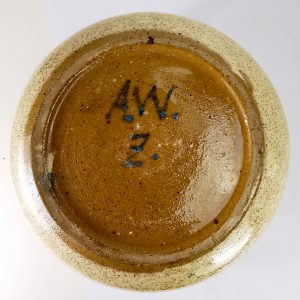
No confirmed chronology of the company marks has yet been compiled. We can only assume that the impressed mark “SCHWEIZER-TÖPFEREI WR HEIMBERG-ZÜRICH” (see above) dates from the period between the naming of the business in 1913 and production being moved to Feldmeilen in 1918 (see also SNM LM-61700; LM-61701; LM-61702; SNM LM-61703; LM-169974). Accordingly, one would like to date the incised or slip-trailed marks “A.W.Z.” and “AW” (e.g. SNM LM-61698; LM-61699; LM-61704; SNM LM-61706; LM-173411; LM-173412) as well as the words “A. Wächter Feldmeilen” to the period after 1918.
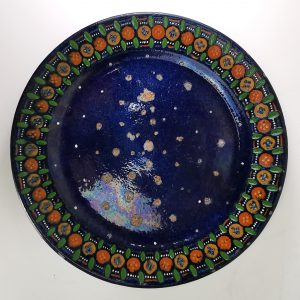
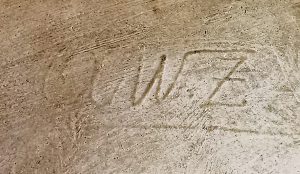
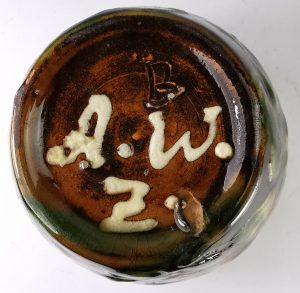
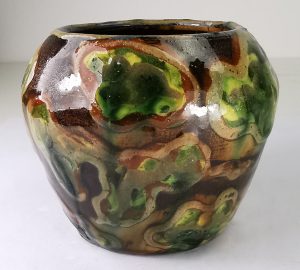
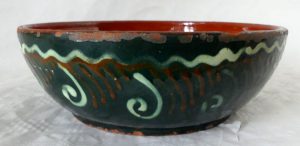
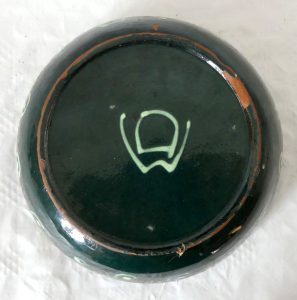
Alle Objektfotos Angello Steccanella.
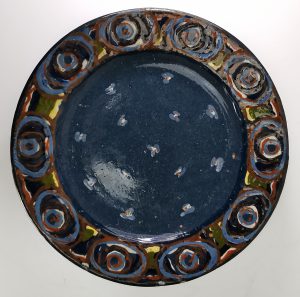
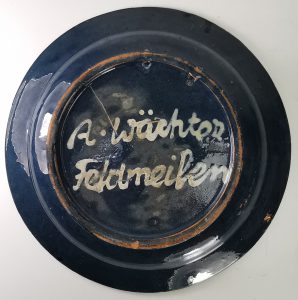
Very few of the later products from the “Grünen Hof” workshop, i.e. from the period after 1920 have survived (SNM LM-61705; Welti 1976, 100). Plates decorated with groups of people in traditional costume inspired by works by the artist Josef Reinhard and bearing the signature “Wächter Zürich” can probably be seen as a reaction to the anti-modernist sentiment of the 1930s (SNM LM-93845; LM-93846).
Albert Wächter died unexpectedly in 1938. The company continued to be run by his children, Anni and Hans Wächter, under the name “Schweizerische Kunsttöpferei Alb. Wächter’s Erben in Zürich” [Swiss Art Pottery Alb. Wächter’s Heirs in Zurich]. The notice in the Swiss Official Gazette of Commerce located the company seat at 4 Waldmannstrasse and the workshop at “Zum Grünen Hof” in Feldmeilen (SOGC 57, No. 16, 141, 18th January 1939). Hans Wächter had trained as a ceramicist in Heimberg and received further training at a German manufactory. The youngest daughter, Vreni Wächter (Emma Verena, born on 20th March 1918 in Zurich, died on 21st December 2005 in Uetikon am See), who had served an apprenticeship as a salesperson, also joined the company and learned the craft. The workshop was fitted with a new electric kiln in 1945. In early 1946, Hans Wächter quit the pottery business and left the company. At the age of 28, Vreni Wächter took over from her brother (SOGC 64, No. 39, 511, 13th February 1946). She was now singlehandedly in charge of production, though she sometimes had help from a cousin from Heimberg. In April 1948, the shop in Zurich closed its doors and the company seat was moved to Feldmeilen (SOGC 66, No. 89, 1080, 14th April 1948). The family opened a small pottery shop in the house, which was run by Anni Wächter. In 1957, the two owners liquidated the partnership “Kunsttöpferei Alb. Wächter’s Erben” and Verena Wächter continued to run the business on her own. Subsequently, up to the year 2000, she displayed her works at numerous exhibitions staged by the Arbeitsgemeinschaft Schweizer Keramik [Swiss Ceramics Association] (ASK) and the Gesellschaft Schweizer Malerinnen, Bildhauerinnen und Kunstgewerblerinnen [Society of Swiss Female Painters, Sculptors and Craftswomen] (GSMBK) (e.g. in Bern, Lausanne, Lucerne, La Sarraz, Solothurn, Winterthur and Zurich, and at the Saffa in Zurich, in Geneva (Musée Ariana), the Parktheater Meilen, in Faenza and at the Swiss Pavillion in Frankfurt in 1956, in Thun, at Schadau Castle in 1972, at “Feu sacré – Biennale der Arbeitsgemeinschaft Schweizer Keramiker” in Lucerne in 2000; Keramikfreunde der Schweiz, Bulletin 55, 2000, 12). In 1980, the Museum of Art and History in Geneva acquired one of her objects at an exhibition run by the Heimatwerk in Zurich for its collection (Genava 29, 1981, 228). Vreni Wächter died in 2005. In 2006, a selection of her works was shown at an exhibition staged in her memory by the gallery Feuer 111 (Keramikfreunde der Schweiz, Bulletin 67, 2006, 17).
I am very grateful to Angelo Steccanella, Andreas Kistler (Bäriswil), Christian Hörack (Swiss National Museum), Roland Böhmer (Department of Monument Preservation of the Canton of Zurich), Hans Isler (Association Heimatbuch Meilen) and Sandra Knus (Brugg Register Office) for their help in researching this subject.
Translation Sandy Haemmerle
References:
Conradin 1914
Christian Conradin, Der Bazar im Dörfli, in: Heimatschutz. Zeitschrift der Schweizer. Vereinigung für Heimatschutz 9, 1914, Heft 6, 89-98.
Renfer 1976
Renfer, Christian, Der Grüne Hof in Feldmeilen. Heimatbuch Meilen 1976, 5–34.
Thun 1972
7. Ausstellung Schweizer Keramik der Arbeitsgemeinschaft schweizerischer Keramiker. Katalog zur Ausstellung. Thun 1972.
Welti 1976
Hilde Welti, Die Töpferei Wächter in Feldmeilen. Heimatbuch Meilen 1976, 99–110.

