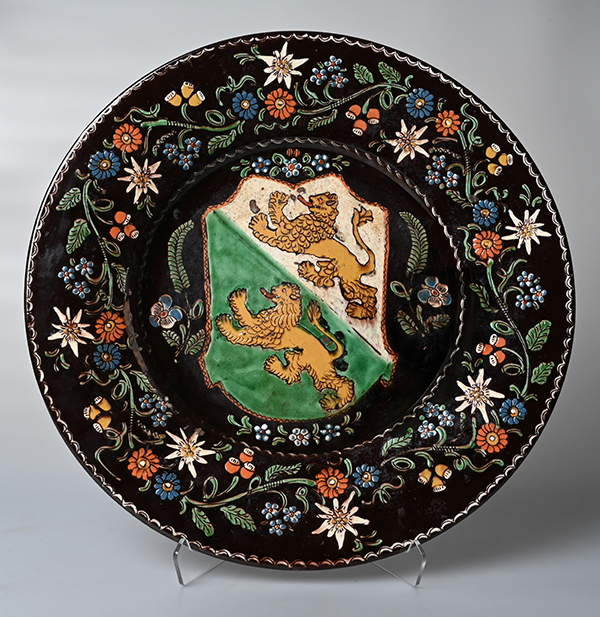
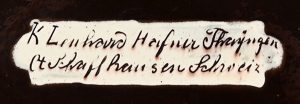
Andreas Heege, Andreas Kistler, 2023
Konrad Lenhard-Zürcher (1837-1896), son of Conrad Lenhard (carpenter?), was christened on 10th December 1837 in Thayngen. It is not known where he learnt his craft, but he is mentioned in records as a journeyman working for the potter Burkhard in Oppligen in 1857. In 1858, he worked for the potter Johann Gasser in Oberwichtrach and from September 1859 to August 1861 at the Grossglauser/Böppli potters’ workshop in Oppligen (Bern register of foreign citizens). It was probably around that time that he met the pottery paintress Rosina Zürcher (christened in Amsoldingen 24th September 1837, died July 1898 in Thayngen). Rosina’s father, Johann Zürcher (1800-1868; citizen of Trub) was a cheesemaker; her mother’s name was Elisabeth Trachsel (1804-1870) (Zürcher family tree). On 5th April 1861, Konrad and Rosina were married at the Nideggkirche church in Bern; at the time they lived in Oppligen (church register Trub 26, 176). We can probably assume that Rosina also found work at one of the potter’s workshops in the area.
The couple appear to have returned to Thayngen within a relatively short period of time, as we find a listing for potter Konrad Lenhard in the 1865 address book for the Canton of Schaffhausen.
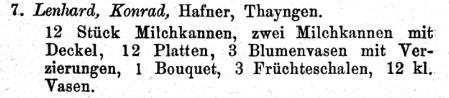
Cantonal Exhibition of Industry and Commerce in Schaffhausen, catalogue of exhibitors, Schaffhausen 1880, 11, No. 7.
In 1880, he was one of the exhibitors at the Cantonal Exhibition of Industry and Commerce in Schaffhausen, where he displayed a fine range of pottery vessels.
The exhibition initially earned him a very positive review in the Schaffhauser Intelligenzblatt (3rd August 1880): “We have good reason to draw our readers’ attention to the products of Herr Lenhard. They are reproductions of the well-known Heimberg-style ware, which is gaining more attention than was the case before. If Herr Lenhard continues to model his works on certain examples, he will find this a most lucrative field of work.” On the other hand, there were also a few detractors, as some people doubted whether he could have made the wares himself. He defended himself in the Schaffhauser Intelligenzblatt newspaper on 8th and 10th August: “As doubt has been raised and spread from certain quarters that the works I have exhibited were not made by me, I would like to cordially invite any interested parties to visit my workshop and witness the process for themselves. Thayngen, August 1880. K. Lenhard, potter” (all quotes from Schiendorfer 2017).
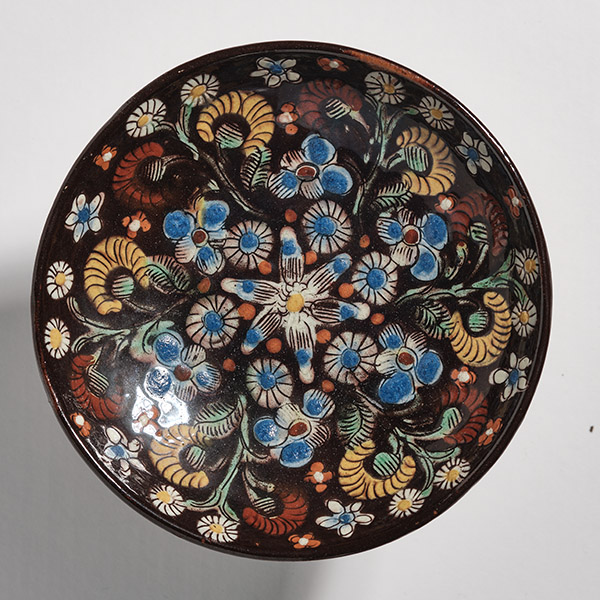
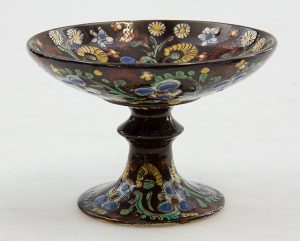
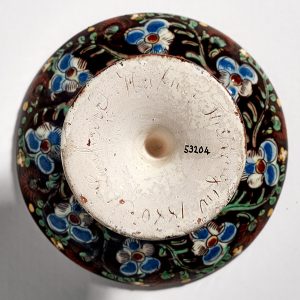
Fruit bowl dated 1880 and signed by Konrad Lenhard in the collection of the Museum Allerheiligen in Schaffhausen (photo by Daniel Grütter).
Based on the originals that have survived in the collection of the Museum Allerheiligen in Schaffhausen, there can be no doubt that Konrad Lenhard, most likely with the help of his wife and her considerable painting skills, created pottery in the early Thun majolica style with violet motifs (so-called “Paris ware”) of the kind that was displayed by the Heimberg potters at the World Exhibition in Paris in 1878.
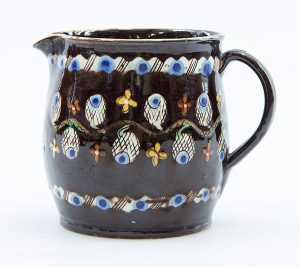
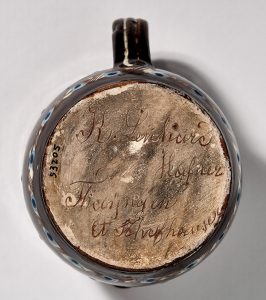
Small milk jug from the Museum Allerheiligen in Schaffhausen (photo by Daniel Grütter).
It is not until 1889 that we hear about the workshop again, this time under the title “Indigenous decorative arts” (Schaffhauser Intelligenzblatt dated 20th August 1889):
“I have recently had occasion to visit the master’s workshop and observe him and his talented wife and assistant at work. I am speaking about the fine master potter Konrad Lenhard in Thayngen, whose ceramic vessels have long enjoyed an excellent reputation for their quality and durability. What is less well known, however, is the fact that he also makes beautiful and extremely well fired display pieces, including vases of all kinds, dishes, dainty jugs, complete coffee sets painted and decorated, and much more, the decorations and painted motifs of which stem from the skilled hand of Frau Lenhard, a Heimberg-born paintress. … In short, the products from the dextrous hands of our master potter and his wife are well worth an occasional trip to Thayngen.” According to Andreas Schiendorfer, the workshop was located on Biberstrasse road in Thayngen.
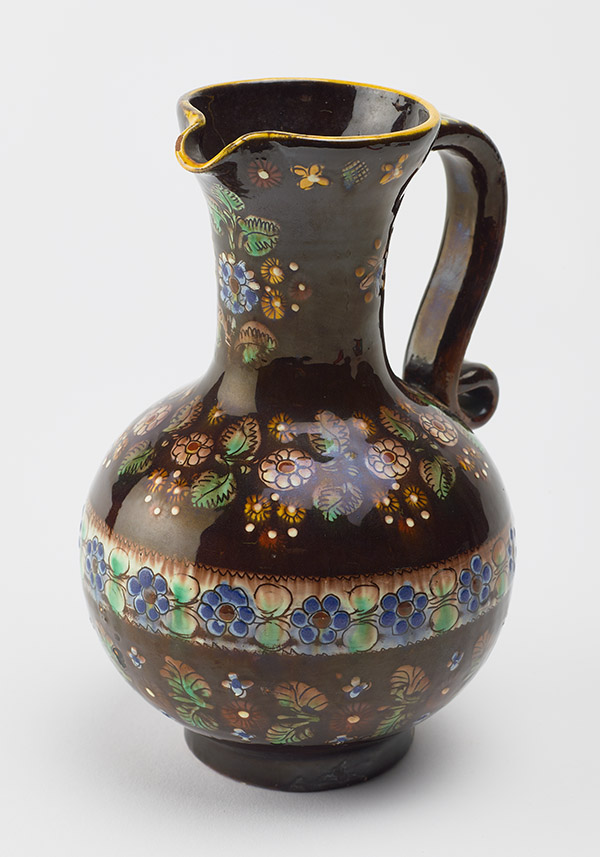
Jug from the Museum Allerheiligen in Schaffhausen (photo by Daniel Grütter).
Pottery made by Konrad Lenhard is housed at the Museum Allerheiligen, Schaffhausen (e.g. Rosina Lenhard’s slip trailers from 1895, Inv. H17499, and Inv. H6186, H17102, H17500, H17502-17507, H17690, H17691, H19681, H20287, H22984, H52002, H53203, H53204, H53206-H53209, H53211), at the Swiss National Museum in Zurich (Inv. LM-50236, 50237) and at the Reiatmuseum in Thayngen.
Konrad and Rosina had a son called Fritz, who also became a potter and who was still making pottery in 1915 at least (Moser 1979; Schiendorfer 1979, 8-9). Exactly when he ceased production is not known at this point in time.
Translation Sandy Haemmerle
References:
Moser 1979
Kuno Moser, Jakob Spühler, der Töpfer von Wil/Buchenloo, in: Mitteilungsblatt der Keramikfreunde der Schweiz 92, 1979, 9-11.
Schiendorfer 2017
Andreas Schiendorfer, Thaynger Keramik im Berner Oberländer Stil. THAYNGER Anzeiger, 14. NOVEMBER 2017.

