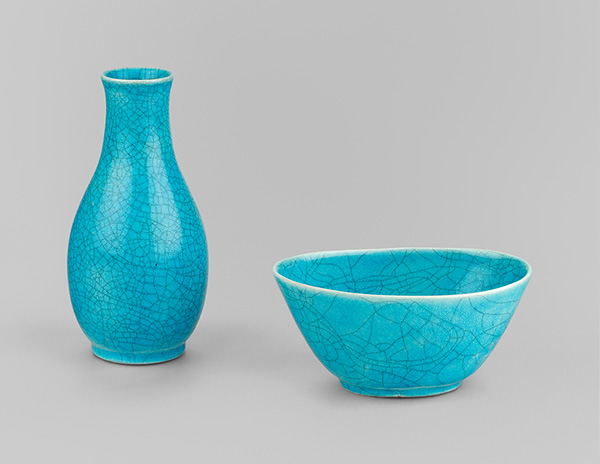
Pottery made by Fritz and Helen Haussmann in CERAMICA CH
Roland Blaettler, Andreas Heege 2021
Fritz Haussmann (1900–1968) and his Basel-born wife, Helene née Frey (1905–1989) set up the Atelier Alsiko in Niederuster, Canton of Zurich, in 1928. They had both learnt their craft in Germany. The business was initially registered in Fritz Haussmann’s name (Swiss Official Gazette of Commerce [SOGC], Vol. 46, 1928, p. 2351).
The first mark, consisting of a curved rafter, was registered on 16th February 1929 (SOGC, Vol. 47, 1929, p. 516). This mark was used throughout the entire lifespan of the studio, and at some stage the words “Haussmann Uster” were added (MHL AA.MI.1835 and 1838).
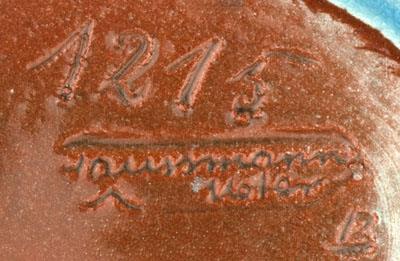
IA year later the couple decided to separate their property (SOGC, Vol. 48, 1930, 2634).
In 1933, the Uster architect Max Ernst Haefeli BSA was commissioned to draw up plans for a modern workshop building, along with a retail shop and an apartment (for a detailed report on the new building and the pottery see Das Werk 22, 1935, Heft 12, 397-406).
The Haussmanns’ range of simple, rational forms made a notable contribution to the modernisation of Swiss pottery for everyday use. In the couple’s mode of operation, Helen was in charge of the decorations and prepared glazes and enamels. Her training in western Germany at the “Keramikfachschule” [Ceramics school] in Höhr-Grenzhausen in the district of Westerwald, Rhineland-Palatinate had a big influence on her work.
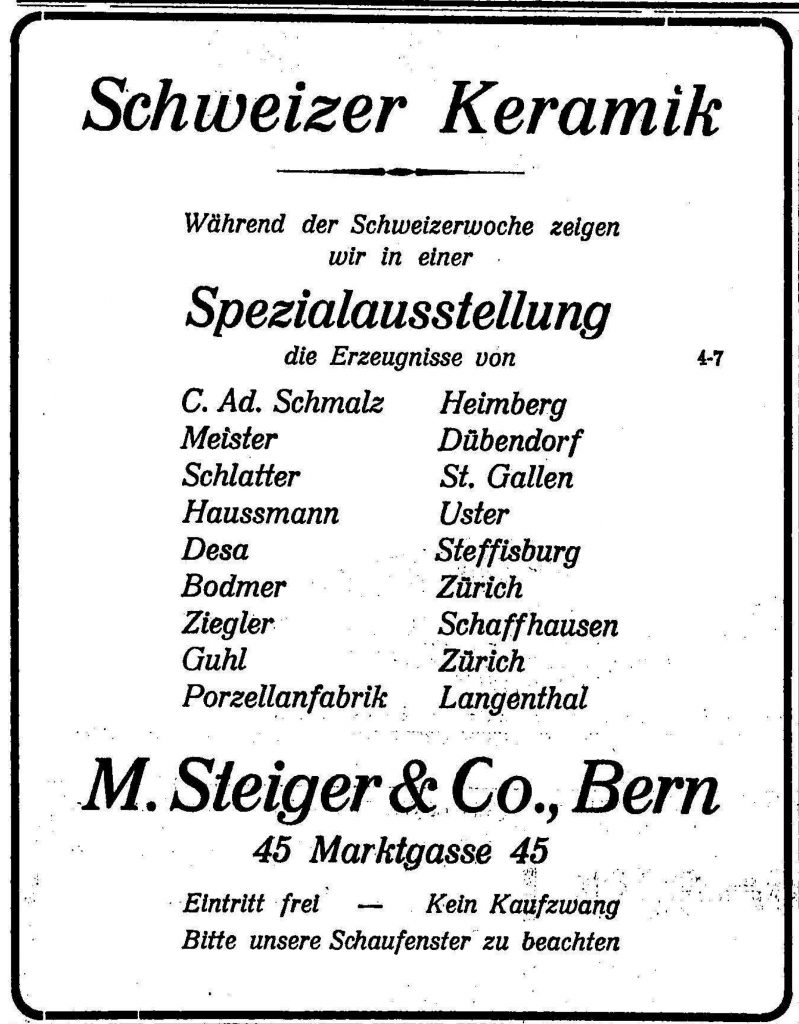

Several major household appliance stores (here Steiger in Bern and Kiefer in Zurich) were important retailers for the business (NZZ, 1935).
With technical support from the Haussmanns, renowned decorators, such as Berta Tappolet (1897-1947), Luise Meyer-Strasser (1894-1974), Cornelia Forster (1906-1990) and Martha Amata Good (1896-1950), created their ceramics at the workshop in Uster. In 1937 the couple joined forces with this group of artists to set up “Cornelius” at 3 Oberdorfstrasse in Zurich. The retail outlet became an important vehicle for the marketing and sale of their products.
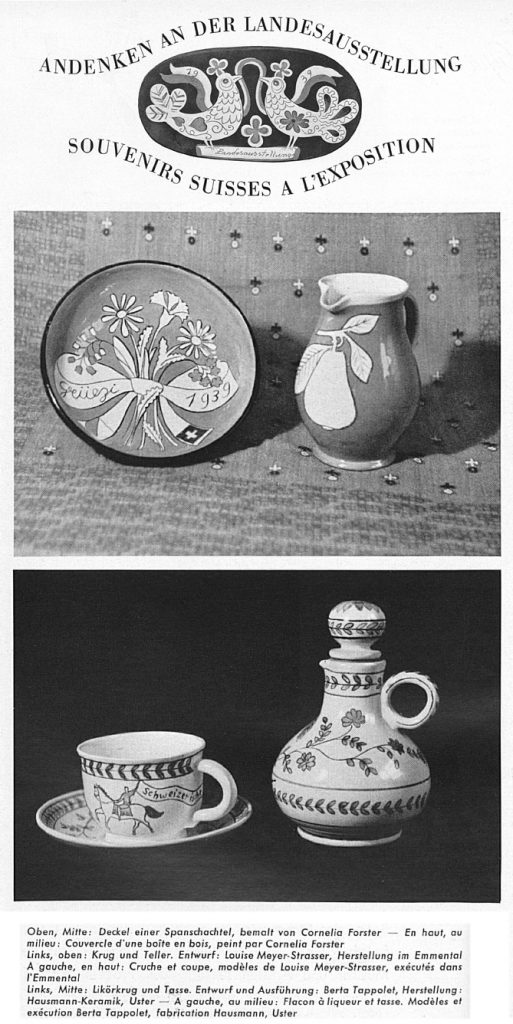
Ceramic souvenirs by Berta Tappolet/Fritz Uster could be admired at the Swiss National Exposition in Zurich in 1939.
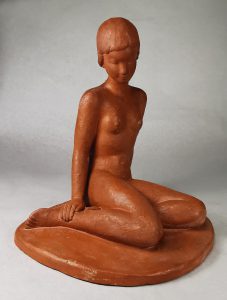
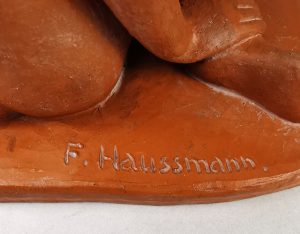
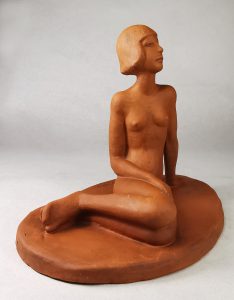
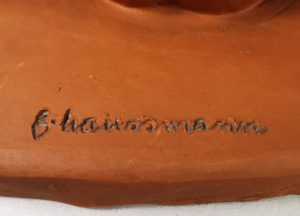
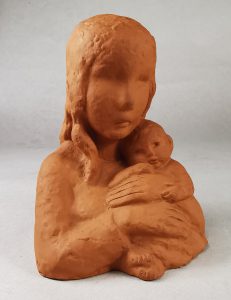
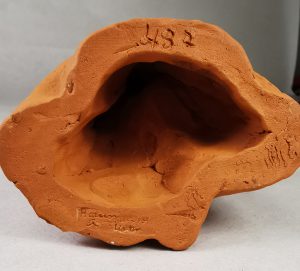
Signed figures by Fritz Haussmann, Uster. Top: statuette of a girl in the nude, height: 23 cm; middle: statuette of a girl in the nude, height: 18 cm; bottom: statuette of a mother and child, height: 12 cm (photos by Angello Steccanella)
From the 1940s onwards, Fritz Haussmann was considered to be one of the country’s finest innovators in art pottery. This was when he began to mainly use stoneware and high-temperature glazes (Das Werk/L’Œuvre 31, 1944, Fig. p. 359). In 1945, the business had a staff of approximately 15, including Ernst Fehr, who later taught at the School of Ceramics in Bern (Fehr 2003, pp. 8–10).
In 1946, the company name “Fritz Haussmann, Alsiko Werkstätte für Keramik” [Alsiko ceramic studio] was dissolved and taken over, with all debts active and passive, by his wife’s new company “Helene Haussmann, Alsiko Werkstätte für Keramik” (SOGC, Vol. 64, 1946, p. 235). The reason for this was that Fritz Haussmann had been deported by the authorities (10th October 1945 to 1957; repealed in 1962). Since 1937, he had maintained close ties with the NSDAP (Nationalsozialistische Deutsche Arbeiterpartei), an antiliberal, antisemitic and anti-Bolshevik political party. He was a member of the party from 1939 onwards (Fehr 2003, pp. 8–10; Schulthess 2017). Helene Haussmann and two of their children were allowed to stay in Switzerland. She continued to run the business, with support from master potter Biedermann and other members of management.
In 1978 the company name was permanently delisted (SOGC, Vol. 96, 1978, 2238).
Objects made by Fritz and Helene Haussmann can be found in the archive of the Museum of Design in Zurich.
Archive of the Zurich University of the Arts
The Swiss National Museum in Zurich has a number of their ceramics in its collection.
Translation Sandy Haemmerle
References:
Fehr 2003
Ernst Fehr, Mein Leben als Töpfer und Fachlehrer für Keramik, Toffen 2003.
Peter Schulthess 2017
Peter Schulthess, Keramische Werkstätte, Helen und Fritz Haussmann, 1928 bis 1968, in: Heimatspiegel, Illustrierte Beilage im Verlag von “Zürcher Oberländer”, August 2017, 58-63.

