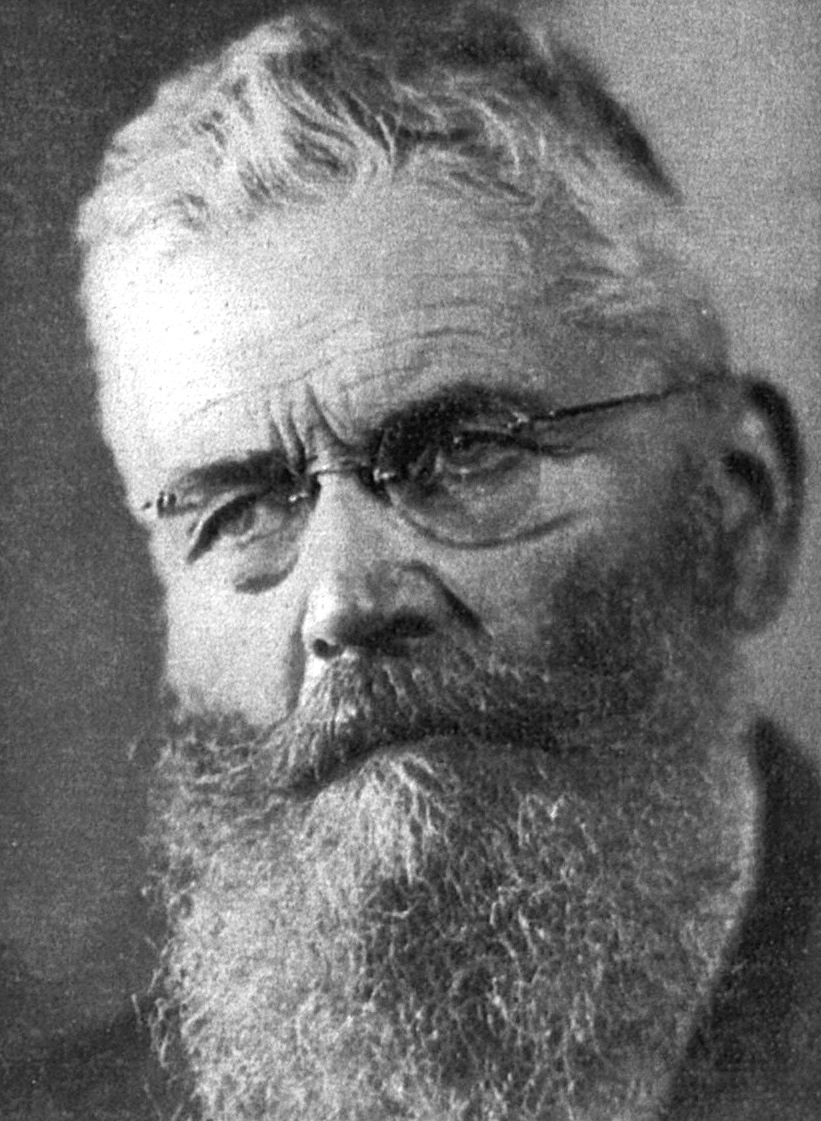
Andreas Heege, Andreas Kistler 2019
Paul Wyss (born on 12th December 1875 in Brienz; died on 29th April 1952 in Bern) was a Swiss painter, draughtsman, graphic designer and arts and crafts instructor. His life motto was “work while there is daylight” (Bohnenblust 2000).
Paul Wyss’s father Johann (1844–1887) was a secondary school teacher in Brienz and, during the heyday of tourism, specialised in creating herbaria of Alpine flowers as tourist souvenirs. When Paul was a little boy, he helped his father pick the flowers and discovered a love for observing plants.
In 1885, Johann Wyss was asked to join the editorial staff of the Emmenthaler Blatt newspaper in Langnau in the Emmental valley where he helped his cousin, Gottlieb Bracher, to maintain the handwritten mailing lists and addresses. He helped out the editorial team wherever needed. His son Paul, who by that stage was a secondary school student, also helped out whenever he could. He also got to know the pastor Ernst Müller and his family. Pastor Müller had a love of culture and the arts, which instilled in Paul a desire to become an artist. His father, on the other hand, warned him against taking on a job where he would struggle to make ends meet.
Paul Wyss duly trained as a primary teacher at the Hofwil Seminary and took over the running of the Ilfis Middle School in Langnau; he instructed the vocational students in Langnau in drawing and design and also continued his own studies, graduating as a secondary school teacher after three semesters. He subsequently attended the School of Applied Arts in Strasbourg where he was mentored by the German professor of arts and crafts, Anton Johann Nepomuk Seder (1850–1916) from Munich, a trailblazer in the floral Art Nouveau style and “reviver of Soufflenheim pottery”. Seder had taught there since 1890; before that, from 1878 to 1882, he had run the School of Applied Arts in Winterthur. His guiding principle was to “create the new in the spirit of the old”. His artistic creativity found expression in various reference books including “Die Pflanze in Kunst und Gewerbe” [Plants in art and crafts] (Seder 1886), “Das Thier in der decorativen Kunst” [Animals in decorative art] (Seder 1896) and other works aimed explicitly at the arts and crafts movement (Seder 1899, 1900, 1901). “Seder was one of the early theorists of Art Nouveau. He was of the generation that knew how to avoid imitating the conventional by studying nature and by replicating shapes borrowed from flora and fauna … He set new standards in artisanship by combining the classroom and the workshop with the aim of eliminating the distance between art and crafts, theory and practice, artist and craftsman. The demands of the Art Nouveau movement for an amalgamation between the artistic and the useful were thus fulfilled even at the training stage” (Richez 2009, 157 and 163).
In Strasbourg Paul Wyss discovered the crucial importance of studying nature and was introduced by Prof. Seder to the methods of stylisation that could be used to develop new types of decoration (Ball-Spiess 1987, 114-115; see also the laudatory piece on Wyss’s 60th birthday in “Die Berner Woche in Wort und Bild: Ein Blatt für heimatliche Art und Kunst, 25, 1935, 947-948). Seder quickly offered him a position as assistant professor. Paul Wyss, however, could not accept the precondition of having to become a German citizen and instead chose to return to Bern, where he continued to work as an art teacher. Back in Bern, he married Anna, the eldest daughter of pastor Müller, in 1900. She bore him two sons but died young in 1906. Paul Wyss remarried in 1909 and his second wife, Rosa Jenzer, bore him another son.
When Paul Wyss returned from Strasbourg in 1900, the Cantonal Museum of Applied Arts in Bern (established in 1869) hired him as an artistic advisor and instructor in drawing/design for artisans and craftsmen. In 1903 he began to offer vocational training, mainly to the potters from Heimberg and Steffisburg.
In 1906 he gave a lecture on “The spirit of the modern style” (Wyss 1906a) and in the same year he published a lecture on “The state, problems and elevation of the craft of pottery making” (Wyss 1906b).
Despite opposition from the authorities of the municipality of Heimberg, his endeavours finally led to the opening of a School of Pottery Making and Drawing in Steffisburg in August 1906, which remained open until 1921. Apart from Paul Wyss, the team of instructors included the art teacher Ferdinand Huttenlocher from Bern as well as Friedrich Ernst Frank, a ceramicist, draughtsman and graphic designer from Bern, who otherwise worked mainly for the Wanzenried Manufactory in Steffisburg (cf. Buchs 1980; Buchs 1988, 69-77).
In 1908, Oscar Blom, Director of the Museum of Applied Arts in Bern, published a detailed report on the efforts to improve the standards of pottery making in the Heimberg-Steffisburg region (Blom 1908). At the suggestion of Paul Wyss and based on Oscar Blom’s report, the Tagblatt der Stadt Thun newspaper also dealt with “The state of pottery making in Heimberg-Steffisburg-Thun” in a series of five articles published that same year.
The documents from a series of drawing classes as well as a small number of object photographs attest to the collaboration between Wyss and Frank in Steffisburg.
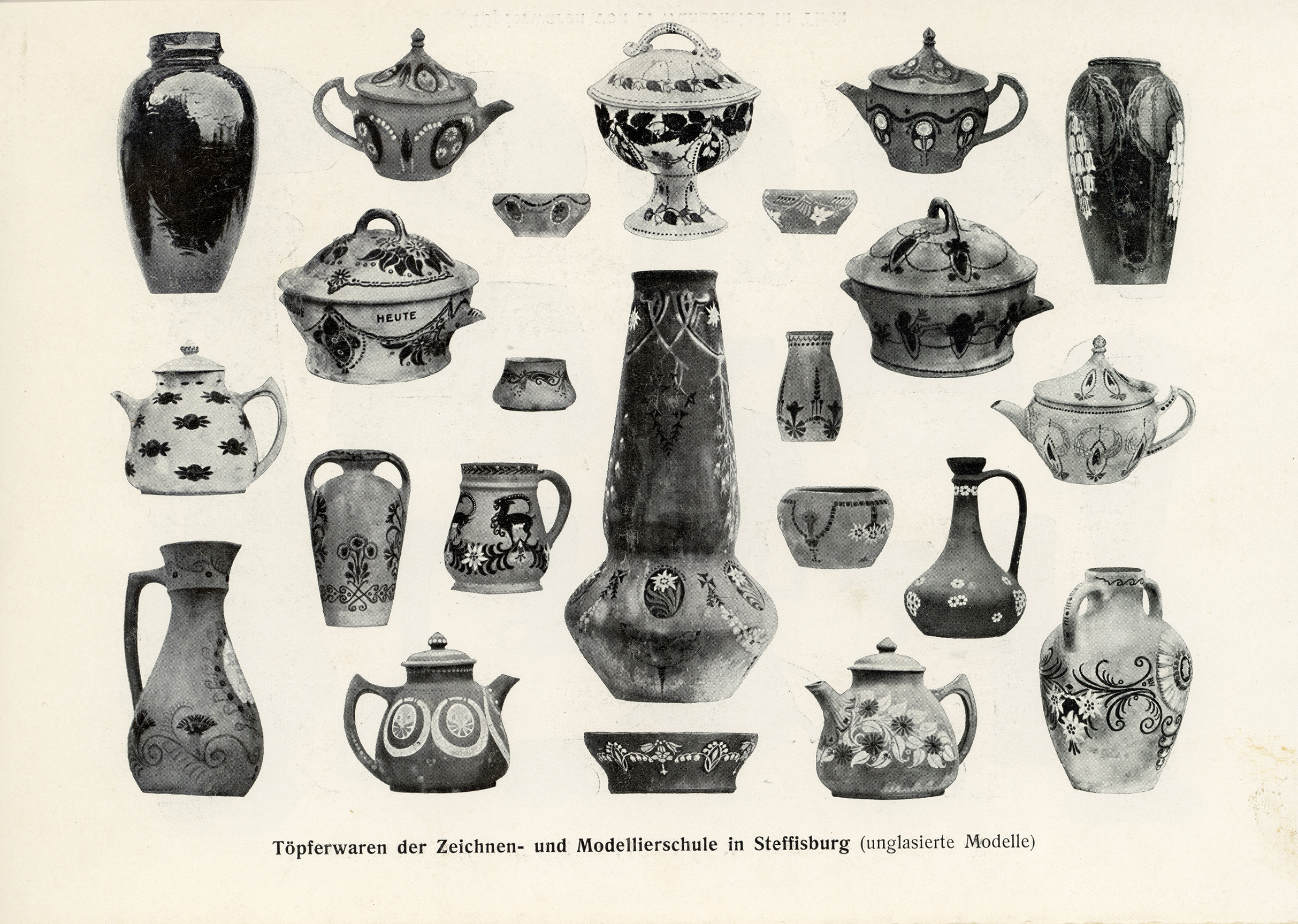
Pictures of the first successes achieved by the Steffisburg School in 1907 were published in 1908 in the Annual Report of the Museum of Applied Arts in Bern.
Wyss also wrote about the curriculum for the School of Pottery Making in Steffisburg and the graphic design skills taught there in an article in the “Blätter für den Zeichen- und gewerblichen Berufsunterricht = Revue suisse de l’enseignement professionnel 34 (1909), Nos. 9, 10, 12 and 18” published in 1909.
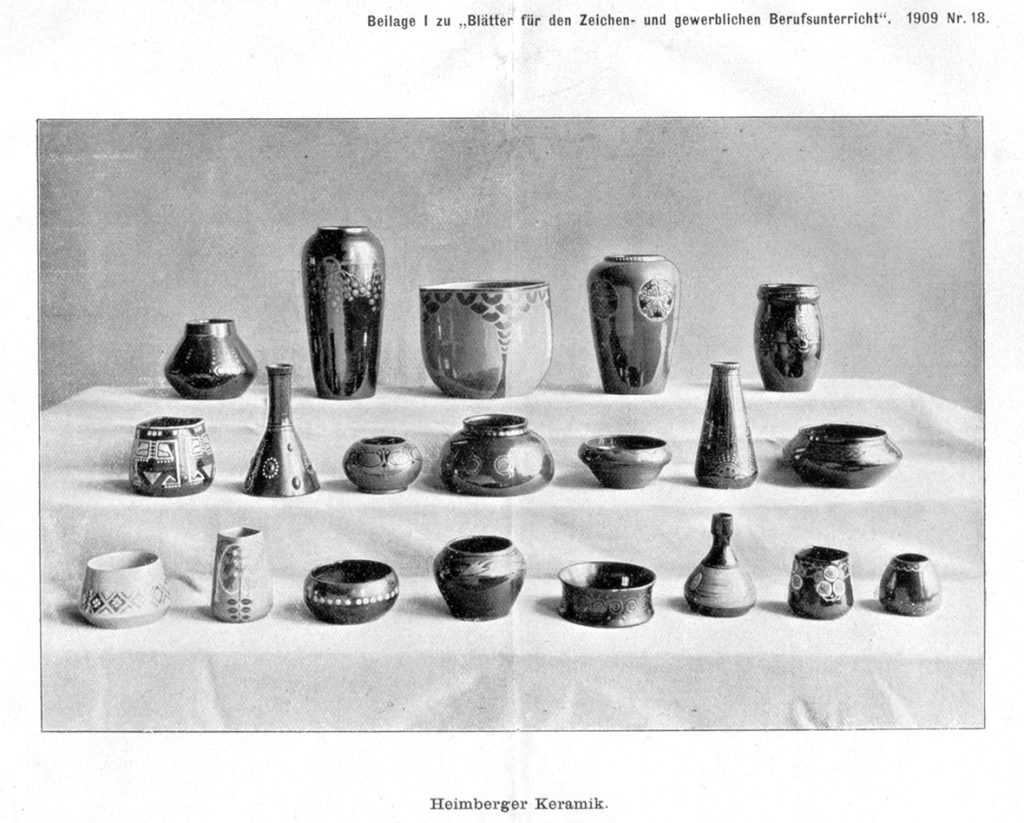
The paper included a picture of a selection of modern Heimberg ceramics intended to highlight the goals pursued by Paul Wyss.
From November 1909, Paul Wyss continued to instruct the potters and pottery paintresses in Langnau (drawing classes). A short profile published in celebration of his 60th birthday explicitly mentioned that potters from Langnau, Schüpbach, Grünenmatt and Oberburg had attended his classes (Messerli 2017, 93).
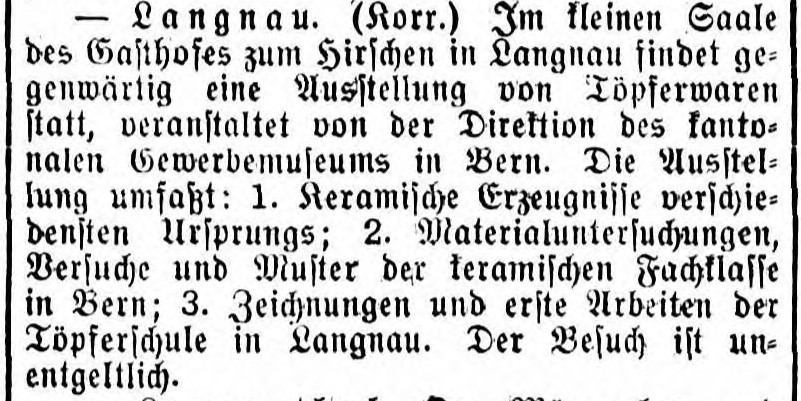
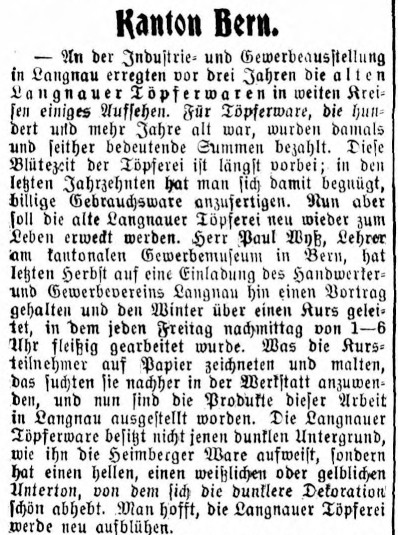
Intelligenzblatt der Stadt Bern 16th and 25th August 1910.
Unfortunately, no names are mentioned but, based on later contacts and products we can assume that these mainly included the workers, children, journeymen or masters from the Gerber workshop in Hasle, the Kohler workshop in Schüpbach, Mosimann in Oberburg as well as Röthlisberger, Aegerter and Werthmüller in Langnau (cf. Heege/Kistler 2017, table of potters).
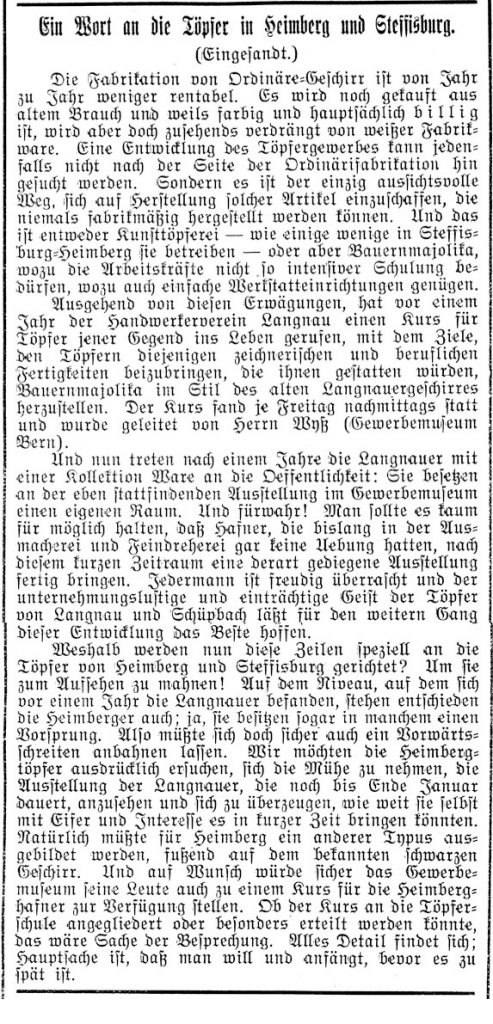
Geschäftsblatt des oberen Teils des Kantons Bern 57 No. 103 , 24th December 1910 with a reference to the Christmas exhibition at the Museum of Applied Arts in Bern.
The press reacted very favourably to the results of Paul Wyss’s efforts and held them up as a shining example to the Heimberg potters.
He also showed an interest in the wood carvers of Brienz, the lacemakers of the Lauterbrunnen valley, craft metalworkers, cabinetmakers, glass painters and graphic designers. He breathed new life into the craft of handweaving in Oberhasli and studied the many developments in Bernese traditional costume, which he helped to restore to its former glory and which he documented by creating a series of illustrations. As a consequence, Paul Wyss was a member of the steering committee for the founding of the Bernese Traditional Costume Association under the protectorate of the Bern Heritage Society in 1929 alongside Lina Bühler-Hostettler.
He created a postcard for the Swiss National Exhibition in 1914. Alongside the artist Rudolf Münger he sat on the judging panel for a souvenirs competition run by the bazaar committee of the National Exhibition (Schweizerische Metallarbeiter Zeitung 12, No. 28, 12th July 1913). He also presided over exhibition group 23: ceramics and glassware (Schweizerische Landesausstellung in Bern, Illustriertes Ausstellungsalbum, Bern 1914, 315).
He created motif templates used by many of Bern’s potters to paint their vessels. A large number of them have survived from the workshops of Friedrich Röthlisberger and Adolf Gerber in Langnau (Heege/Kistler 2017, 187–193).
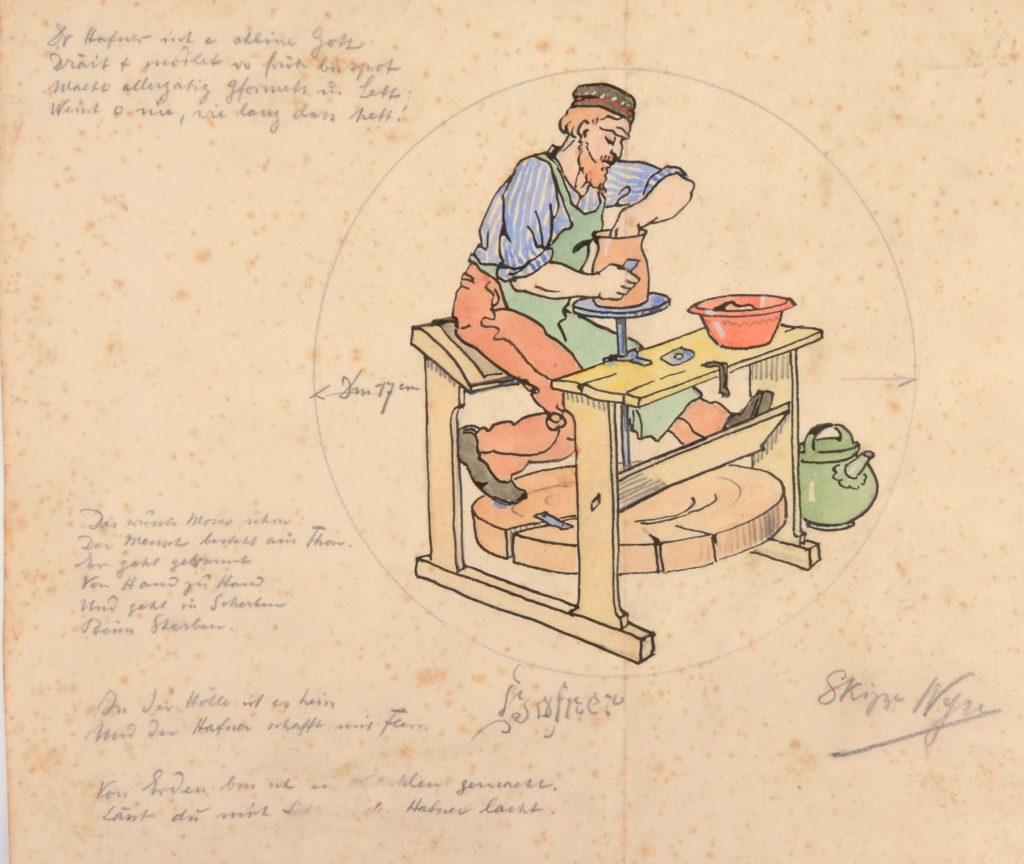
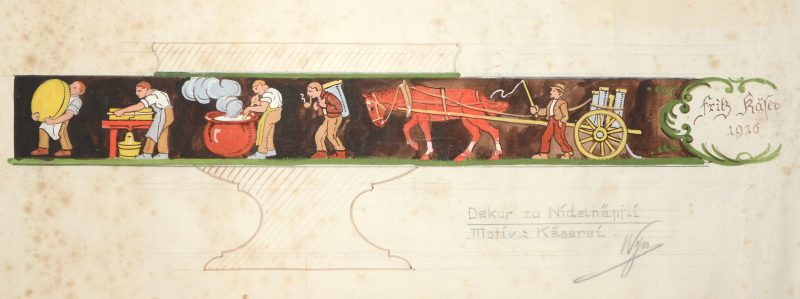
Paul Wyss maintained lifelong ties to the 40th Emmental Battalion. Mobilisation during the First World War brought him up to the Gotthard region with the 171st Fortress Infantry Battalion. He recorded his impressions and experiences from that period in several different drawings that were also printed. Outside of active service he also sat on the board of military marksmen in Bern. For many years, he volunteered on the parish council of the Church of the Holy Spirit and in community healthcare.
In 1918, Paul Wyss was appointed to the position of art teacher at the secondary school of Bern, where he taught until retirement age. In his spare time, he created a vast number of drawings, watercolours and oil paintings in the Bernese Oberland and Emmental regions, some of which were published in the Alpenhorn-Kalender and in supplements of the Emmenthaler-Blatt. Comical bear caricatures were among his favourite motifs.
As an artist, Paul Wyss designed posters, club flags, certificates and a range of illustrations for books and for his own publications. Some of his more notable illustrations were those for the books of his sister-in-law, the renowned writer Elisabeth Müller (1885-1977).
Paul Wyss died in Bern on 29th April 1952.
Translation Sandy Haemmerle
References:
Ball-Spiess 1987
Daniela Ball-Spiess, «Wie ist das Kunstgewerbe in der Schweiz zu heben und zu pflegen?» Der Beitrag von Nora Gross (1871–1929) zur ästhetischen Erziehung. Dissertation, Universität Basel, Bern 1987, besonders 114-115.
Blom 1908
Oscar Blom, Die Förderung der Majolika-Industrie in Heimberg-Steffisburg-Thun durch das kantonale Gewerbe-Museum in Bern, in: Jahresbericht pro 1907 des kantonalen Gewerbemuseums Bern, 1908, 1-9.
Bohnenblust 2000
Emil O. Bohnenblust, Der Berner Paul Wyss – sein Leben und Werk. Erinnerungen an einen gütigen Menschen und grossen Maler. Bärner Brattig, 2000, Nr. 4, S. 7 und 9.
Buchs 1980
Hermann Buchs, Die Thuner Majolika des Johannes Wanzenried und des Zeichners Friedrich Ernst Frank, in: Jahresbericht Historisches Museum Schloss Thun, 1980, 5-43.
Buchs 1988
Hermann Buchs, Vom Heimberger Geschirr zur Thuner Majolika, Thun 1988.
Heege/Kistler 2017
Andreas Heege/Andreas Kistler, Keramik aus Langnau. Zur Geschichte der bedeutendsten Landhafnerei im Kanton Bern (Schriften des Bernischen Historischen Museums 13), Bern 2017.
Messerli 2017
Christoph Messerli, 100 Jahre Berner Keramik
von der Thuner Majolika bis zum künstlerischen Werk von Margrit Linck-Daepp (1987-1983). Hochschulschrift (Datenträger CD-ROM), Bern 2017, besonders 87-95.
Richez 2009
Jean-Claude Richez, Städtische Kunstgewerbeschule Straßburg (1889–1914). Wegbereiter des Jugendstils oder Prüfstand der Moderne im Elsass, in: Dorothee Kühnel/Joanna Flawia Figiel/Elisabeth Gurock, Jugenstil am Oberrhein, Karlsruhe 2009, 154-163.
Seder 1886
Anton Seder, Die Pflanze in Kunst und Gewerbe, Wien 1886.
Seder 1899
Anton Seder, Kunstgewerbliches Skizzenbuch für Metall-Glas-Industrie und Keramik, Stuttgart 1899.
Seder 1900
Anton Seder, Die Kunstgewerbeschule Strassburg i. Elsass und ihre Entwicklung : Vorlagen für das Kunstgewerbe, Strassburg i. Elsass 1900.
Seder 1901
Anton Seder, Neue Bestrebungen im Zeichenunterricht, Straussberg 1901.
Wyss 1906a
Paul Wyss, Der Geist des modernen Stiles mit spezieller Berücksichtigung der Holzschnitzerei, in: Jahresbericht für das Jahr 1905 des Kantonalen Gewerbemuseums Bern 37, 1906, 40-46.
Wyss 1906b
Paul Wyss, Stand, Probleme und Hebung des Töpfergewerbes, Vortrag von Herrn P. Wyss, Zeichner am Gewerbemuseum Bern (Umschlag: Nach dem Vortrage von Hrn. P. Wyss … in Bern niedergeschrieben von Hermann Röthlisberger, Sel.-Lehrer in Steffisburg, No. 14-19 Oberländer Volksfreund Jhrg. 1 (Hrsg.), Steffisburg 1906.
Nachruf im Emmenthaler-Blatt vom 5. Mai 1952

