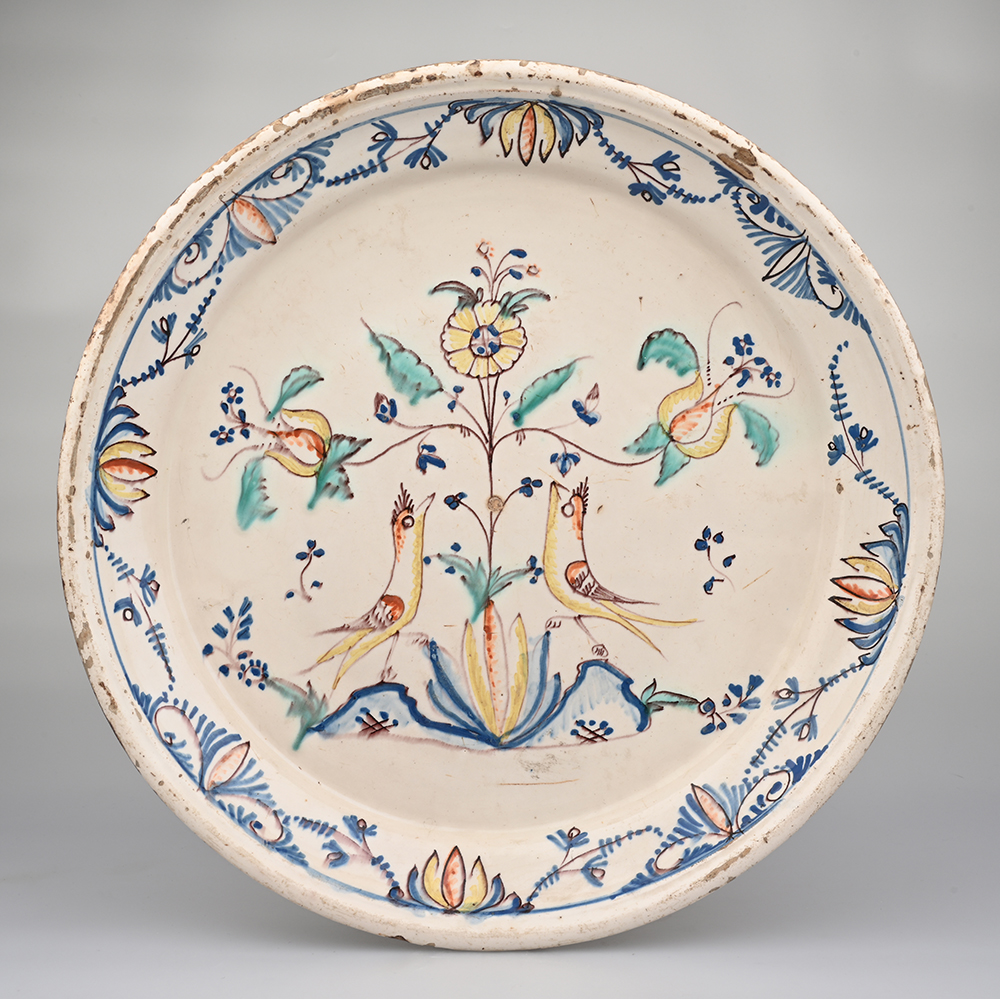
Pottery from Yverdon (Museum of Cultures, Basel, Inv. VI-59212)?
Roland Blaettler 2019
In 1765 the Trade Council of Bern launched an in-depth inquiry into the production of cookware in the Vaud region. This was in reaction to a petition submitted by local potters who were complaining about the drastic increase in imports of such vessels and who wished to decry the effect it was having on their business (see Schwab 1921, 23–25 for citations and comments). Because the results of the inquiry referred to more than just the category of cookware, they actually painted quite a complete picture of the pottery industry in Vaud. No fewer than seven potters worked in the city of Yverdon and its surrounding area at the time – according to Catherine Kulling this was the greatest concentration anywhere in the Vaud region (Kulling 2001, 33) – mainly producing “white tableware”. In terms of actual cookware (i.e. heat-resistant vessels), local potters claimed that they were not able to compete with the imported products.
As part of her research on 18th century tiled stoves from Vaud, Catherine Kulling also turned her attention to the stove fitters operating in Yverdon, especially to Jean-Albert Pavid (1710-1778) and Jacob Ingold (c. 1742-1816), who were among the most productive and most prominent specialists in their particular field in the Vaud region (Kulling 2001, 26-105). She ran with the theory proposed by Schwab (Schwab 1921, 25) that the potters who specialised in making crockery had mainly used the faience technique. Her support for this view was not only based on the Bern inquiry mentioned above, but also on a document that she had found in the city archive of Yverdon. It was a letter dated 1752 where local potters petitioned the city council to build a mill “for grinding the glazes needed to produce their ceramic wares, which are a type of faience” (Kulling 2001, 32).
If we take this text at face value, we must conclude that when the potters call their wares “a type of faience”, they mean that their products are similar to faience but are not made employing the actual faience technique. In our opinion, the “white tableware”, or at least most of the white tableware that was viewed as an Yverdon specialty in 1765, was earthenware with a coat of white slip, which was sometimes refined by adding underglaze brushwork decoration, in other words a more sophisticated version of slipped earthenware than what was usually available as everyday crockery. The technique that was used to make this white tableware (and in the production of tiled stoves) had long been established throughout the region and the resulting pottery was visually very similar to lead-tin glazed faience. The production of real faience, however, was more expensive and required a different expertise. Nevertheless, it is in some cases quite difficult to distinguish between these two types of pottery with the naked eye. The only regional examples of this type of pottery that have been firmly identified so far are the works of the , some 12 kilometres from Yverdon. The Swiss National Museum in Zurich has in its collection two signed shallow dishes with curvilinear rims dated 1795 (SNM LM-6212 and SNM LM-23403). A third, unsigned and undated dish is kept at the Musée Ariana in Geneva (MAG R 0136).
While compiling this inventory we found several examples of earthenware with a coat of white slip and brushwork decoration in the Cantons of Neuchâtel and Vaud, which could not be readily attributed to the pottery tradition in the German-speaking part of Switzerland or to any tradition from abroad either; some may well belong to the group of “white tableware” from Yverdon:
MAHN AA 1798; MAHN AA 1847; MAHN AA 1850; MAHN AA 1858; MAHN AA 2189; MAHN AA 2090; MM 2010; MPE 483; MAF No 1; MHL AA.46.B.36.
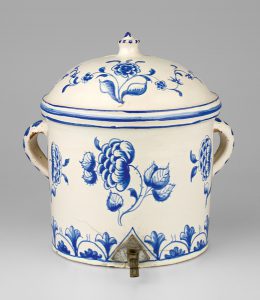
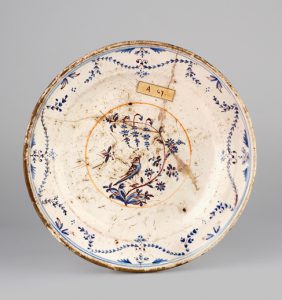
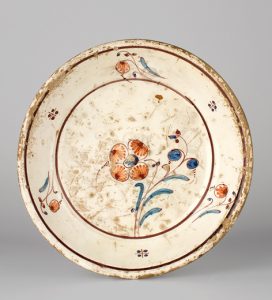
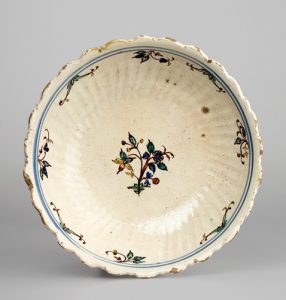
The Musée Ariana also has in its collection various objects, that could be added to this provisional category: MAG AR 11659; MAG G 0161; MAG R 0203, and the following examples could, in our opinion, also be consistent with the same group: MAG R 0146, MAG R 0202, MAG R 0205, MAG R 0206, FWMC C.1963-1928, MKW 382, SfGB 44, SMT 9641, SMT 9651, MKB HM-1888.0148.01, MKB VI-59211, MKB VI-59212.
While real, unadulterated faience (a type of earthenware with a lead-based white, opaque glaze) was produced in Yverdon, this was mainly in the form of stove tiles, as can be seen, for example, in the work of Jacob Ingold. When it comes to tableware, we only know of a single example of faience that can be attributed to a workshop in Yverdon: a shaving basin decorated with a shepherd motif dating from 1781, painted in high-temperature colours and signed by Jacob Ingold (SNM LM-23699 – Lissabon 1998, No. 96; Kulling 2001, Fig. 323). It is possible that Ingold, in addition to his work as a stove setter, also made crockery, but it is also possible that the famous shaving basin was more of an outlier and a relatively rare, and perhaps custom-made product.
In any case, the technique of producing lead-tin-glazed faience was well known in Yverdon, as attested to by a notice in the Feuille d’Yverdon dated 3rd January 1795 (p. 1), which tells us that a certain Monsieur Simond, a goldsmith’s dealer was offering for sale “a batch of fine English tin suitable for casting or for glazing in pottery production”.
In 1791, a potter by the name of Jean-François Ecoffey presented his idea of building a “faience factory” on municipal land to the authorities of Yverdon. They appear to have been interested in the positive effect this new piece of infrastructure could have on their town and, not long thereafter, purchased a plot on Chemin du Cimetière in the suburb of Notre-Dame. Construction of the facility was completed in 1792 and Ecoffey was the first tenant. His tenancy, however, was terminated in 1796 (Kulling 2001, 33), as his endeavours obviously did not live up to the town’s expectations. During the discussions about a possible sale of the studio in 1809, the authorities were recorded as stating that “ever since its construction, the building has been more costly than profitable” (Deonna 1937, footnote 5). Did Ecoffey even produce real faience? Officials spent several years trying to find a new tenant, who would be able to run their faience factory.
The Rieff Faience Manufactory, 1811–1847
Having heard about this opportunity, François Rieff (1767–1838), a faience manufacturer from Poppelsdorf (now a district of the city of Bonn in North Rhine-Westphalia), contacted the authorities in early 1809 citing his intention of purchasing “the faience factory house and garden”. It is highly likely that Rieff had learned his craft at the Poppelsdorf Faience Manufactory founded in 1755. During her research, Catherine Kulling discovered that, prior to his arrival in Yverdon, he had spent several years in Nyon (Kulling 2001, 33, footnote 56). Did he perhaps work at the Baylon Faience Factory? Regardless of Rieff’s background, the town officials did not hesitate to accept his offer, as they were of the opinion that “the industry this citizen could bring to the town would be useful and beneficial”. Does this wording not suggest that the manufacture of faience tableware would have been a novelty in Yverdon? It took the cantonal government almost two years to grant permission but in February 1811, the sale was finally completed (Deonna 1937, footnotes 5 and 6).
The faience factory appears to have blossomed under the new ownership. In 1819, François Rieff, his wife Jeanne née Charbonnet and their three children, two boys and one girl, were granted Yverdon citizenship. In its statement of grounds, the town council highlighted the “active, industrious and orderly” behaviour of the candidate as well as “the type of useful industry he is engaged in” (Deonna 1937, footnote 7). One of François’s sons, Charles-Abraham (1795–1869), married Françoise Henriette Roulet (died in 1872), and was also mentioned in municipal records as a faience manufacturer (Deonna 1937, footnote 8). We do not know the dates of birth and death of his brother Joseph, who was related by marriage to Peytignet (?), but we assume that he was the eldest. Otherwise, we know that he emigrated to America and not far from New York (Crottet 1859, 644).
Researching the local newspapers brought to light a few additional pieces of information about the family and about François Rieff’s faience factory. In 1826, Rieff ran several newspaper advertisements stating that he was “manufacturing “chauffe-pences” [sic], and all types of stove [and that he] was also willing to repair stoves. Like before, a complete range of faience tableware and good-quality cookware was available” (see e.g. the Feuille d’avis d’Yverdon newspaper dated 1st July 1826, 2). The “chauffe-panses” [modern spelling] mentioned by Rieff were relatively small indoor open fireplaces. The term was commonly used in France and in some areas of the French-speaking part of Switzerland, although Emmanuel Develey believed it to be typical of the Vaud region and incidentally called it “ridiculous” (Develey 1824, 23). We can therefore assume that the stoves advertised by Rieff were relatively small and perhaps portable devices that could be inserted into open fireplaces to effectively turn them into more practical, efficient and safe heating appliances.
A few years later, Joseph Rieff also placed an advertisement in which he called himself a “stove setter, currently working freelance” and offered his services in manufacturing or assembling stoves. At the time he lived with his mother-in-law on “la Place”, in the home of Monsieur Bourgeois (Feuille d’avis d’Yverdon dated 19th September 1829, 2). This shows that Joseph too had learned the craft, possibly in his father’s workshop, before he became self-employed around 1829. A year later, we learn that he had taken over the business of Jacob Mébold, “consisting of groceries, meats, Bernese flour, semolina, barley from Ulm and other products that cannot all be listed in detail”. Joseph also sold “a range of cookware and more” and he announced that he would move into the ground floor of the house owned by the heirs of the Benoit family on Rue du Milieu and that he would continue to manufacture and repair tiled stoves (Feuille d’avis d’Yverdon dated 12th June 1830, 2). A few months later, Joseph Rieff, “grocer”, announced that, as well as the usual groceries, he had just received “a range of refined white earthenware (terre de pipe) from Carouge” and that he was selling “a good selection of cookware from Thun and from other places”. His services as a stove setter, however, were no longer mentioned (Feuille d’avis d’Yverdon dated 18th September 1830, 2).
As attested to by several signed objects, his brother Charles worked with their father, probably until the latter’s death in 1838. A short article published in 1937 by Waldemar Deonna suggests that the business may have closed down after François’ death, but we now know this was not the case. It was obviously taken over by one of the sons, but not, as one would have expected, by Charles, but rather by Joseph. A notice from 1844 put the apartment on the first floor of the faience factory up for rent. Interested parties were asked to contact the “owner”, Joseph Rieff (Feuille d’avis d’Yverdon dated 16th November 1844, 4).
It is quite probable that Joseph continued to produce his ceramics in his father’s faience factory. Advertisements from 1840 read: “Joseph Rieff, faience manufacturer, is in a position to produce all kinds of cookware and other types of pottery, which can now be purchased from him, either wholesale or retail; furthermore, he continues, as before, to manufacture portable stoves made from brick etc.” (Feuille d’avis d’Yverdon dated 22nd February 1840, 1). To confuse matters, there was a certain Henri Rieff, who was also calling himself a “faience manufacturer”, and was at the same time running similar advertisements: “H. Rieff offers a range of cookware and other types of pottery, wholesale or retail; as before, he continues to produce portable and other kinds of stoves. He will do his best to serve any customers who honour him with their trust to their utmost satisfaction.” (Feuille d’avis d’Yverdon dated 1st February 1840, 1–2). A month later, Henri was more specific when he called himself a “faience manufacturer in the district of Notre-Dame” (Feuille d’avis d’Yverdon dated 28th March 1840, 2). Henri was probably one of Joseph’s sons and was offering the same services in the same premises. Was the father possibly preparing the ground for his son so that he himself could retire from the business?
The notices in the Feuille d’avis, many of which offer one of the apartments in the faience factory building for rent, attest to Joseph’s presence in Yverdon at least until October 1845. The issue dated 10th October that year (p. 2) offers for sale a “tiled stove” and asks any interested parties to contact Joseph Rieff at the faience factory. After that date and up to the spring of 1847, Henri was consistently identified as the person to contact in respect of the faience factory (Feuille d’avis d’Yverdon dated 17th April 1847, 4). Subsequently, Henri too disappeared from the record. Did he perhaps follow his father across the Atlantic?
Based on the information provided, we can assume that Joseph emigrated to North America between the winter of 1845 and the early part of 1846. He settled in Carthage (in what is today New York state?), where he appears to have opened up a new pottery business. This, at least, is what a notice in the Feuille d’avis d’ Yverdon dated 15th April 1848 (p. 3) suggests: “We are looking for 2 or 3 good throwers for a pottery business in Carthage in North America. Your travel expenses will be paid if you agree to work for a certain length of time. Please contact Charles Rieff-Roulet, La Plaine in Yverdon”.
After Henri had left, Joseph’s interests in Yverdon were represented by his brother Charles. Following the death of their father, Charles Rieff-Roulet had changed profession as we can see from a notice that was published in early October 1840. “Charles Rieff-Roulet is honoured to inform the public that his business in the building of Monsieur Ellenberger in La Plaine offers cleaning brushes and cloths in various sizes, wholesale or retail, a nice selection of pipes, many other items and a wide range of groceries […]” (Feuille d’avis d’Yverdon dated 3rd October 1840, 1).
In June 1847 – i.e. after Henri’s presumed departure – the apartments in the faience factory building were offered for rent, most notably “An apartment on the ground floor […] In addition to this accommodation, the contract includes the complete equipment and all the tools necessary to manufacture tiled stoves or stoves, a mill for grinding glazes and the right to extract approximately 30 cartloads of clay annually from a piece of land owned by Joseph Rieff, for use in the factory. To arrange a viewing, one may contact Ch. Rieff-Roulet, in La Plaine” (Feuille d’avis d’Yverdon dated 3rd June 1847, 4). This shows that Joseph was still the owner of the faience factory at that time. Presently, we do not know if the workshop later continued to operate.
What we do know is that in October 1849 the property and its outbuildings were put up for sale: “On Monday, 22nd October […], a representative of Joseph Rieff, who is currently residing in America, will sell at auction the buildings in Yverdon that are known as the Faience Factory, along with a field of 244 Klafter in size near Montagny, known as “à la Malirausaz”. Furthermore, a large amount of pottery is being stored in the faience factory buildings and these will be sold at a reduced price. Please contact Monsieur Charles Rieff-Roulet or Monsieur Correvon-Pavid, notary in Yverdon” (Feuille d’avis d’Yverdon dated 13th October 1849, 1).
This ends the history of the faience factory, which was taken over (or even started up?) by François Rieff in 1811. François ran the business together with his son Charles until he died in 1838. The business was then taken over by his second son Joseph, who up to that point had run his own workshop in Yverdon. In all likelihood, Joseph formed a partnership with his son Henri before he emigrated to America in late 1845 or early 1846. Henri stayed on in the faience factory, running it on his own at least until April 1847. After that, his name no longer appears in any of the newspaper notices relating to the building, and it is possible that he followed his father to America. The building, complete with the “factory”, was put up for rent from June 1847 and sold in October 1849.
Even though the company was in operation for more than 35 years, we know of only a few objects that can be attributed to the Rieff workshop; furthermore, all these valuable pieces of evidence only pertain to the era of François Rieff, i.e. mainly to the period between 1825 and 1834.
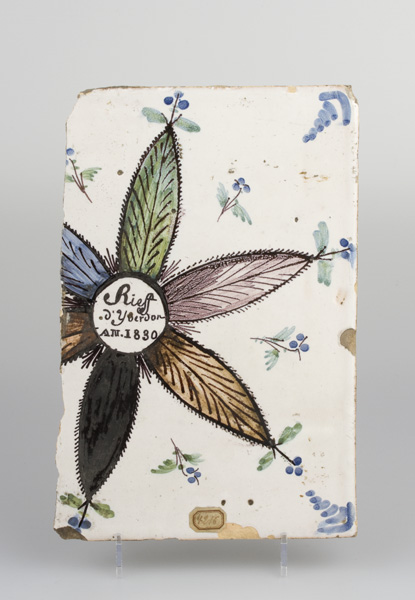
The products that are most often mentioned in the newspaper notices are stoves and tiled stoves. The Museum of Yverdon, in particular, has in its collection a stove tile decorated with a polychrome pattern painted in high-temperature colours (blue, purple-black, green, purple and brown), signed and dated “Rieff d’Yverdon AN 1830” (MY EPM.C.1).
The National Museum in Zurich has a frieze tile with a polychrome decoration consisting of flowers, leafy twigs and a heart motif, signed and dated “François Rieff 1811” (SNM LM-50507 – Jahresbericht, vol. 81, 1972, 58).
We can assume that many of the stoves, in particular the portable stoves (and especially the “stoves for chauffe-panse”) were probably undecorated.
As for the faience tableware made by the Rieffs, the Musée Ariana has in its collection an oval dish with a curvilinear rim measuring 510 mm in width and 252 mm in depth, signed “Cs. Rieff d’Yverdon / 1834” on the back (MAG AR 00947 – Deonna 1937, Fig. p. 367). The well of the dish is decorated with a rather naïve depiction of a large fish (perhaps a pike?) and the lip has a wreath of leaves and small flowers consisting of three dots; the entire decorative scheme is a monochrome purple painted in high-temperature colours.
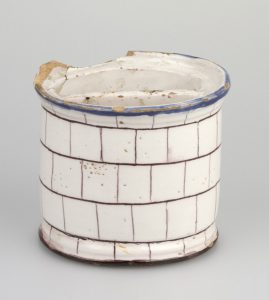
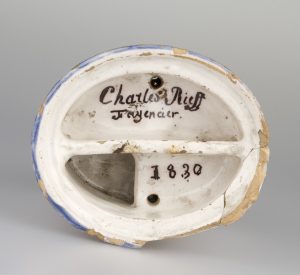
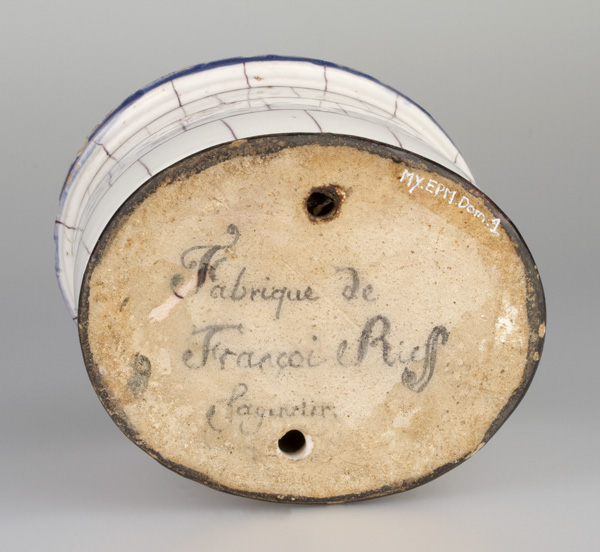
The collection of the Museum of Yverdon contains an object whose function is something of an enigma. It is a vessel in the shape of an elliptic cylinder with the upper part quite obviously missing (MY EPM.Dom.1). Its interior is divided into two sections, one of which is again divided into two levels. Both the decoration of the object and its shape are reminiscent of a miniature kiln. Is this a model of a kiln or an ink stand? The question must remain unanswered. The vessel has a double mark. The mark in the interior reads “Charles Rieff / Fayencier / 1830”, while the mark on the base refers to the factory owner: “Fabrique de Françoi Rieff / Fayencier”.
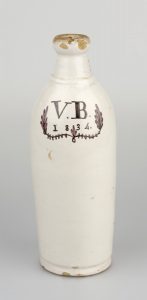
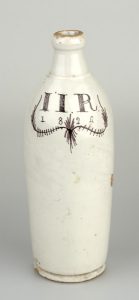
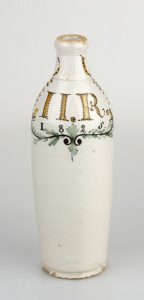
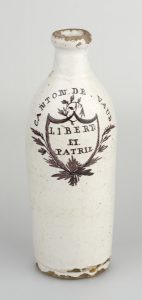
Otherwise, most known vessels are of a type that appears to have been a speciality of François Rieff: slightly bellied to elongated bottles with short necks and high handles. They are strongly reminiscent of stoneware Westerwald bottles which were filled with mineral water and imported into Switzerland in large quantities from the end of the 17th century onwards (e.g. MHV 2898-2; MHL AA.46.E.2; MHL AA.46.E.3 – see also Heege 2009, 57–75). Almost all of the bottles from Yverdon bear dates ranging from 1824 to 1834 and the majority are painted with the initials of the recipient. In most, the decoration is painted in purple-brown and is limited to the initials and the date underlined by two stylised leafy branches that cross each other (MY EPM.Alim.18; MY No. 2; MY No. 1). In some cases, there are no initials but instead there is a more elaborate motif such as the coat of arms of the canton (MY EPM.Alim.16) or municipality (MY EPM.Alim.19). A polychrome version of this reduced form can be found on a bottle dated 1825 (MY EPM.Alim.17).
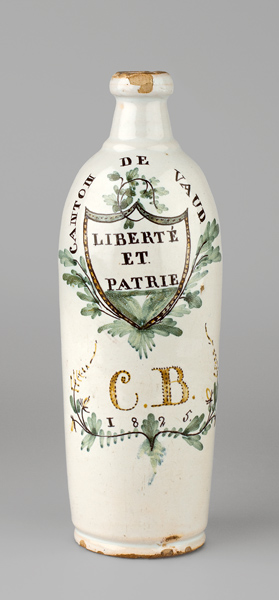
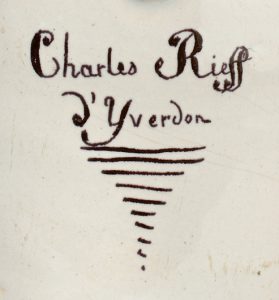
The Museum of Art and History in Neuchâtel has one example in its collection, which is also dated 1825 and which has a particularly elaborate polychrome decoration consisting of the coat of arms of the canton, the initials “CB” and the crossed branches mentioned above. To emphasise the unusual style of the work, Rieff placed his mark “Charles Rieff d’Yverdon” on the back of this vessel (MAHN AA 2173).
The question of what exactly these bottles made by François and Charles Rieff were used for, remains unanswered. Were they used for wine, or for schnapps or perhaps for mineral water? Two of the examples, MY No. 1 and MY No. 2, bear the same initials but different dates. One is tempted to associate the initials with a winegrower or distiller and interpret the dates as vintages. When the two objects were gifted to the collection, they came with a note that said they came from Paul Wüst in Morges (1898 to c. 1990), who was said to have owned several dozen of these bottles. According to their former owner, they had been used as wine bottles.
We know that François Rieff’s successors, i.e. his son Joseph and his presumed grandson Henri, produced stoves and probably tiled stoves. The fact that the notice which was published when the faience factory was put up for sale in 1849 mentioned “a large amount of pottery” which was being “stored in the faience factory buildings” and would be “sold at a reduced price”, suggests that the production of tableware did not completely cease when François died in 1838.
Sources:
Press from the Canton of Vaud, accessed via the “Scriptorium” website of the Cantonal and University Library in Lausanne.
Translation Sandy Haemmerle
References:
Crottet 1859
A. Crottet, Histoire et annales de la Ville d’Yverdon depuis les temps les plus reculés jusqu’à l’année 1845. Genève 1859.
Deonna 1937/3
Waldemar Deonna, «Faïencerie d’Yverdon». Revue historique vaudoise 45, 365-370.
Develey 1824
Emmanuel Develey, Observations sur le langage du Pays de Vaud, seconde édition. Lausanne 1824.
Heege 2009
Andreas Heege, Steinzeug in der Schweiz (14.–20. Jh.). Ein Überblick über die Funde im Kanton Bern und den Stand der Forschung zu deutschem, französischem und englischem Steinzeug in der Schweiz. Bern 2009.
Kulling 2001
Catherine Kulling, Poêles en catelles du Pays de Vaud, confort et prestige. Les principaux centres de fabrication au XVIIIe siècle. Lausanne 2001.
Lisbonne 1998
Cerâmica da Suíça do Renascimento aos nossos dias. Ceramics from Switzerland, from Renaissance until the Present. Cat. d’exposition, Museu Nacional do Azulejo, Lisbonne, 23 juillet-4 octobre 1998.
Schwab 1921
Fernand Schwab, Beitrag zur Geschichte der bernischen Geschirrindustrie. Schweizer Industrie- und Handelsstudien 7. Weinfelden/Konstanz 1921.

