Roland Blaettler 2019
Keramik der Céramique d’Yverdon AG in CERAMICA CH
The company “Céramique d’Yverdon” was set up in September 1944 as a limited liability company (LLC). Founded by Jacques Blanc, Charles Bonzon and Gustave Delisle, its purpose was to produce and sell ceramic objects. The company was registered at 18 Avenue de l’Hippodrome (Swiss Official Gazette of Commerce [SOGC], Vol. 62, 1944, 2227).
The three partners in the business not only provided the capital for the new company; they also contributed “machinery and goods” (ibid.). Before the Yverdon venture, Blanc, Bonzon and Delisle had already been acquainted with the pottery industry, as they had all worked at the tile factory in Thayngen (Canton of Schaffhausen), probably in the art pottery workshop that had been installed there in the mid-1920s. Contrary to the “romantic” version of the story later recounted by Charles Bonzon (see the references below), it was not the destruction of the factory in Thayngen by American bombers on 25th December 1944 that led the three ceramicists to return to Yverdon. They had, in fact, set up their company three months prior to that dramatic event.
In June 1946, a public limited company (PLC) called “Céramique d’Yverdon S.A.” was set up. Apart from operating the “Céramique d’Yverdon S.à.r.l.” (LLC), the public limited company (PLC) reserved the right to hold shares in other companies and to acquire or set up similar or comparable companies (SOGC, Vol. 64, 1946, 2057). All three partners became shareholders and together they formed the first board of directors. In September 1946, the LLC was suspended and its assets and liabilities were taken over by the public limited company. Blanc resigned from the board of directors in 1950, followed by Delisle in 1951, leaving Bonzon as the sole remaining partner on the board. Gustave Delisle (1922–1990) held on to his shares and continued to work for many years in the workshops of the Céramique d’Yverdon; Jacques Blanc (1920–2015), on the other hand, went back to Thayngen, where his name was mentioned in the context of rebuilding the pottery workshop, which was renamed “Tonwerke Thayngen AG” [Thayngen Ceramic Works] (Schiendorfer 2017).
In April 1971, the District Court initiated bankruptcy proceedings against the Yverdon company, which in its heyday had employed up to 22 workers, and it was eventually dissolved (SOGC, Vol. 89, 1971, 1088). Like other factories of its kind, the small crafts enterprise fell victim to rationalisation and assembly-line work, which was standard in rival companies abroad (Tribune de Lausanne – Le Matin dated 7th September 1971, 5).
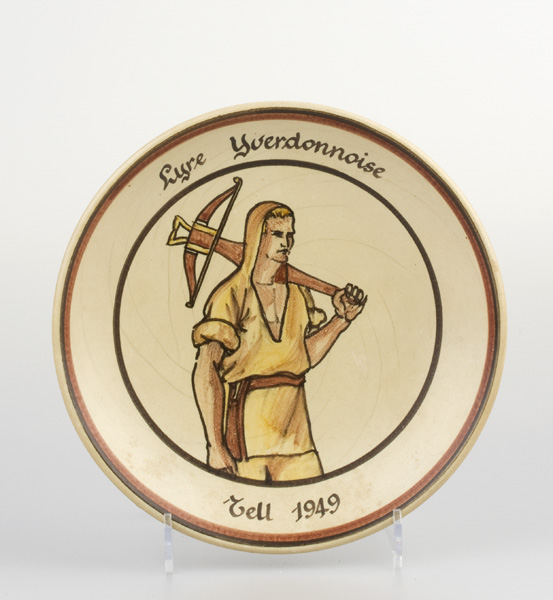
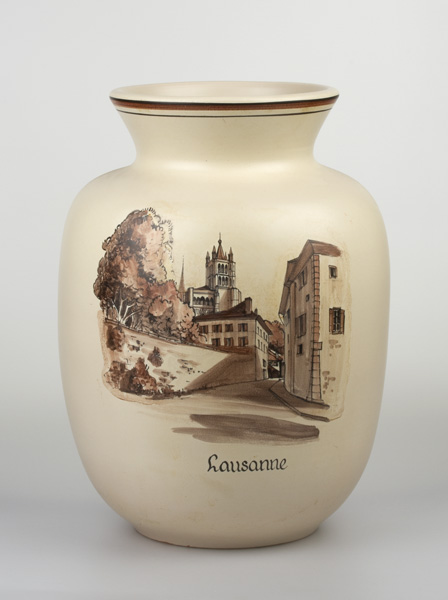
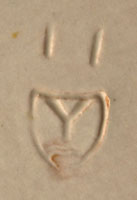
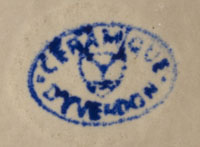
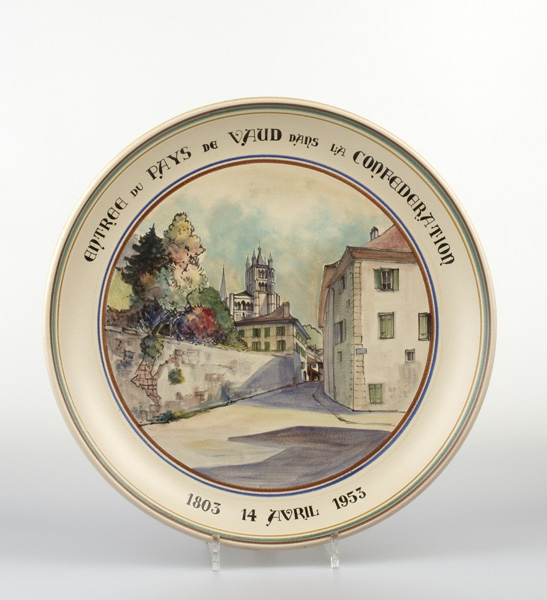
During the twenty-seven years of its existence, the company used a semi-industrial production method to make containers for everyday use and/or decorative purposes (casting and turning in addition to the traditional technique of throwing). To the naked eye at least, the products looked like lead-tin glazed faience and were decorated with glazes applied by aerograph or brush. Some decorations were in-glaze painted, while others were screen-printed. Like other similar companies at the time, the Céramique d’Yverdon also made commemorative objects (MY EPM.Art.13, MY EPM.Alim.213, MY EPM.Art.40), for example to celebrate the 150th anniversary of the Canton of Vaud joining the Swiss Confederacy (MY EPM.Art.19, MY EPM.Art.18).
Other classic products included articles for advertising purposes, family coats of arms and awards or prizes, mainly for sports clubs. The company supplied wholesalers throughout both the French and the German speaking parts of Switzerland, as attested to by an illustrated advertisement taken out by the Gonset department store in Yverdon (Journal d’Yverdon dated 28th March 1956, 9).
As suggested by a comment in a report on a local art exhibition in the Journal d’Yverdon in 1946, the Céramique d’Yverdon occasionally dabbled in art pottery production: “We should also mention in passing a number of works of exceptional quality made by the Céramique d’Yverdon group. A large decorated green vase, whose turquoise colour is happily interrupted by drawings that are reminiscent of the best Barrault was particularly beautiful; two large bowls with smoke-coloured decorations, a domino bowl with a Picasso motif…” (issue dated 22nd November 1946, 7).
Various ceramicists that later became well known at a regional or national level, worked at Céramique d’Yverdon at some stage in their careers, either as apprentices or as paid employees: Willy Dougoud (born in 1937), André Bioley (1926–1987), Roger Equey (1930–2018).
Translation Sandy Haemmerle
Sources:
Press from the Canton of Vaud, accessed via the “Scriptorium” website of the Cantonal and University Library in Lausanne.
Swiss Official Gazette of Commerce, accessed via the website e-periodica.ch.
References:
«Visite à la Céramique d’Yverdon». Journal d’Yverdon du 29 juillet 1969, 1 et 6 [interview de Bonzon] et «Céramique S. A.: Trois fondateurs». Journal d’Yverdon du 31 juillet 1969, 6 [rectificatif par Delisle].
«Theodor Schaefle-Zündel» [nécrologie du directeur de l’Aktiengesellschaft der Ziegelfabriken Thayngen und Rickelshausen]. Mitteilungen der Naturforschenden Gesellschaft Schaffhausen 23, 1949/50, 323.
Schiendorfer 2017
Andreas Schiendorfer, Thayngens Beitrag zu moderner Kunstkeramik. Thaynger Anzeiger 3/48, 5 décembre 2017, 5 et 7.

