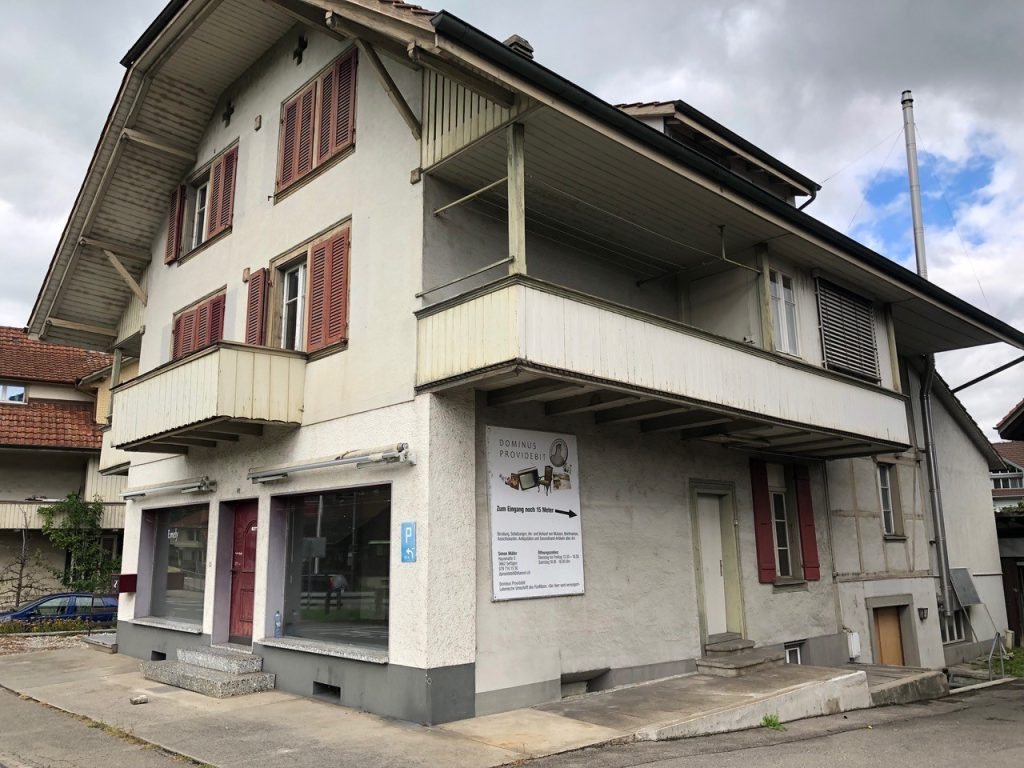
Seftigen, 5 Hausmattweg, September 2023. The workshop was located in the extension to the building (photo by Heidi Meer, Seftigen)
Pottery made by Hans Schneider in CERAMICA CH
Andreas Heege, 2023
From 1941 to 1943, Hans Schneider (1923-2006) served his apprenticeship with Hans André in Heimberg and then worked as a journeyman for Fritz Haussmann in Uster from 1944 to 1947 (Info Angelo Steccanella). In the autumn of 1945, he and his wife, Susi, set up a potter’s workshop in their property at 5 Hausmatt in Seftigen (information provided by their granddaughter, Verena Peronino, Steffisburg, obituary written by Volker Ellwanger, December 2009 ).
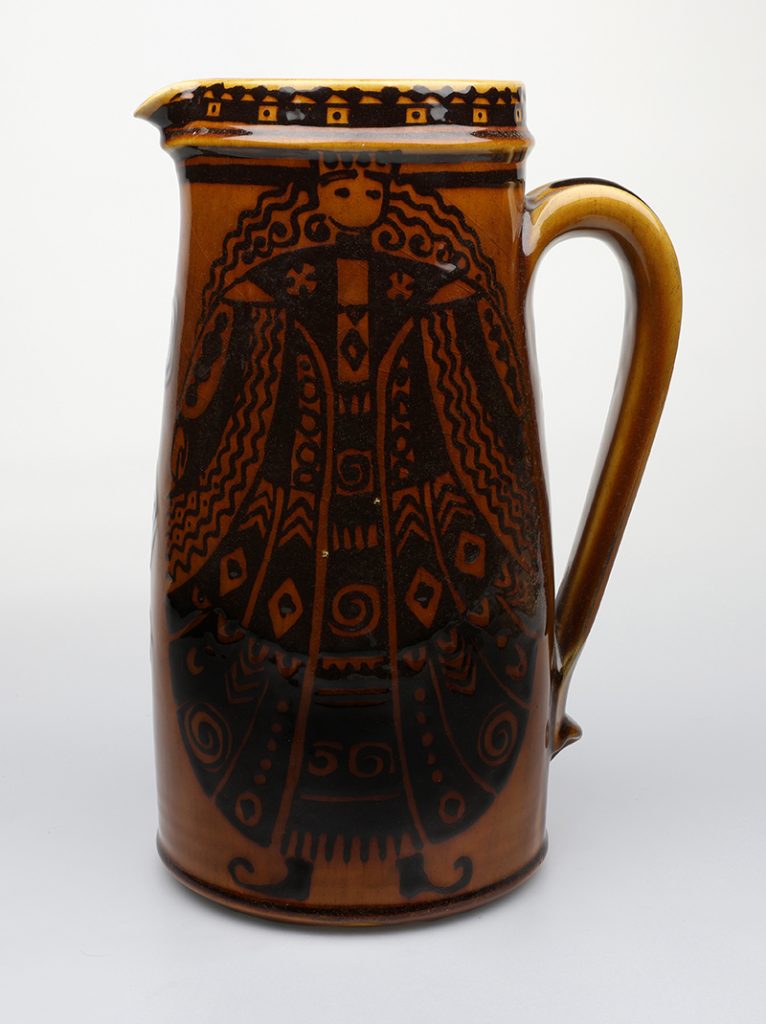
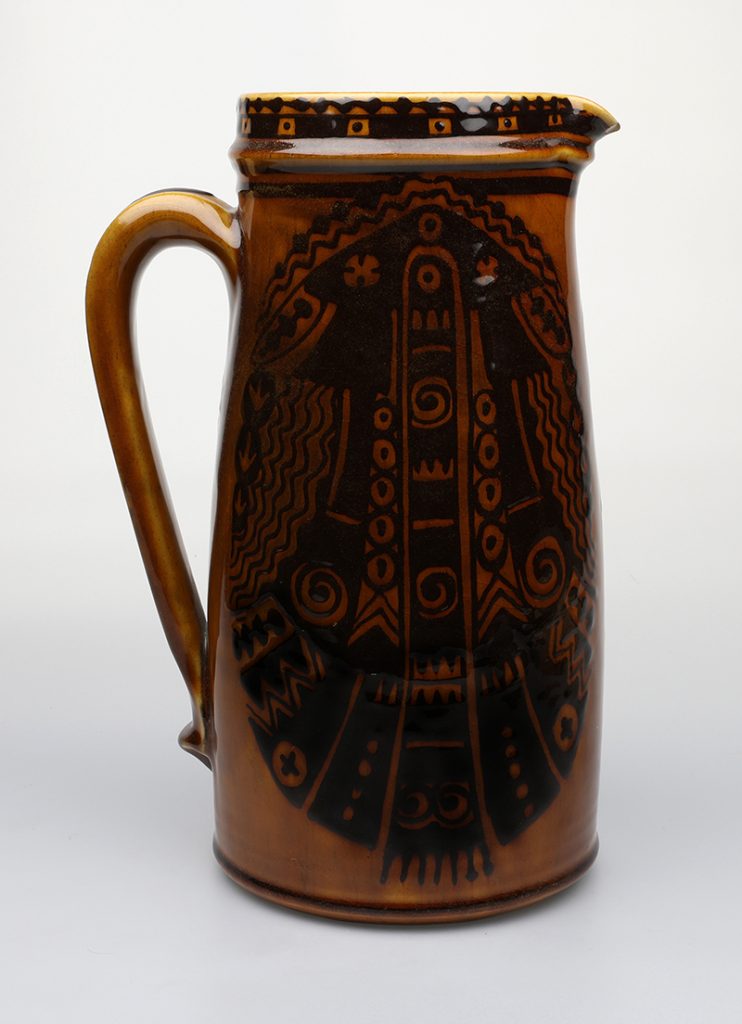

In 1950/51 “Schneider Bros., Seftigen, Hausmatt” are listed for the first time in the exhibition catalogue for the Mustermesse fair in Basel (MUBA). However, the Schneider brothers are not listed in the Swiss Official Gazette of Commerce. The “Schneider Bros.” were Ernst and Hans Schneider. Ernst Schneider (1922-2010) served his apprenticeship as a potter in Gwatt near Thun and subsequently worked for various Swiss potteries. From 1943 to 1946 he attended the Schools of Design in Zurich and Bern (although his name does not appear on the list of students in Bern). Having recovered from pulmonary tuberculosis, he eventually went to work for his brother Hans in Seftigen and probably also in Steffisburg. In 1955, he began to make clay sculptures in his apartment in Thun and was later also commissioned to create bronze figures (obituary)..

It is not clear which products should be associated with the early period in Seftigen, but Hans Schneider used the workshop mark that can be seen in this letterhead from as early as 1960.
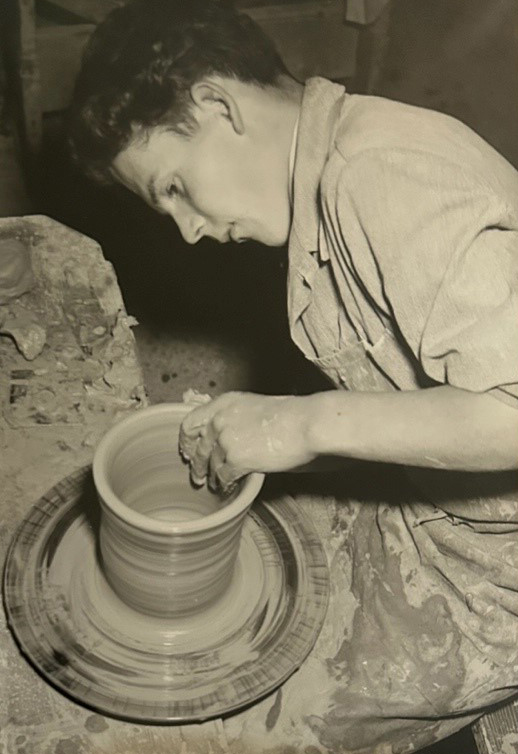
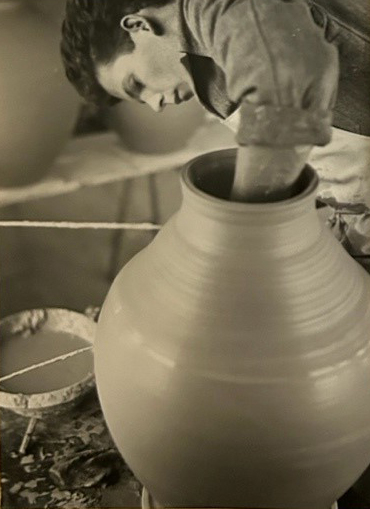
Kurth Dänzer working at the potter’s wheel (unknown photographer, reproduced by Roland Dänzer)
Hans Schneider trained apprentices in Seftigen, including, from 1952 to 1955, Kurth Dänzer (1935-2008); there are two photos of him working at the potter’s wheel.
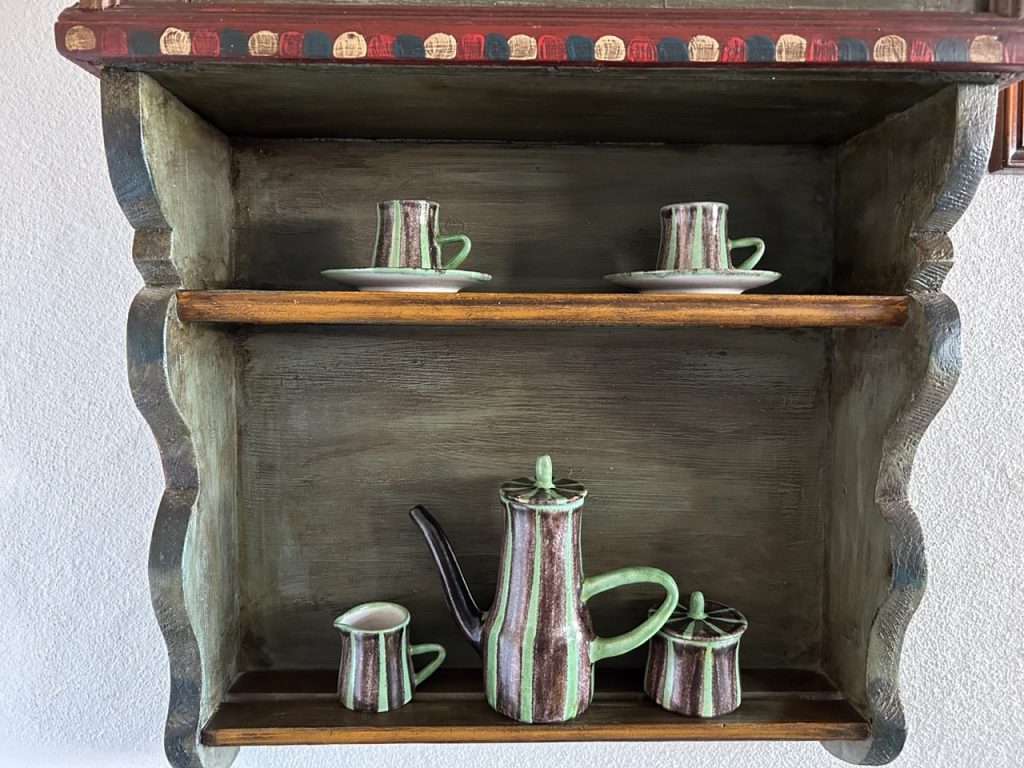
The ceramics he made for his final examination have also survived. Kurth Dänzer subsequently went to work as a thrower for the company Kunstkeramik in Lucerne. He also returned to Schneider’s workshop in Seftigen to work as a thrower for two years from 1957 to 1959. Another one of Schneider’s apprentices was Hans Gillardi.
On 1st May 1961, Hans Schneider-Kraft bought the former Wanzenried Manufactory at 25 Glättemühleweg in Steffisburg from Adolf Schweizer including all assets and liabilities (for more on this see Frank 2000, 575). Schneider modernised and renovated the enterprise extensively (Thuner Tagblatt 86, No. 275, 23rd November 1962; also GB Thun, Belege 6, No. 7226, dated 16th October 1961). In 1965, he dismantled the old clay preparation equipment because it was much too large for his business and not economically viable (Frank 2000, 575, 578).
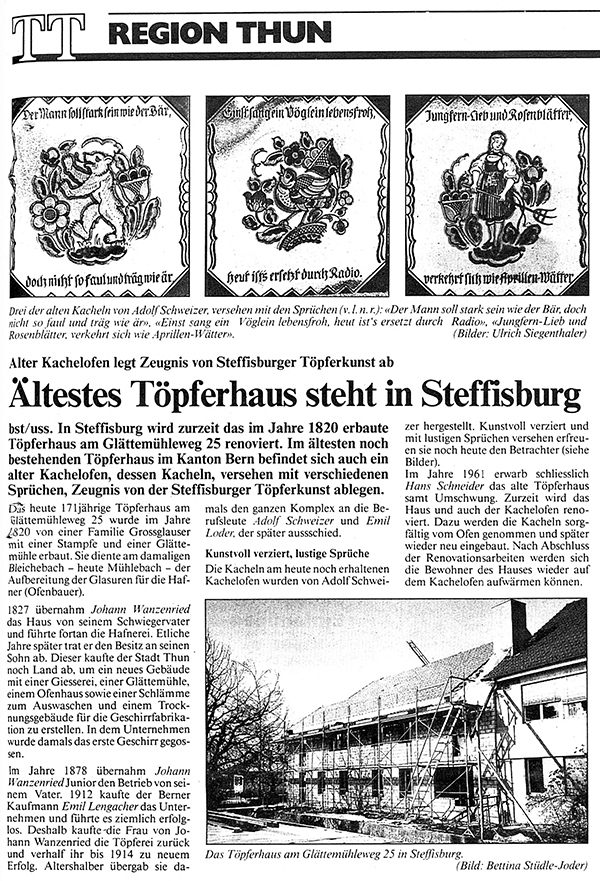
1991 renovations: Thuner Tagblatt, Volume 115, No. 38, 15th February 1991
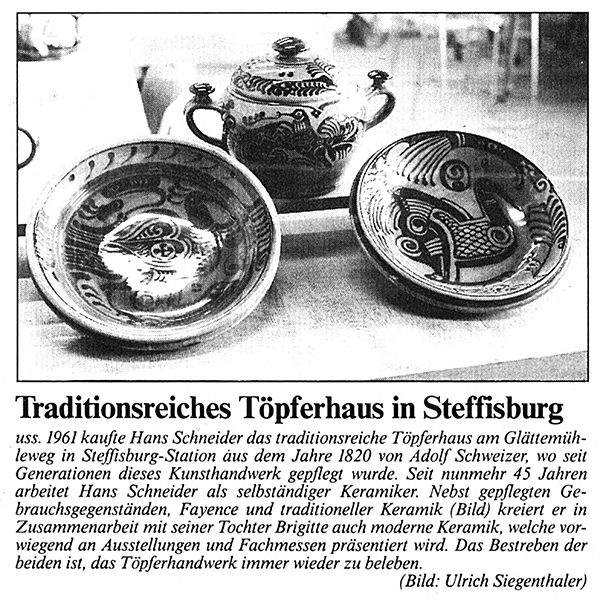
Thuner Tagblatt 115, No. 77, 4th April 1991
Further extensive renovation work was carried out on the buildings of Johann Wanzenried’s former majolica factory from 1989 to 1992 (Thuner Tagblatt, Volume 115, No. 38, 15th February 1991; Thuner Tagblatt 115, No. 77, 4th April 1991, see also Frank 2000, 575).
Hans Schneider continued to manufacture pottery until at least 1996. In April 1996, he exhibited his ceramics at a trade exhibition in Steffisburg (Thuner Tagblatt, Volume 120, No. 95, 24th April 1996). In May 1996, his daughter, Brigitte Peronino, exhibited her own works at the Turmcafe in Thun (Thuner Tagblatt 31st May 1996). There is no further mention of the potter’s workshop in the press after that date. By 2006, Hans Schneider had closed down his business, though it is not clear exactly when this occurred.
Acknowledgements
Heartfelt thanks to Verena Peronino, Steffisburg, Andreas Kistler, Bäriswil, Heidi Meer, Seftigen and Roland Dänzer, Seftigen, for their assistance in compiling this chapter.
Translation Sandy Haemmerle
References:
Frank 2000
Georg Frank, “Dank dem Gewerbefleiss früherer Jahrhunderte”. Die Nutzung der Wasserkraft in der bernischen Gemeinde Steffisburg vom ausgehenden 13. Jahrhundert bis zur Gegenwart, Thun 2000, bes. Kap. 4.16.

