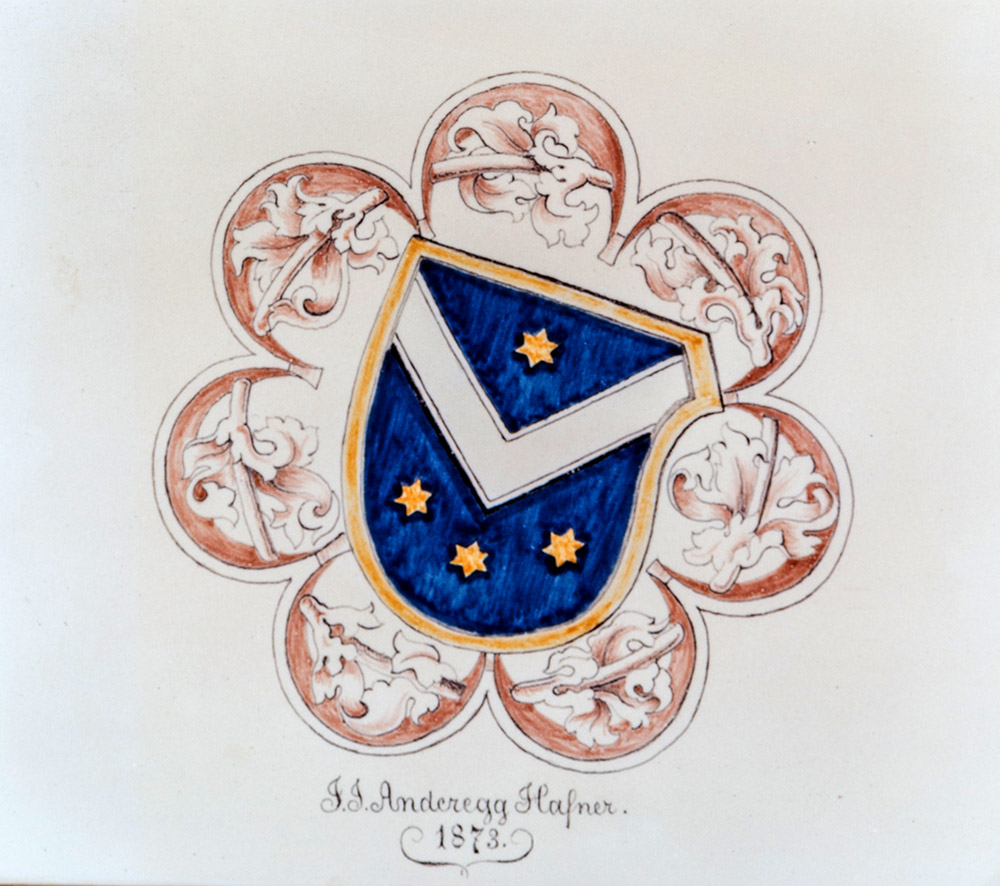
Coat of arms of the Anderegg family of potters from their home at 18 Vorstadt in Wangen, dismantled tiled stove.
Andreas Heege, Andreas Kistler, 2026
based on Mühletaler 1983 and documents from the Museum in Wangen a.A.
Family tree of the Anderegg potters
Genealogical information about the Anderegg potters
Records for Wangen an der Aare, which in the 16th century was the smallest town in the Canton of Bern, numbering only about 110 inhabitants, mention the first potter called Martin Hartmann for the years 1634 to 1638. During that time, he paid the community rent for the use of a potter’s kiln. In 1634/35 he fitted a stove in the customs house in Wangen and in 1635/36 another in the castle (bailiwick). Like the potters in the Bailiwicks of Aarwangen and Bipp, he too was subject to a tradesman’s code which came into force in 1636 (Schwab 1921, 14-16). For 1658/59, there are records pertaining to a potter named Bendicht Burckhardt (from 1641 to 1658/59, he was in Walliswil near Wangen). He fitted stoves in the castle and probably worked in Wangen until 1685/86 (unless stated otherwise, what follows is based on Mühletaler 1983, who in turn took his information from K.H. Flatt 1982; see also Heege/Kistler 2026). Prior to 1757, records also mention a potter called Abraham Rikli (1688-1757), who was also the clerk of works and public fire warden.
From the 18th to the early 20th century, however, the main local manufacturers of tiled stoves and crockery were the Anderegg potters. The 1798 Helvetic Citizens’ Register lists three further potters for Wangen: Johannes Arn from Wangen (1768-1834), Ludwig Kräuchi from Bäriswil (1770-1851) and Johannes Berchtold from Safenwil, Canton of Aargau (1752-?); the latter, however, lived (and worked?) in Inkwil at the time.
Potters in Wangenried near Wangen a.A.
The Anderegg family moved to Wangen a.A. from Oberbipp in 1622 and later became naturalised citizens. The first Hans Anderegg (1601-1664?) was an innkeeper and mayor. The second Hans Anderegg (1668-prior to 1737, see the family tree) was a butcher and intermittently held the lease for the Rössli Inn. He was married twice, first to Elisabeth Kuhn from Steckholz in 1694, who bore him a son, Jakob (1695-1773); in November 1706 he married Verena Rikli (1657-?), who was 49 at the time, yet still went on to bear three more sons between 1709 and 1713, one of whom, Hans Ulrich Anderegg (1709-1776), was the first potter in the family. When Hans Ulrich Anderegg married in 1736, he purchased land in Ried (Wangenried, a small village 3 km south of Wangen a.A.). In 1737, he, together with his brother Josef (1713-1802), who was a farmer, received half a house from their mother, Verena Rikli (plot unknown). Josef sold his quarter share of the house to Hans Ulrich in 1739 and used the money to purchase a plot at 18/20 Vorstadt in Wangen, which later became a pottery.
Information from the cadastral register about the properties owned by the Anderegg family
The property at 18/20 Vorstadt in Wangen
Hans Ulrich Anderegg and his son, Johann Anderegg (1740-1795), first appear in records as potters in Ried in 1769 and in 1762. In 1765/66, Hans Ulrich repaired the stove at the school in Wangen.
In 1774, Johann Anderegg took over his father’s half share of the house; the other half belonged to a man called Jakob Rikli, who was perhaps related to Johann’s mother. Johann Anderegg died without issue. No tiled stoves or vessels made by the two potters in Wangenried are known to still exist.
The next records for potters in Wangenried date from between 1817 and 1832 (master potter Jäger, 1821; Joseph Wyss, 1824-1825, a non-citizen from Subingen, Canton of Solothurn, both of whom registered journeymen (register of journeymen). In 1813, a journeyman potter by the name of Maximilian Teptor from Mössingen in Württemberg, got Elisabeth Rikli, the daughter of retired Chorrichter (a member of a church court) Jakob Rikli (1760-1833) pregnant and went on to marry her in 1814. In 1817 he was added to the list of journeymen as a non-citizen. Two more children were baptised in 1817 and 1820 in Wangen a.A. It is not clear if Maximilian Teptor worked at (rented?) the workshop of retired Chorrichter Jakob Rikli as an independent potter from the beginning or if he worked for an unknown potter or one of the two potters mentioned above (from 1813). We can also only assume that the records refer to the same potter’s workshop that Johann Anderegg had worked at until 1795. In any case, Maximilian Teptor registered a journeyman called Sebastian Teptor from Mössingen (a relative, younger brother, nephew?) between 1831 and 1833, suggesting that he probably ran the workshop independently at that stage. Astonishingly, he once again appears as a journeyman in 1840 and 1841, working for the potter Kaspar Studer in Safnern between Bienne and Büren a.A.; in 1842, working for the potter (?) Biedermann in Nidau and later that same year working for publican Schmalz in Nidau; in 1843, for bathhouse keeper Roth in Worben and later that same year for Johann Stämpfli (potter?) in Grossaffolter-Kosthofen. It is not clear what he worked at in his final three jobs, when he died or what happened to his wife and children.
Rikli_Teptor Wangenried_genealogical information Rikli-Teptor family tree
Potters in Wangen a.A.
The farmer Josef Anderegg senior (1713-1802) married a distant relative, Anna Maria Anderegg, who bore him six children, one of whom, Josef Anderegg junior (1752-1831), trained to be a potter with his uncle or cousin in Ried (family tree). In 1777 he was granted planning permission for a “potter’s workshop with a kiln in the Vorstadt area of Wangen” where his father lived (rent rolls of Wangen no. 7, p. 38, 22nd March 1777). This is when the Anderegg pottery production in Wangen began. In 1784, Josef Anderegg junior married Anna Geiser (1759-1829, citizen of Leuzigen). The couple had three children. From 1797 to 1817, Josef Anderegg junior also served as a court official and from 1803 to 1817 he was a Chorrichter.
Because of the absence of marked pottery or tiled stoves we have no knowledge of what Josef Anderegg junior produced at his workshop in the Vorstadt area, nor do we know who painted his stoves between 1777 and c. 1825; was it himself or a specialist stove painter? What we do know is that he repaired a stove in the school building in Wangen in 1787/88. There is also evidence that he was able to fit a new stove on the first floor of the rectory in 1792/93. Two stoves, dated 1816 and 1817 respectively, on the second floor of the home of ship owner, merchant and governor Johann Rudolf Vogel, at 17 Vorstadt in Wangen (erected from 1813), could have been made at the workshop of Josef Anderegg junior or his son, Johannes Anderegg (1785-1860), even though they do bear neither a maker’s nor a painter’s mark.
Johannes Anderegg (1785-1860), Josef junior’s son, married Elisabeth Schneider (1784-1831) in 1807. He was a town councillor and court official. The couple had three children. In 1837 Johannes’ two sons, Johann Jakob senior (1809-1875) and Johannes junior (1814-1846), both of whom also became potters (family tree), received part of their father’s property in Wangen. They were granted permission to extract clay from the Riedmatt area and from a field known as Tonen in Wiedlisbach (neither location is known precisely).
Johann Jakob senior’s (1809-1875) journeyman’s travelling book covering the period between 1825 and 1829 has survived (Mühletaler 1983, 156-157). It shows that he set out on his travels at the unusually young age of 16 and that he travelled as far away as Mecklenburg.
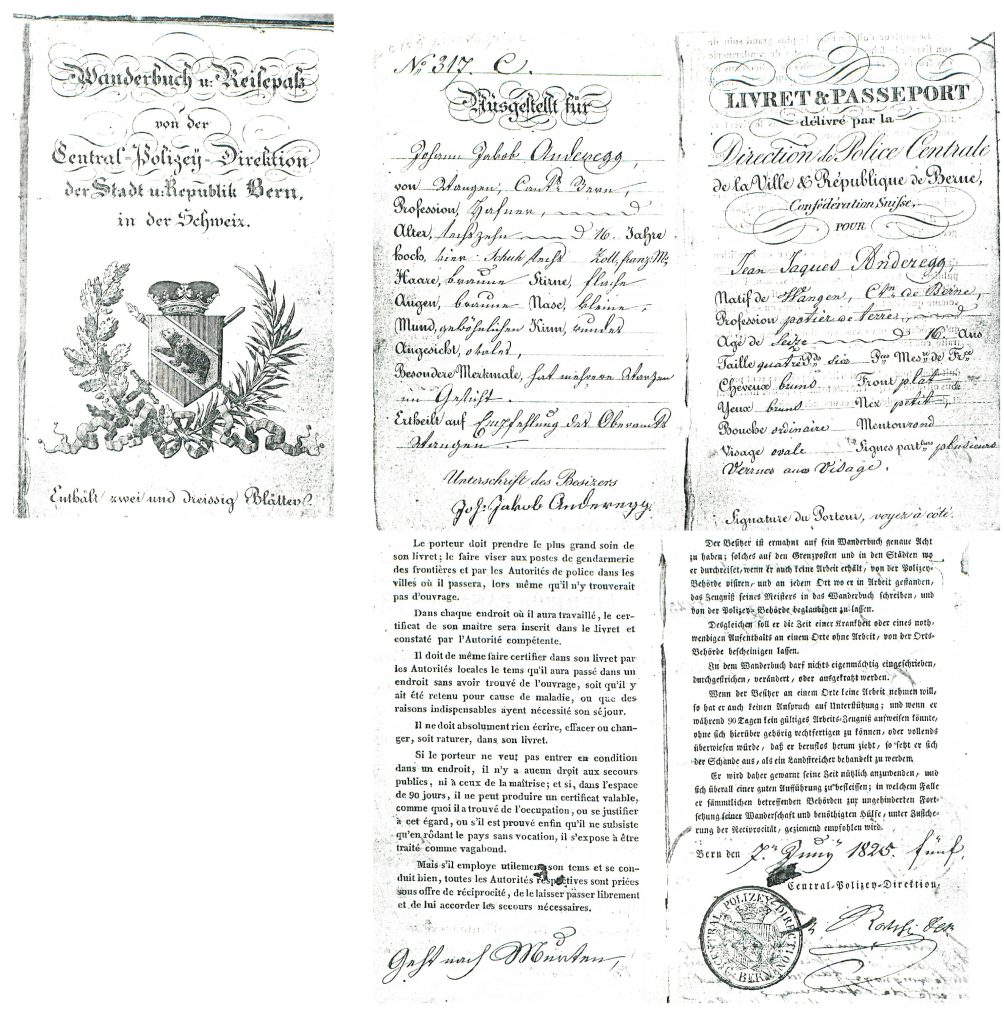
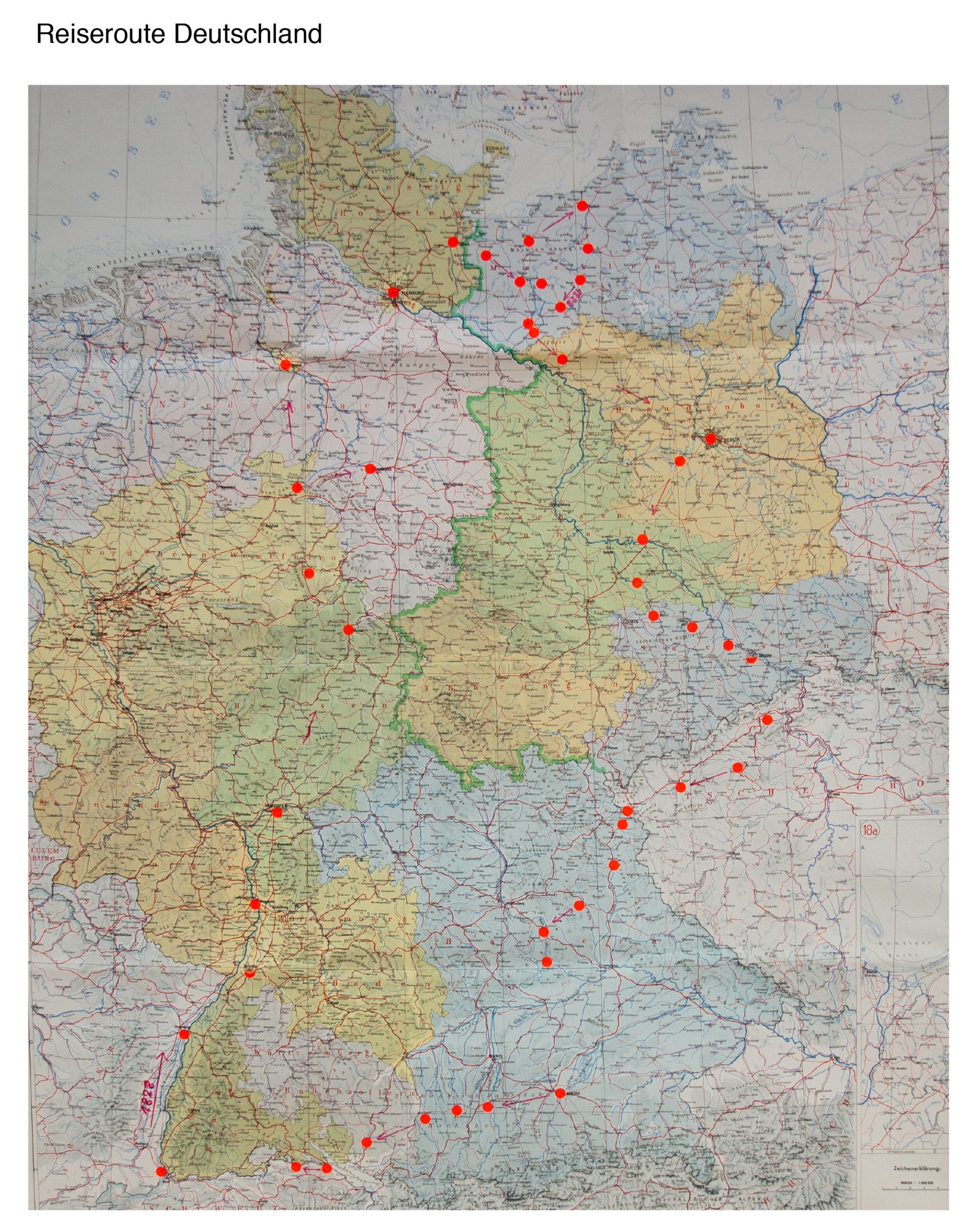
The Aarau stove painter Johann Heinrich Egli also worked for the Anderegg potters in Wangen a.A., from 1829 to 1832 (one stove still exists in the house at 9 In der Gass in Wangen a.A.). By that time, Johannes Anderegg (1785-1860) had probably taken over the workshop from his father Josef (1752-1831).
In 1840, the two sons divided up the property and Johann Jakob was granted permission to build a new house on the same site. Johannes Anderegg (1814-1846) and Anna Barbara Herzig from Steckholz near Lotzwil were married in Wynigen on 27th January 1843 (see the family tree). The baptismal record of their firstborn child dated 31st December 1843 identifies Johannes as a “potter in Steckholz”, suggesting that he had set up a workshop there. He died there only three years later. No products from his workshop are known to still exist.
GBWangen_Hafner_Anderegg_2 Wangen_Vorstadt 18_20
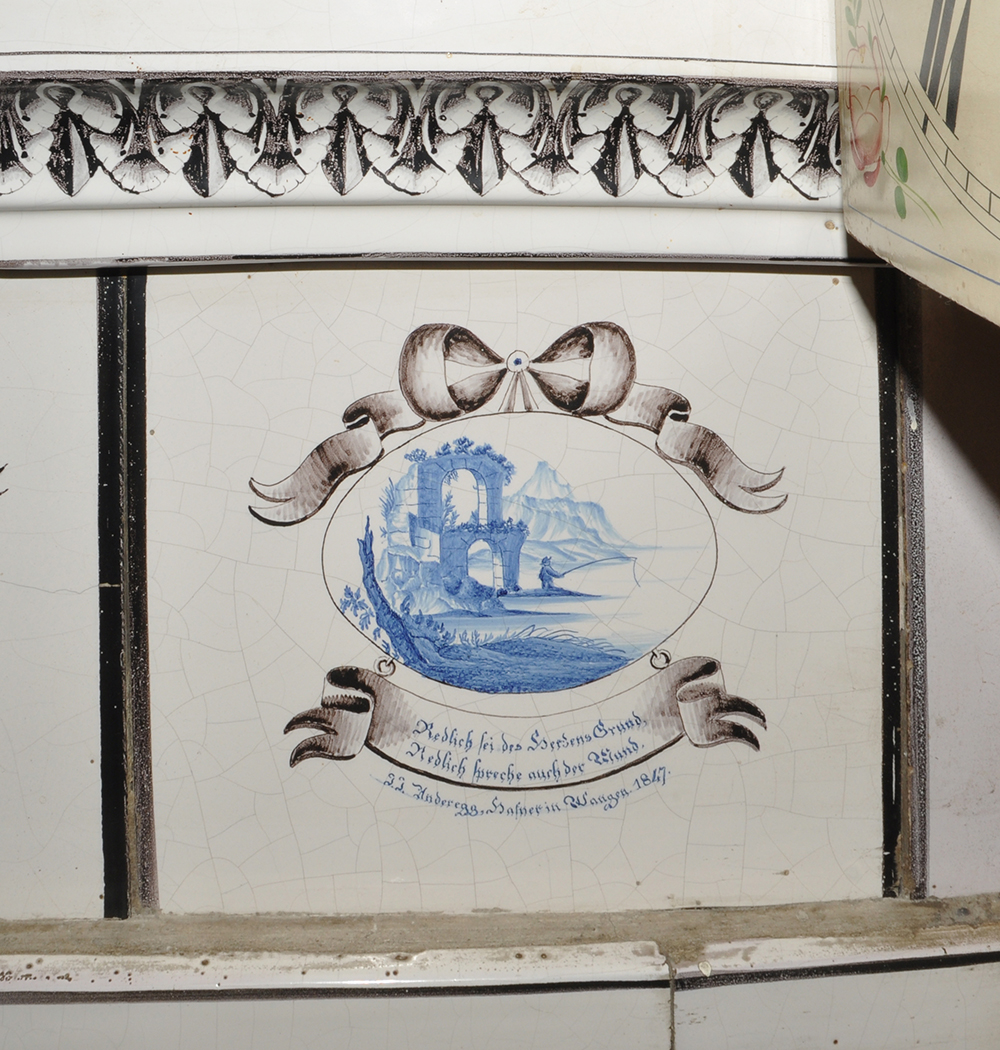
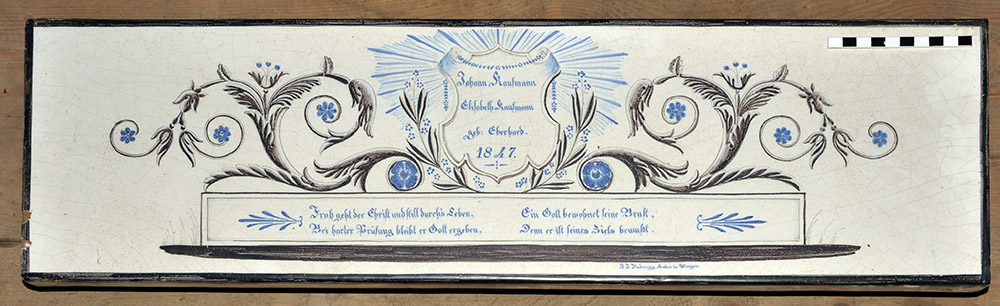
Stove tiles dated 1847 made and signed by Johann Jakob Anderegg senior (1809–1875), Herzogenbuchsee, Sternen Inn; possibly painted by stove painter H.F. Lanz.
Johann Jakob Anderegg senior (1809–1875), who had married Anna Barbara Ingold (1813-1902, place of origin Heimenhausen) in 1834, took over his father Johannes’ (1785–1860) workshop shortly before Johannes died. The couple had seven children (see the family tree). Two sons – Johann Jakob, 1834-1894, and Johann Gottfried, 1846-1927 – also became potters. They were the fifth and final generation of Anderegg potters in Wangen. We know that Johann Jakob (known as Jakob) got as far as the island of Rügen in Germany on his journeyman’s travels in 1860 (Anderegg 2026). In one of his letters, written to his son in 1860, Johann Jakob Anderegg senior (1809–1875) wrote that his fourteen-year-old brother Gottfried was helping his grandfather (Johannes Anderegg, 1785-1860) in his workshop, was preparing the clay and was already making fairly decent plates and coffee bowls. We know from the same source that his other brother, Adolf Anderegg (1843-1893), was also working in the workshop and doing very well at painting tiles, even though he would later become a plumber (Mühletaler 1983, 137).
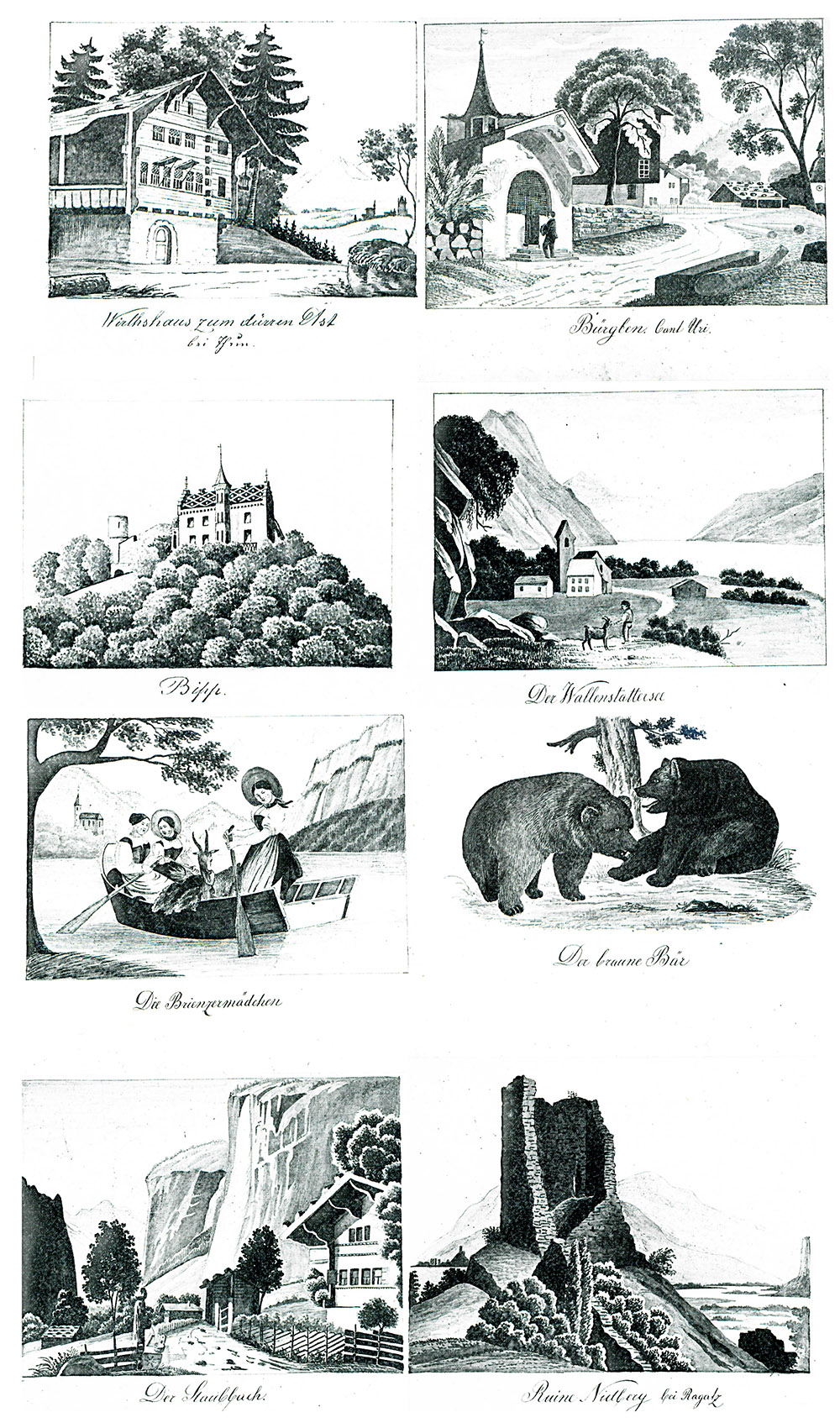
Booklet of tile templates 1855-1866, example page, private ownership, copies in the collection of the Museum in Wangen a.A.
Johann Jakob Anderegg (1834-1894) left a 124-page collection of sketches from the period between 1845 and 1851; there is also a booklet of tile templates with dates ranging from 1855 to 1866 (for a list of images see Mühletaler 1983, 141-144).
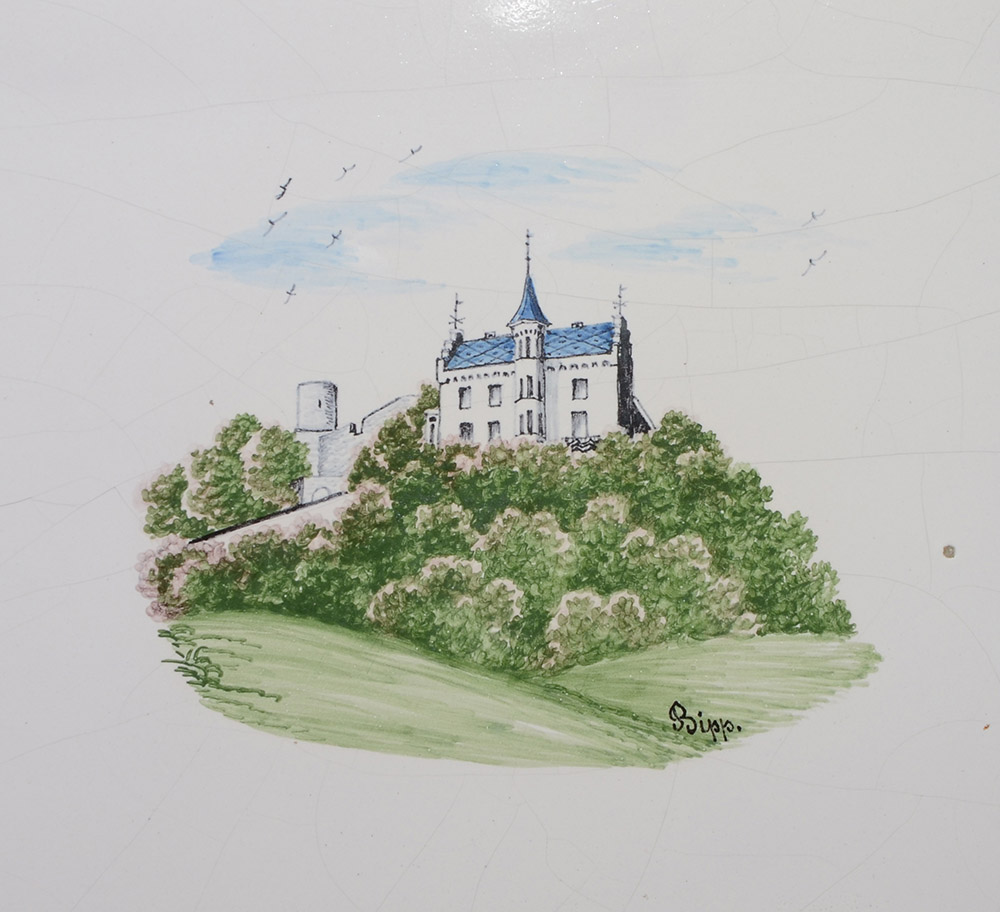
Bipp Castle, tiled stove dated 1861 in the Museum im Kornhaus Wiedlisbach (compare the template above).
The section of the property at 20 Vorstadt was destroyed by fire in 1902. The section at 18 Vorstadt was extensively remodelled. In the 1970s, the remains of a potter’s kiln were found (but not recorded) in the property dating from the period around 1840. When Johann Gottfried Anderegg died, pottery production at 18/20 Vorstadt in Wangen ceased.
More than 100 entries for the period between 1820 and 1899 in the register of journeymen attest to the regional importance of the Anderegg pottery business.
A rare example of a jardinière from the Anderegg workshop has survived in the Felchlin collection in Matzendorf (SFM 31).
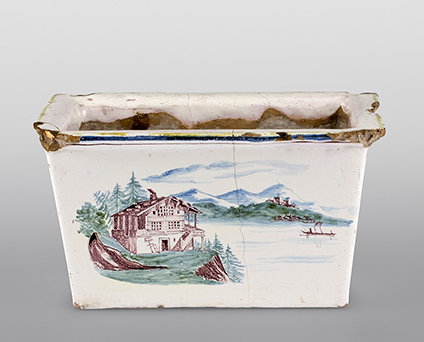
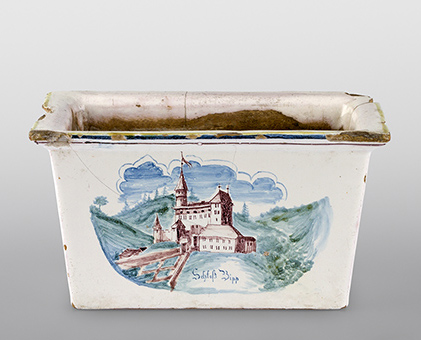
On the front it has the words “Schloss Bipp” and a view of Bipp Castle inspired by an engraving by David Herrliberger (1697–1777; “Neue und vollständige Topografie der Eydgnoschaft”, 1754–1758, Pl. 70). The piece was probably painted by Johann Jakob junior (1834–1894) (see the booklet of templates).
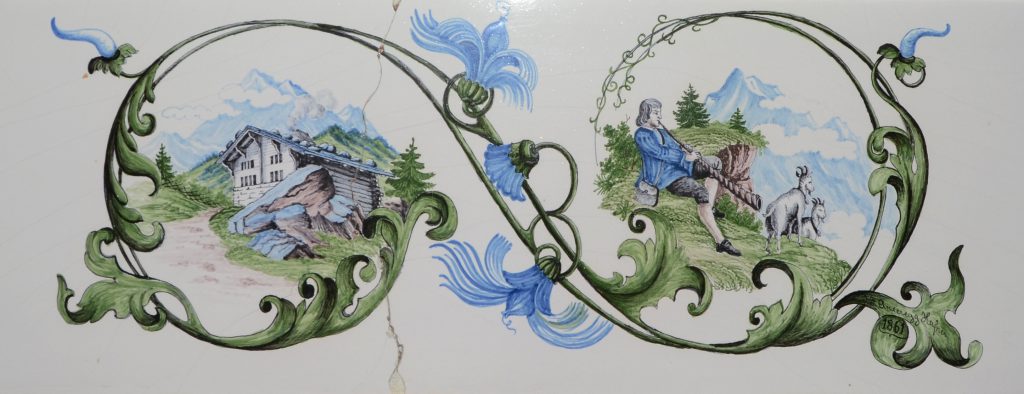
Stove tile made by Johann Jakob Anderegg (1834–1894), signed and dated 1861, tiled stove at the Museum im Kornhaus Wiedlisbach.
A comprehensive study of the tiled stoves and crockery made by the Anderegg potters and their supra-regional importance is still outstanding (for references to individual stoves see Heege 2011; Heege 2015; Leuenberger 1957; Leuenberger 1959; Mühletaler 1983). The Städtli-Museum in Wangen a.A. has a large collection of tiles made by the Anderegg potters.
Translation Sandy Haemmerle
References:
Anderegg 2026
Jonas und Samuel Anderegg, Von der Aare bis an die Elbe: Wanderjahre des Hafnergesellen Johann Jakob Anderegg. Städtli-Museum, Jahresblatt Wangen an der Aare 2026, 15-26.
Blaettler/Schnyder 2014
Roland Blaettler/Rudolf Schnyder, CERAMICA CH II: Solothurn (Nationales Inventar der Keramik in den öffentlichen Sammlungen der Schweiz, 1500-1950). Sulgen 2014, 72.
Heege 2011
Andreas Heege, Langenthal, St. Urbanstrasse 40–44. Die Hafnerei Staub und ihre Werkstatt, in: Archäologie Bern/Archéologie bernoise. Jahrbuch des Archäologischen Dienstes des Kantons Bern, 2011, 209–287.
Heege 2015
Andreas Heege, Die Hafnerei Staub in Langenthal, Kanton Bern, 1730 bis 1870, in: Silvia Glaser, Keramik im Spannungsfeld zwischen Handwerk und Kunst. Beiträge des 44. Internationalen Symposiums Keramikforschung im Germanischen Nationalmuseum, Nürnberg, 19.-23. September 2011 (Wissenschaftliche Beibände zum Anzeiger des Germanischen Nationalmuseums 40), Nürnberg 2015, 125-145.
Heege/Kistler 2026
Andreas Heege/Andreas Kistler, Die Hafner Anderegg, Kachelofenbauer aus Wangen an der Aare. Städtli-Museum, Jahresblatt Wangen an der Aare 2026, 4-14.
Leuenberger 1957
Walter Leuenberger, Alte Ofensprüche aus dem Oberaargau, in: Berner Zeitschrift für Geschichte und Heimatkunde, 1957, 80-92.
Leuenberger 1959
Walter Leuenberger, Ofensprüche, in: Jahrbuch des Oberaargaus 2, 1959, 117-129.
Leuenberger 1993
Walter Leuenberger, Ofensprüche, in: Hanspeter Bögli/Anita M. Friedli-Jenzer/Markus Friedli u.a., Bannwil. Ein Dorf im Oberaargau, Bannwil 1993, 243-259.
Mühletaler 1983
Hans Mühletaler, Die Hafner Anderegg. Eine Ofenbauer-Dynastie in Wangen an der Aare. Jahrbuch des Oberaargaus 26, 1983, 129–158.
Schwab 1921
Fernand Schwab, Beitrag zur Geschichte der bernischen Geschirrindustrie (Schweizer Industrie- und Handelsstudien 7), Weinfelden/Konstanz 1921.

