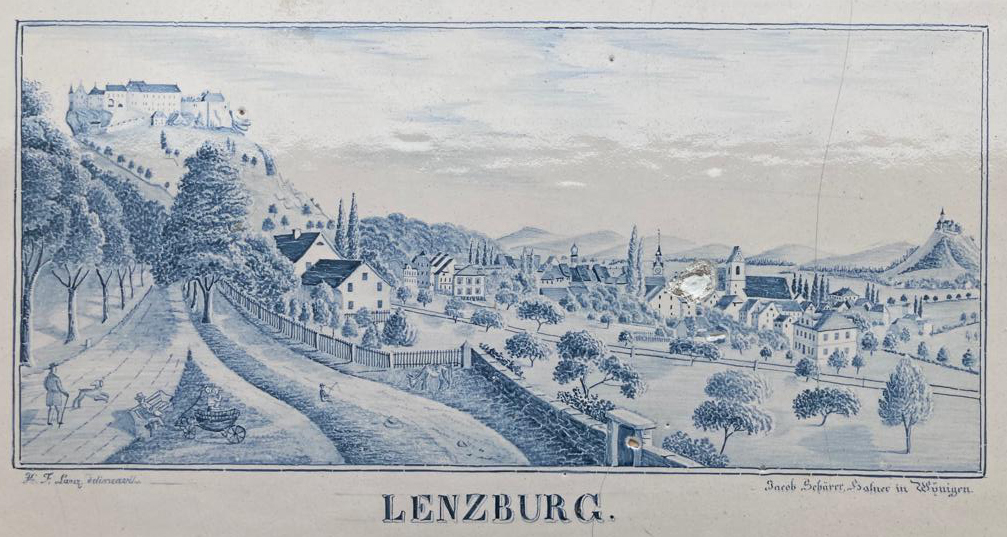

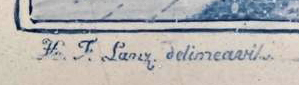
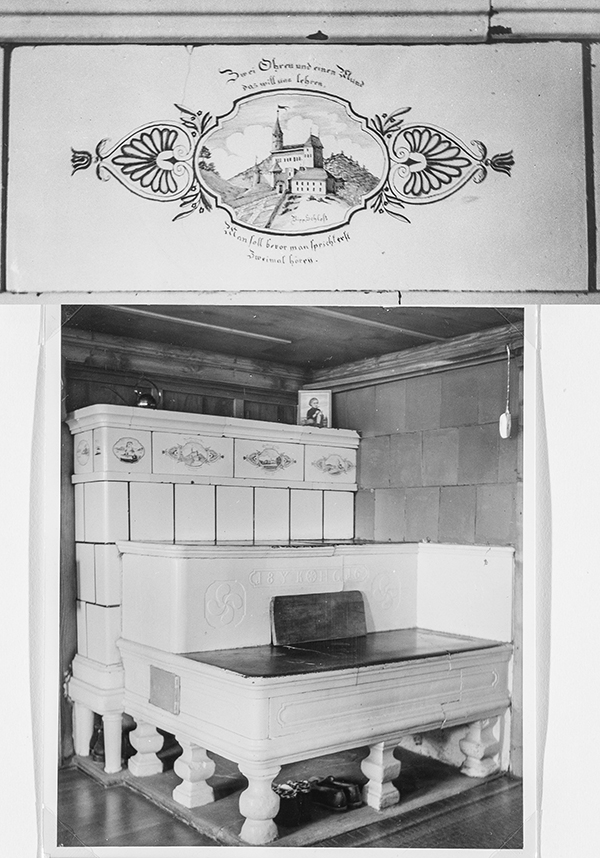
Faience stove tile with a view of Lenzburg. Made by the potter Jakob Schärer from Wynigen, Canton of Bern, and decorated by the stove painter H.F. Lanz from Langenthal (photos by Werner Gut, Triengen).
Andreas Heege, Andreas Kistler, Alfred Spycher, Daniel Dähler, 2025
One only becomes aware by chance of some of the smaller workshops from the 19th century. Jakob Schärer’s workshop in Wynigen, Canton of Bern, is one such example, and we would therefore like to present this chance find made by Werner Gut from Triengen. The community of Wynigen is situated between Burgdorf and Langenthal. So far, the stove tile pictured above is the only one of Jakob Schärer’s products to have survived. It is not known what else he made.
Jakob Schärer was born in Wynigen on 19th May 1816 (Church register [KR] Wynigen 7, 151). He had seven siblings. His father, Niklaus Schärer (28th June 1780-8th July 1866), was a carpenter from Wynigen; his mother, Elsbeth Grossenbacher, came from Hasle near Burgdorf (see the family tree). Jakob Schärer was married twice. In 1849, he married Margaritha Brechbühl in Lotzwil. The couple had two daughters and one son. After Margaritha’s death, he married Katharina Schneeberger from the neighbouring community of Ochlenberg in Herzogenbuchsee in 1856 (KR Wynigen 19, 133). On 2nd May 1857, she bore him a son, Gottfried (KR Wynigen 9, 97) and on 8th January 1859, the couple had a daughter, Lisette (KR Wynigen 9, 110). Not long after that, Katharina Schneeberger was admitted to the Waldau Clinic in Bern due to mental illness (Mühletaler 1983, 137).
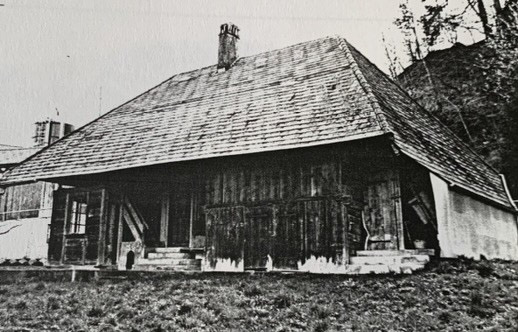
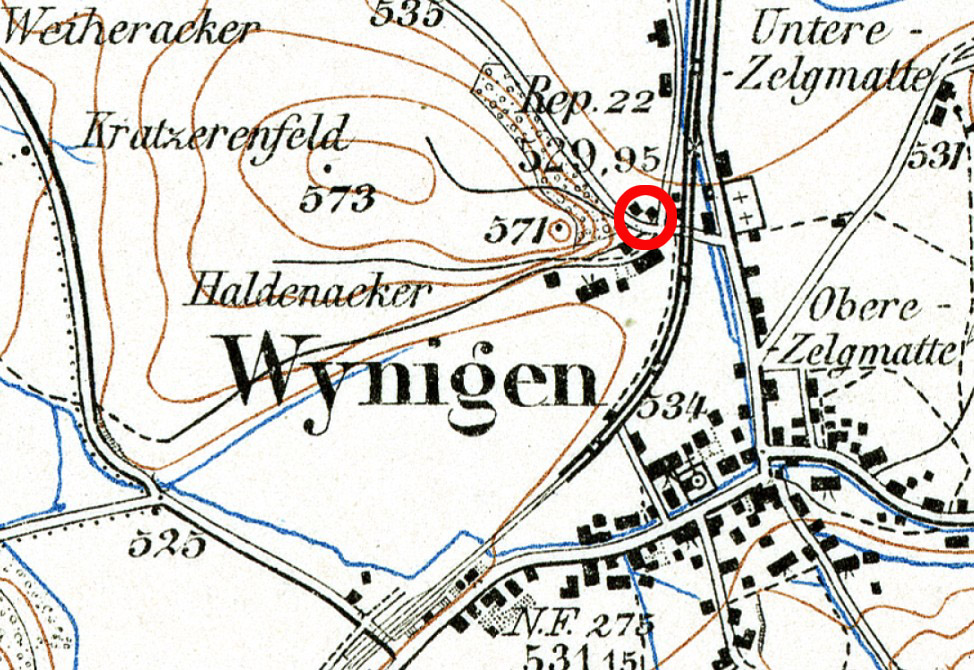
All four records list Jakob Schärer’s address as Wynigen, “Wächterhaus” or “Hafnerhütte”. The “Wächterhaus” property consisted of a farmstead and garden as well as meadows, fields and woodlands, and had been bought by his father Niklaus in 1819. On 15th November 1865, he sold it to the local forest warden, Johannes Moser (land register entry for Wynigen 16/680). The house is still standing today. It is a typical late 18th century smallholders’ house (year of construction 1780; Bauinventar der Gemeinde Wynigen, Teil I, Denkmalpflege + Stelle für Bauern- und Dorfkultur des Kantons Bern, c. 1988).
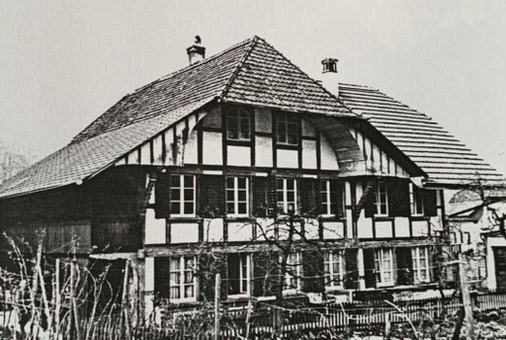
In March 1836, Niklaus Schärer purchased a meadow, approximately half a Mad in size in the Neumatte area from the community of Wynigen and, in 1839 (according to a building inscription) built a wood-frame construction with a half-hipped roof to serve as a residence and potter’s workshop (Bauinventar der Gemeinde Wynigen, Teil I, Denkmalpflege + Stelle für Bauern- und Dorfkultur des Kantons Bern, c. 1988). This building, which was obviously Jakob Schärer’s home and workplace, is also still in existence today.
Western building: Wächterhäusli, eastern building: the potter’s house (now 9 and 11 Neumattweg).
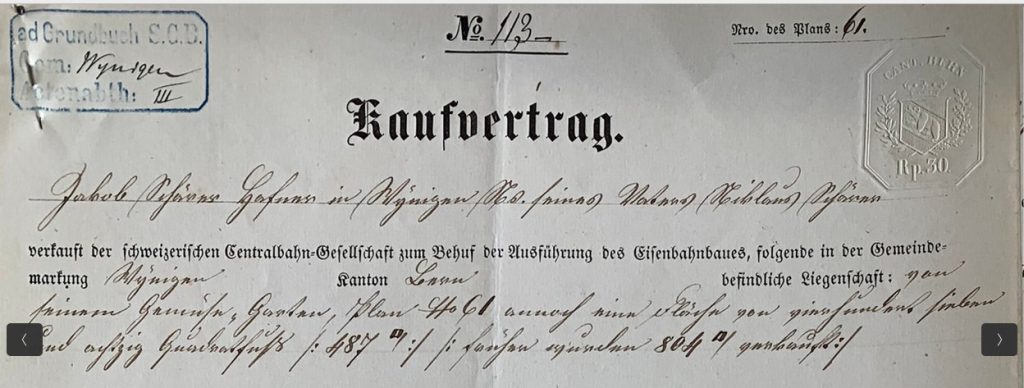

Both the father, Niklaus, and the son, Jakob, appear in records in connection with the construction of the railway line that ran through Wynigen. Because the course of the lane had to be changed near the railway crossing at Tönihof (also known as Tönihaus), there was a land exchange between Niklaus Schärer and the railway company (Schweizerische Centralbahn-Gesellschaft) in 1857, which Jakob Schärer signed on behalf of his father (KDII_DIV_SBB79_0709 Wynigen: Immobilienrechtsgeschäfte, Verträge und Pläne, 1856-1920 (Dossier).
Jakob Schärer died from pneumonia at a relatively young age on 12th May 1860 (KR Wynigen 24, 75), having returned home feeling unwell after setting a stove in Herzogenbuchsee (Mühletaler 1983, 137). As he died without intestate, his “heirless estate” was sold at auction immediately after his death. This also included “circa 2 carts full of” moulds, some of which had been purchased at auctions in Burgdorf.
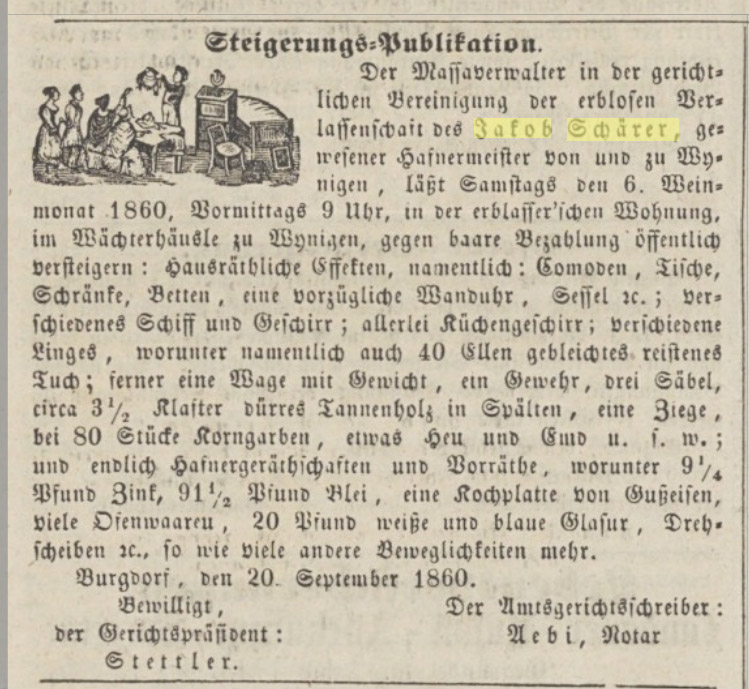
Emmenthaler Bote, No. 78, 27th September 1860.
After his son’s death, Niklaus Schärer, carpenter, resident at the Wächterhäusli in Wynigen, sold “THE RESIDENCE AND POTTER’S WORKSHOP THAT HE HIMSELF HAD BUILT outside of the village of Wynigen, … with access to half of the water supplied by the well on the property. Also, the ground on which the building stands, the garden in front of it, in total c. ¼ Jucharte of land …” to Johann Lüthi, place of origin Lauperswil, a potter resident in Schüpbach near Signau on 13th July 1860 (land register Wynigen 15/322). The potter Johann Lüthi was born on 2nd February 1834. At the time of his birth, his parents, Johannes Lüthi and Anna Barbara Riser, lived in Bowil (KR Grosshöchstetten, 10/94). He was placed under guardianship in Signau in 1850 (KR Lauperswil 21/58). On 1st July 1858 he married Anna Gisel (1830-?), possibly a potter’s daughter from Wilchingen, Canton of Schaffhausen, in Laufen, Canton of Zurich (KR Lauperswil 21/58; two journeymen by the name of Gisel from Wilchingen were registered in the period between 1841 and 1861; Niklaus Gisel worked in Oberwichtrach in 1841; Martin Gisel was registered as working in Heimberg in 1861; “Der Grütlianer”, 2nd November 1881). Johann Lüthi’s marriage record lists him as a “potter in Wilchingen” (Canton of Schaffhausen). On 24th October 1858, the couple had their first daughter, Elisabeth, baptised there (KR Lauperswil 17/93). The second child, Johann Willibald, was baptised on 9th December 1859 in Signau, Canton of Bern. That record lists Johann Lüthi as a “potter in Schüpbachfuhren” (KR Lauperswil 171/110). Lüthi was obviously not very happy with the house he had bought in Wynigen, as he sold it again just a short while later, on 16th December 1861, to the brothers Jakob and Ludwig Althaus from Schwarzenegg, potters in Langnau (land register of Wynigen 15/554; for more information on the Althaus potters see Heege/Kistler 2017, 186-187). Jakob Lüthi seems to have returned to Wilchingen with his family, as he was identified as a “potter in Wilchingen” when another daughter, Anna, was baptised on 3rd January 1864 (KR Lauperswil 17/166). It appears that only Ludwig Althaus actually moved to Wynigen, where he had four children baptised between 1862 and 1866 (KR Wynigen). In 1866, Jakob and Ludwig Althaus sold the workshop to master cabinetmaker Jakob Ledermann from Madiswil (Wynigen land register 17, 47). In 1869 and 1871, we find Ludwig Althaus working as a potter in Oberburg (Berner Zeitung, Vol. 25, No. 37, 13th February 1869; Grütlianer 30th August 1871).
The information available on H.F. (Heinrich Friedrich) Lanz, the painter of the tile shown above, is rather limited indeed. He was born out of wedlock to Susanna Stumpf from Wattwyl, Canton of St. Gallen, on 31st May 1820 in Lausanne, where he was also baptised (church register of Lotzwil 13, 1820,12). In July 1820, the church court in Bern registered Friedrich Lanz from Rütschelen as the child’s father. On 20th April 1849, Heinrich Friedrich Lanz from Rütschelen near Langenthal in the Canton of Bern married Sophie Geiser in Lotzwil. She was from Langenthal and her father’s name was Jakob Geiser (KR Lotzwil 17, 1849, 95). The record of the marriage, listed Lanz as a “painter in Langenthal”. On 25th August 1850, the couple had a son, Johann Friedrich, baptised, who had been born on 30th July 1850 (KR Lotzwil, 13, 1850, 61). A girl, born in 1849, had died after just one day (church register of Langenthal, 18, 1849, 151). The citizens’ register of Rütschelen (p. 347) contains the following entry: “This family emigrated to America in the year 1852”.
The description “painter in Langenthal” corresponds with what is written on one of the tiles on an undated stove fitted by J.J. Grütter from Seeberg at a house in Rüdtlingen, Canton of Bern (Swiss Farmhouse Research Archive).
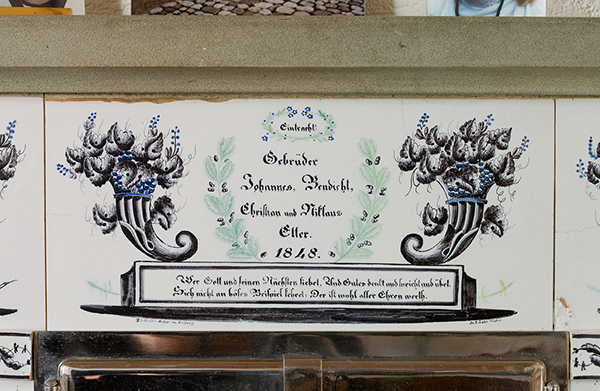
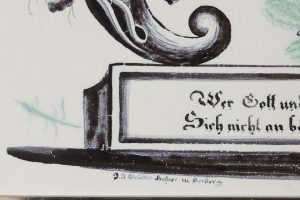
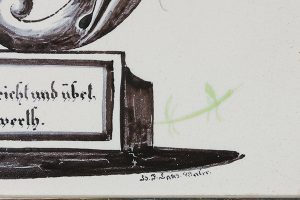
In 1848, Lanz signed another stove made by the same stove fitter in Jetzikofen, Canton of Bern (Affolter/Pfister 2013, Fig. 318). This stove allows us to clearly identify Heinrich Friedrich Lanz’s style so that other stoves, both signed and unsigned, can be attributed to him with a high degree of certainty.
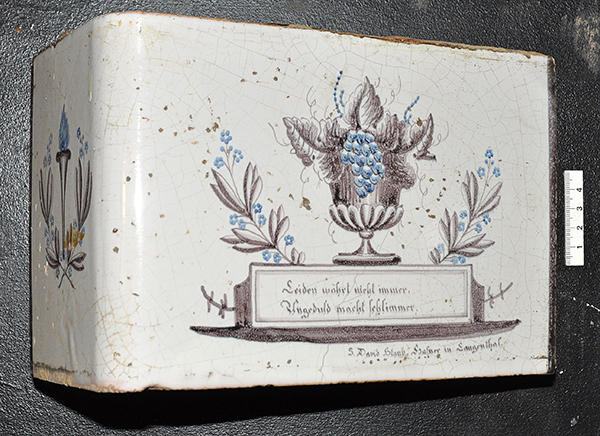
The same goes for a tile from the workshop of Johann David Staub in Langenthal, Canton of Bern (Heege 2011, Fig. 74, now at the Museum in Langenthal).
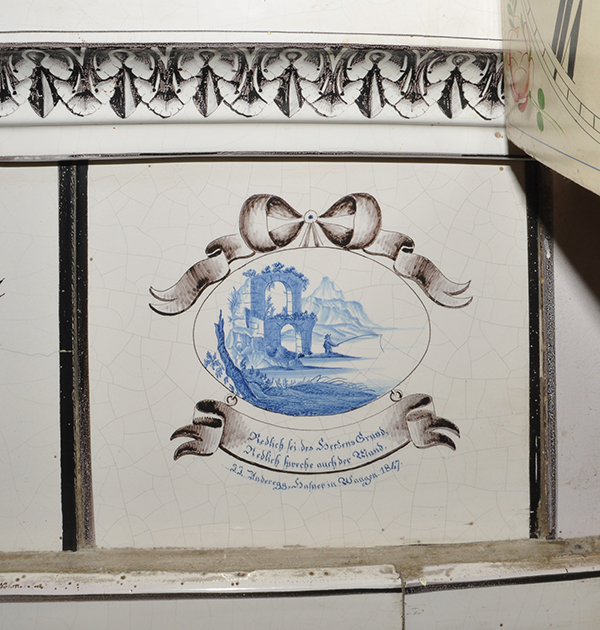
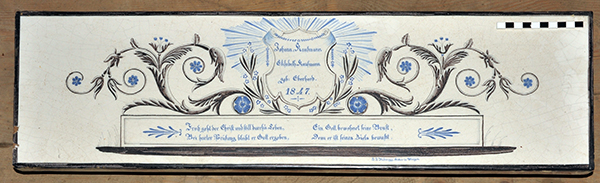
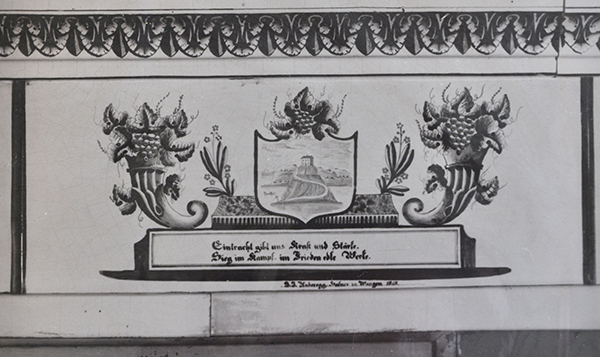
Judging by the writing style, Lanz also worked for the Anderegg workshop in Wangen an der Aare in 1847 (Mühletaler 1983).
One stove, dated 1848, still stands in Fulenbach, Canton of Solothurn, at 37 Dorfstrasse.
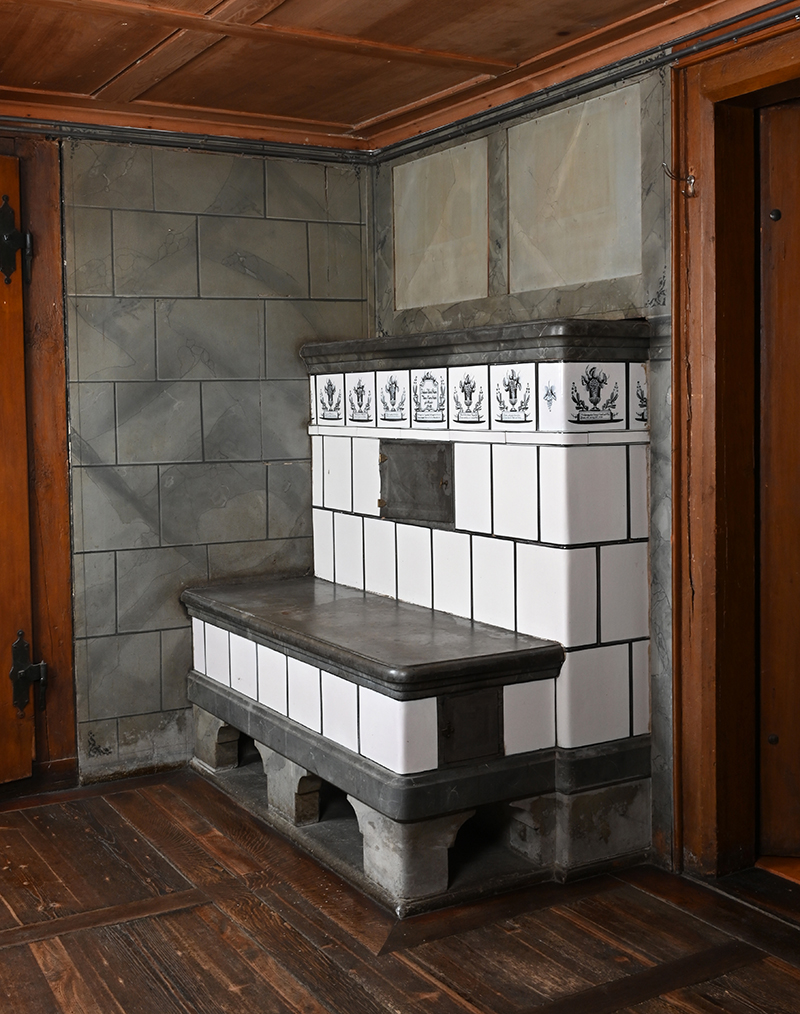
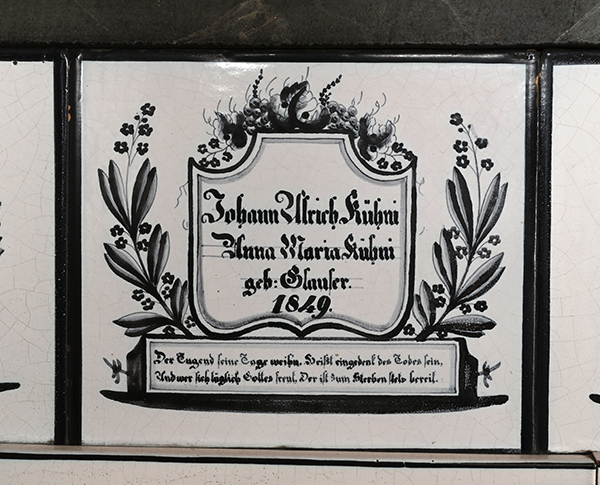
A stove at 50 Zimmerbergstrasse in Oberburg, Canton of Bern, was also painted by Lanz. Unfortunately, there is no mention of the stove fitter’s name.
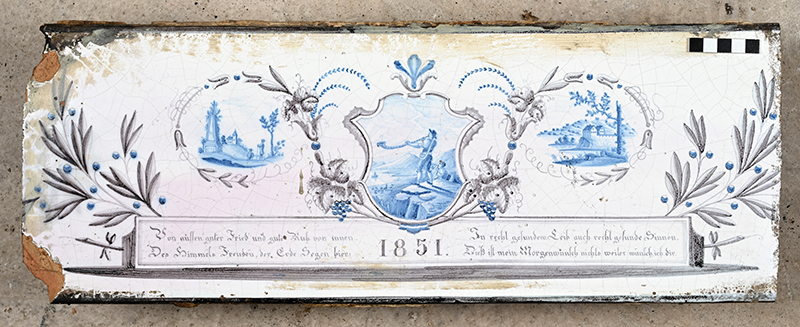
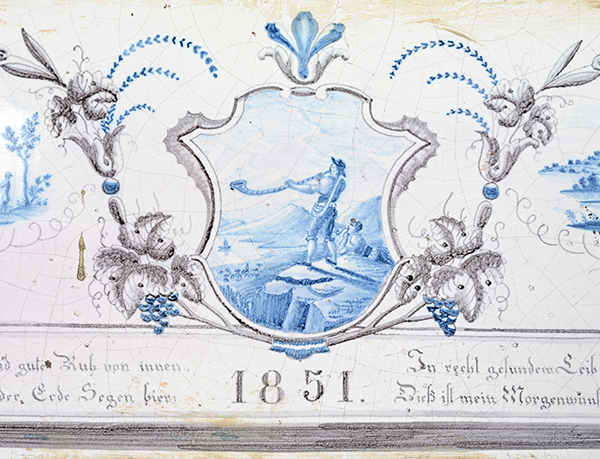
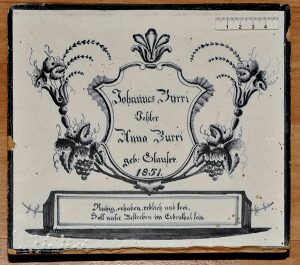
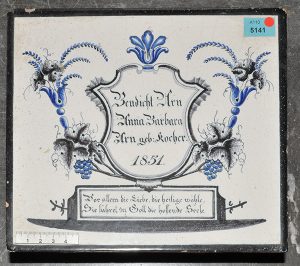
Other tiles are dated 1851.
The tiles on a stove in Bannwil, Canton of Bern, are perhaps a little later in date (around 1851/52?), because he emigrated to the US in 1852.
Genealogical information supplied by Andreas Kistler, Bäriswil, Alfred Spycher, Krauchthal, and Daniel Dähler, Wynigen.
Translation Sandy Haemmerle
References:
Affolter/Pfister 2013
Heinrich Christoph Affolter/Christoph Pfister, Die Bauernhäuser des Kantons Bern, Bd. 3: Das tiefere Berner Mittelland (Die Bauernhäuser der Schweiz 29), Basel 2013.
Heege 2011
Andreas Heege, Langenthal, St. Urbanstrasse 40–44. Die Hafnerei Staub und ihre Werkstatt, in: Archäologie Bern/Archéologie bernoise. Jahrbuch des Archäologischen Dienstes des Kantons Bern, 2011, 209-287.
Heege/Kistler 2017
Andreas Heege/Andreas Kistler, Keramik aus Langnau. Zur Geschichte der bedeutendsten Landhafnerei im Kanton Bern (Schriften des Bernischen Historischen Museums 13), Bern 2017.
Mühletaler 1983
Hans Mühletaler, Die Hafner Anderegg. Eine Ofenbauer-Dynastie in Wangen an der Aare, in: Jahrbuch des Oberaargaus 26, 1983, 129-158.

