Andreas Heege, 2026
“Before the outbreak of the Second World War, a new arts and crafts aesthetic – and with it, a reform of ceramic decoration – was developing; in Switzerland, this movement was led and influenced mainly by women. Its leading figures were Berta Tappolet (1897–1947), Martha Amata Good (1896–1950) and Luise Meyer-Strasser (1894–1974). From the 1920s to the 1940s, the three women created unique decorative designs for the Bodmer pottery factory in Zurich and for Fritz Haussmann’s company in Uster.” (Messerli 2009, 69).
Amata Good (1896-1950) was born on 13th February 1896 in Münsingen, Canton of Bern. Her father, Dr Alfred Good (1866-1940) was a neurologist from Ragaz, who worked at the Münsingen “Lunatic Asylum” from 1895 onwards and later settled in Thun (Der Bund, Vol. 77, 13th February 1926; Geschäftsblatt für den obern Teil des Kantons Bern, Vol. 85, No. 106, 12th September 1938; Der Bund, 23rd April 1940). She died on 14th November 1950 in Meilen, Canton of Zurich (Messerli-Bolliger 1988, 20 fn. 4).
From 1919 to 1922, Amata Good trained as a ceramicist under Jakob Herrmanns at the School of Visual Arts and Design in Bern, where she met Gertrud Meister-Zingg (1898–1984), Hanny Krebs-Nencki (1903–1986) and Margrit Linck-Daepp (1897–1983) (Messerli 2017, 159). In 1923, she attended the School of Applied Arts in Stuttgart (Bodmer-Huber and Messerli-Bolliger 1986, 33). In the years that followed she worked at several different studios and workshops. Amata Good joined the SWB (Schweizerischer Werkbund), but left it again in 1942 alongside Berta Tappolet and Luise Meyer-Strasser. Their reason for leaving is not known. From 1944 to 1950, Good was a member of the Swiss Society of Female Artists.
1921 She was still a student when she exhibited her first ceramic works in the Kunsthalle in Bern alongside Luise Strasser and Clara Vogelsang-Eymann (Die Berner Woche in Wort und Bild 1921, 559).
1923 Christmas Bazaar of the Bern Section of the SWB at the Museum of Applied Arts in Bern. Favourable review of her work in the press alongside Jakob Herrmanns and Adolf Schweizer (NZZ, 26th November 1923).

1924 Together with Jakob Herrmanns, Bern, ceramic exhibition at the 1924 KABA in Burgdorf (NZZ, 9th August 1924).
1925 Amata Good and Berta Tappolet entered a competition staged by the Langenthal Porcelain Factory to create a coffee service. Berta Tappolet won third prize, and Amata Good’s design was also picked up. The associated exhibition was staged at the Museum of Applied Arts in Bern (Neue Zürcher Zeitung, No. 480, 27th March 1925)
1925 Amata Good and Berta Tappolet entered a competition staged by the Langenthal Porcelain Factory to create a coffee service. Berta Tappolet won third prize, and Amata Good’s design was also picked up. The associated exhibition was staged at the Museum of Applied Arts in Bern (Neue Zürcher Zeitung, No. 480, 27th March 1925).
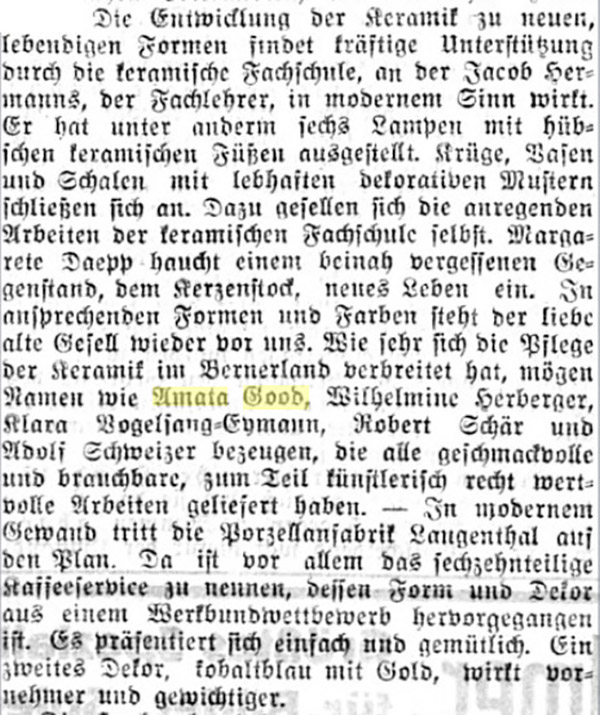
Review in the NZZ newspaper of the Christmas exhibition of the Bern Section of the Schweizerischer Werkbund at the Cantonal Museum of Applied Arts in Bern.
1925, December Good participated in the Christmas exhibition of the Bern Section of the Schweizerischer Werkbund at the Cantonal Museum of Applied Arts in Bern alongside Berta Tappolet, Hanny Krebs-Nencki, Luise Meier-Strasser and Margrit Linck-Daepp. One of the critics wrote: “The pottery is experiencing an ever greater upswing from one year to the next. The bowls, vases and lamp stands by Hermanns himself and his school are accompanied by larger ceramic works by Margarete Daepp, Amata Good, Wilhelmine Herberger, Robert Schär, Adolf Schweizer and Klara Vogelsang-Eymann, which achieve their artistic climax in Oscar Wenker’s ‘Figure’.” (Irmiger 1926).
Between 1926 and 1929: Collaborating in part with Berta Tappolet, Martha Amata Good created a series of decorative faience designs for the Carl Bodmer & Cie Pottery Factory in Zurich (Bodmer-Huber and Messerli-Bolliger 1986, 32-33, Pl. 32-37), which she appears to have produced at the workshop on site.
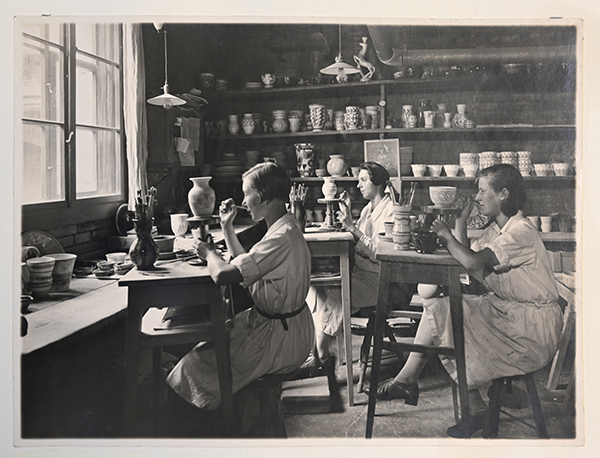
In the painting shop of the Carl Bodmer & Cie Pottery Factory in Zurich, around 1925/26. On the left Berta Tappolet, in the middle possibly Louise Meyer-Strasser. As Martha Amata Good also supplied the company with designs in 1926, she could be the third paintress on the right (the original is in box 75 at StAZH VII-174).
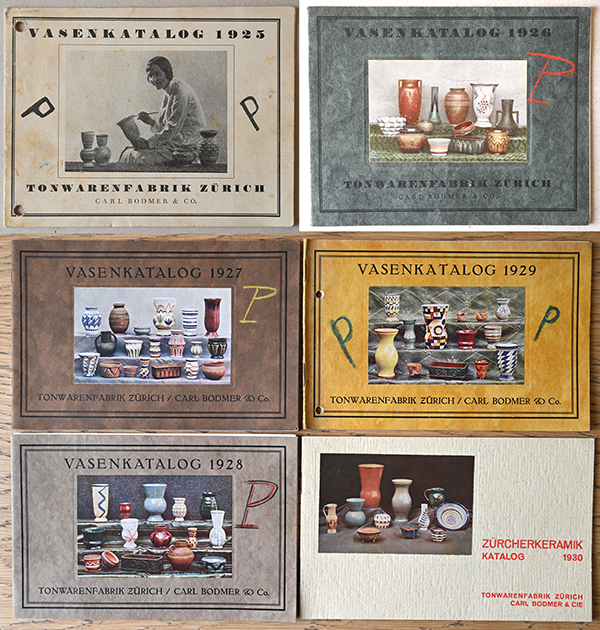
The designs themselves can mainly be found in the company’s pricelists. No original ceramics have so far come to light (the originals can be found in box 47 at StAZH VII-174).
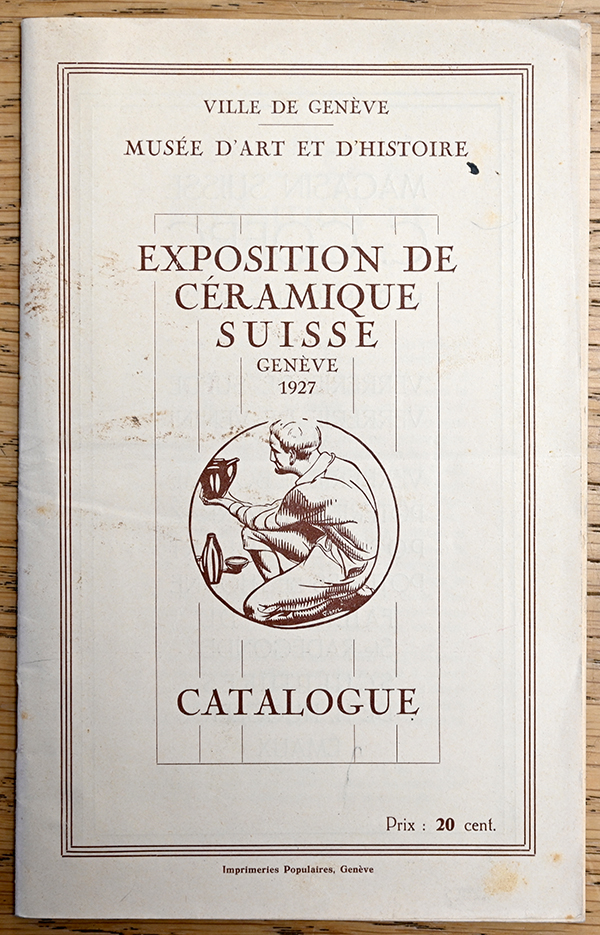
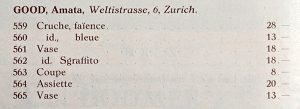
1927 At the “Exposition de céramique Suisse” [Exhibition of Swiss pottery] in Geneva, Amata Good exhibited a small group of ceramics with faience glaze and sgraffito decoration using her own name and an address at 6 Weltistrasse in Zurich.
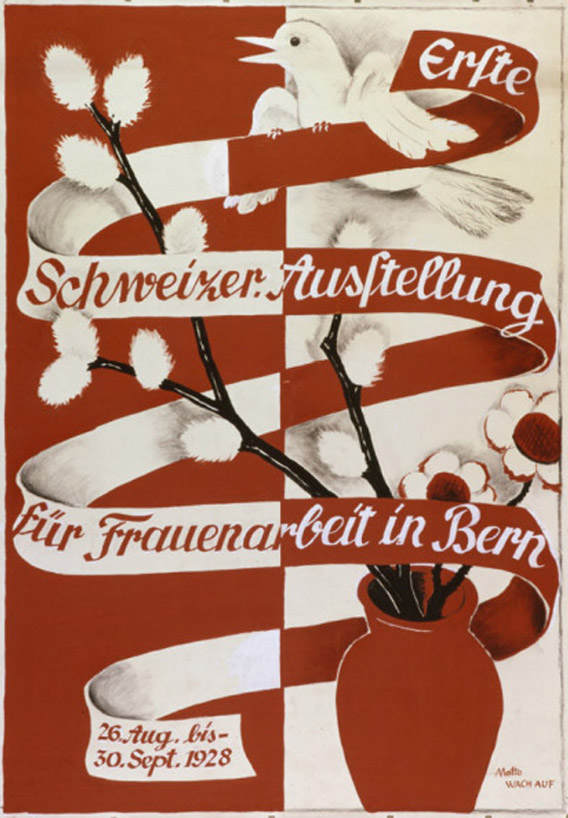
1928 Amata Good was also represented at “Saffa” alongside the companies Adolf Schweizer and DESA in the section entitled “Women Working in Art Pottery” (Oberländer Tagblatt 52, 25th September 1928; Neue Berner Zeitung, 27th September 1928).
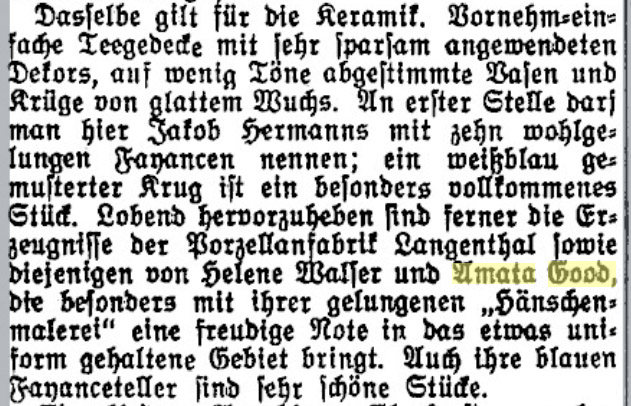
1929 Participation at the Christmas exhibition of the Schweizerischer Werkbund in Bern. Amata Good’s ceramics were favourably mentioned (Der Bund, 13th December 1929; NZZ, 18th December 1929; Das Werk 17, 1930, XXXIII; Berner Tagwacht, 28th December 1929).
1930 Arts and crafts exhibition staged by the Schweizerischer Werkbund at the Museum of Art in Lucerne. Amata Good exhibited “faience objects representing the old peasants’ art in a modern concept of style” (Der Bund 6th August 1930).
1932 March exhibition of the Bern Section of the Swiss Society of Female Painters, Sculptors and Craftswomen. Amata Good exhibits her work alongside Gertrud Meister-Zingg, Hanni Nencki and Helène Imbert (NZZ, 9th March 1932; Das Werk 19, 1932, XXXIV).
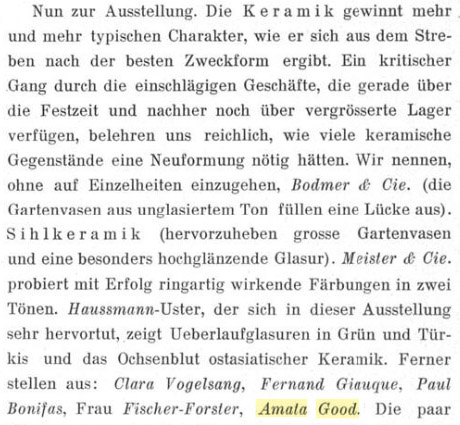
1933 Sales exhibition of the Zurich section of the SWB (Das Werk 20, 1933, XXXVIII).
1934 Christmas exhibition of the Zurich section of the SWB at the Museum of Applied Arts in Zurich. Amata Good’s ceramics, together with those of Margrit Linck-Daepp bore “the liveliness of ornamentation”, while all the other ceramics were “monochrome or slightly tinted variations of an elegant basic form, the purity of which must not be disrupted by decoration” (NZZ, 2nd December 1934). Amata Good exhibited “blue plates and dishes with lively, figurative painted designs” (Der Bund 13th December 1934).
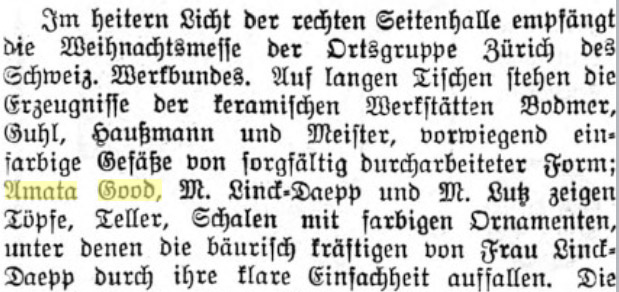
1935 Christmas exhibition of the Zurich section of the SWB at the Museum of Applied Arts in Zurich (NZZ, 4th December 1935; Das Werk 22, 1935, XVIII)
1936 Special sales exhibition at the shop of Elfi Moser at 56 Marktgasse in Bern, including works by Amata Good (Der Bund, 26th May 1936).
1936 Exhibition “Swiss Architecture and Artworks 1920-1936” at the Museum of Applied Arts in Zurich. A special exhibition entitled “Painted Ceramics” included a working group of some members of the Schweizerischer Werkbund, including Berta Tappolet, Luise Meyer- Strasser, Amata Good and Claire Guyer, who had their objects thrown and fired by Fritz Haussmann in Uster, another member of the SWB. Other participants in the exhibition were Margrit Linck-Daepp, Gertrud Meister-Zingg, Margit Lutz from Winterthur and Cornelia Fischer-Forster (Das Werk 23, 1936, XXIII; Tages-Anzeiger 2nd September 1936). “Several plates by Luise Meyer-Strasser and a light-coloured service decorated with polychrome floral designs by B. Tappolet” received special mention (Thurgauer Zeitung, 18th September 1936).
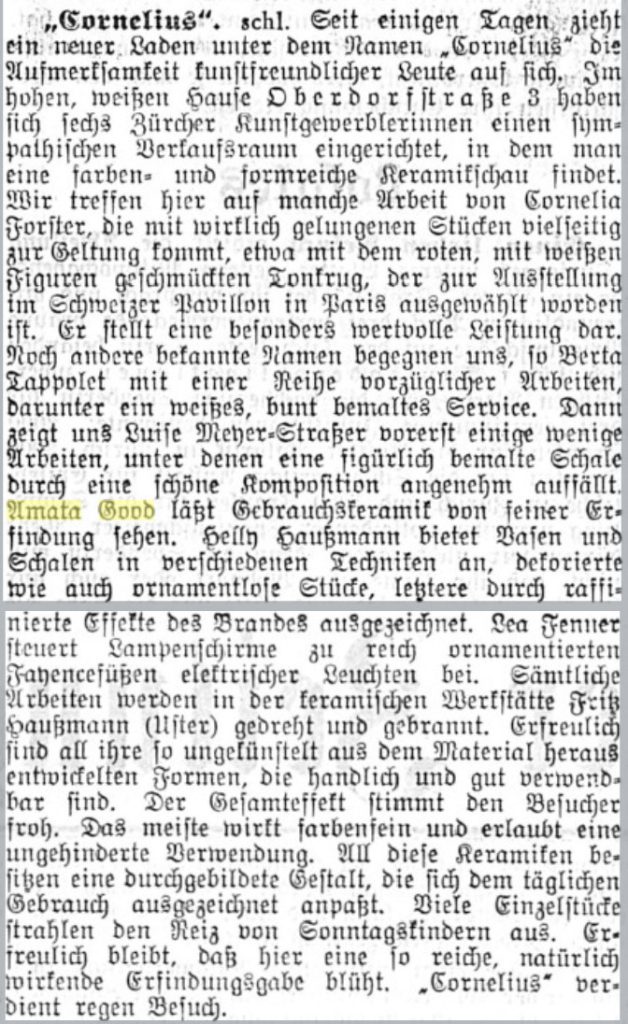
NZZ, 11th March 1937.
In 1937, Martha Amata Good (1896–1950), Berta Tappolet, Cornelia Forster (1906–1990), Luise Meyer-Strasser and the ceramicists Fritz and Helene Haussmann opened a shop together called “Cornelius” at 3 Oberdorfstrasse in Zurich, which specifically sold the ceramics they designed, which were thrown, decorated and fired at the workshop of the Haussmanns in Uster (L’Œuvre 24, 1937, Fig. p. XVI and pp. 357, 360–361, 363; see also Tages-Anzeiger, 10th March 1937; NZZ 11th March 1937).
1937 Fourteenth exhibition of the Swiss Society of Female Painters, Sculptors and Craftswomen in Bern. Amata Good exhibited her works alongside Margrit Daepp-Linck (Berner Tagwacht, 15th November 1937).
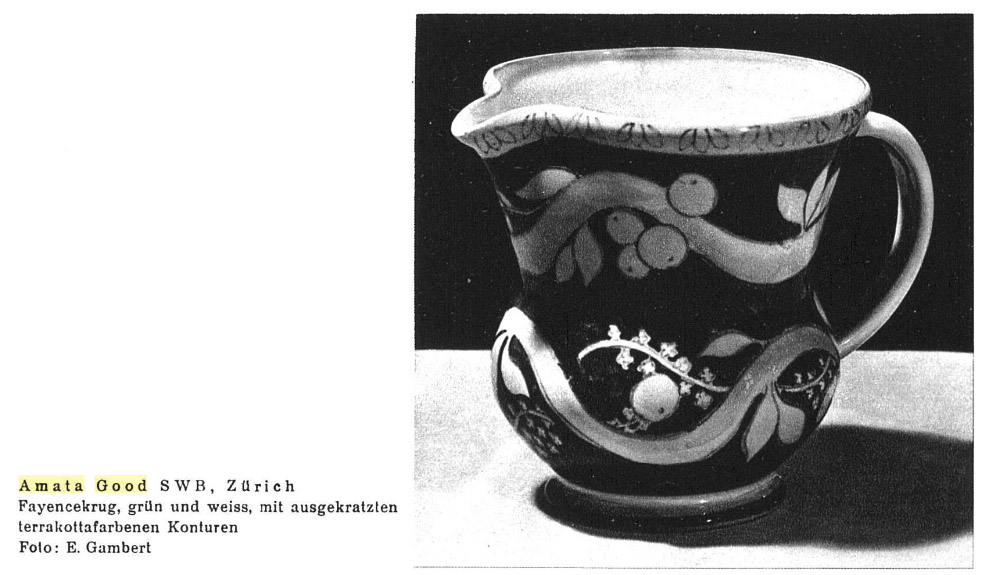
1937 Christmas exhibition of the SWB together with Berta Tappolet, Cornelia Forster (1906–1990), Luise Meyer-Strasser (1894–1974) as well as the ceramicists Fritz and Helene Haussmann. The magazine Das Werk (24, 1937, Issue 12, XIV, 353-363), published a series of photographs of ceramics, one of which was made by Amata Good (see also Die Schweiz 1937, Issue 11).
1938 Zeigte das Kunstgewerbemuseum Zürich “Neues Zürcher Kunsthandwerk”. Vertreten waren Amata Good, Berta Tappolet und Luise Meyer-Strasser (NZZ, 30. Juli 1938; Thurgauer Zeitung 19. August 1938 mit positiver Besprechung).
1938 Amata Good took part in an exhibition of works by the painter Werner Engel from Thun (Der Bund, Vol. 89, No. 439, 20th September 1938 Edition 02). The press favourably reviewed the ceramics as “tasteful and in part quite original” (Oberländer Tagblatt, 20th September 1938; Der Bund, 20th September 1938; Geschäftsblatt für den obern Teil des Kantons Bern, 23rd September 1938).
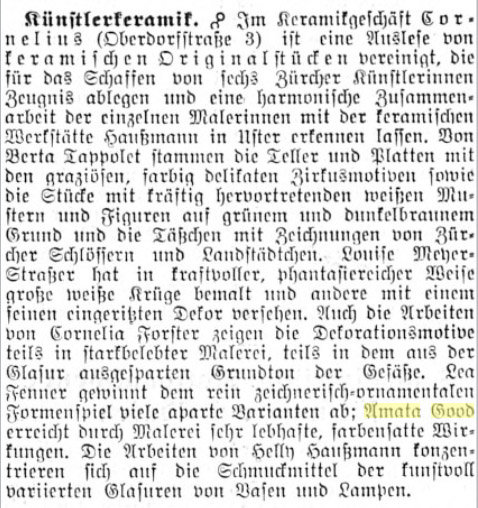
1938, December Exhibition of art pottery at Cornelius (NZZ 15th December 1938).
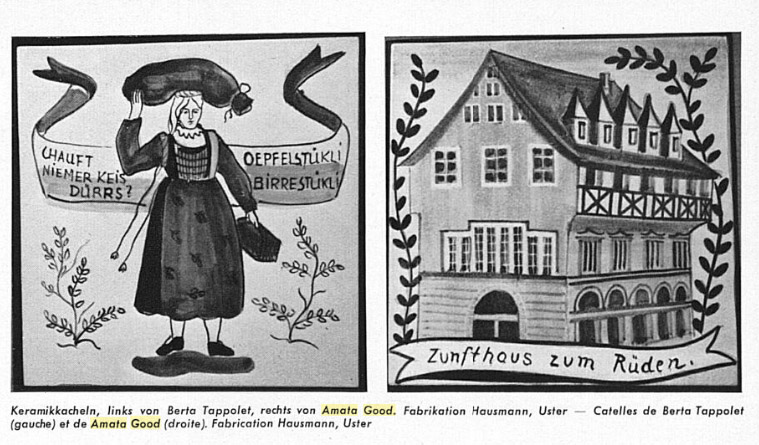
1939 Creation of souvenirs for the Swiss National Exhibition in Zurich (Die Schweiz, 1939, Issue 7).
1939 Christmas exhibition of the Zurich section of the SWB at the Museum of Applied Arts in Zurich. The SWB members Berta Tappolet, Luise Meyer-Strasser, Amata Good and Cornelia Forster exhibited their ceramics alongside Gertrud Meister-Zingg, Margrit Linck-Daepp as well as Fritz and Helene Haussmann (NZZ 25th November 1939).
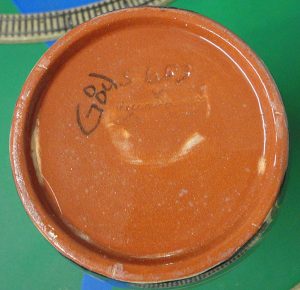
Base of a vase bearing the marks of the Haussmann pottery factory and the ceramic paintress Amata Good (photo by Christoph Messerli, Swiss private collection).
1940 At that time Amata Good also worked for the company Haussmann in Uster or decorated pottery produced there; she signed the pieces with her surname, “Good” (Messerli 2017, 279).
1940 Exhibition staged by the Swiss Society of Female Painters, Sculptors and Craftswomen at the Museum of Applied Arts in Bern together with Helene Pflugshaupt, Elisabeth Eberhardt, Edith Dussere-Duflon, Hanni Nencki, Luise Meyer-Strasser, Berta Tappolet and Cornelia Forster (Tages-Anzeiger, 27th September 1940).
1940/41 Together with Berta Tappolet, Luise Meyer-Strasser and Cornelia Forster, Amata Good decorated the walls and ceilings of the newly renovated Haus zur Münz (an alcohol-free restaurant; see also Die Tat, 28th June 1941), 3 Münzplatz, Zurich. In the 1960s, the house was destroyed by fire and demolished. A Julius Baer banking group office building now stands on the site.
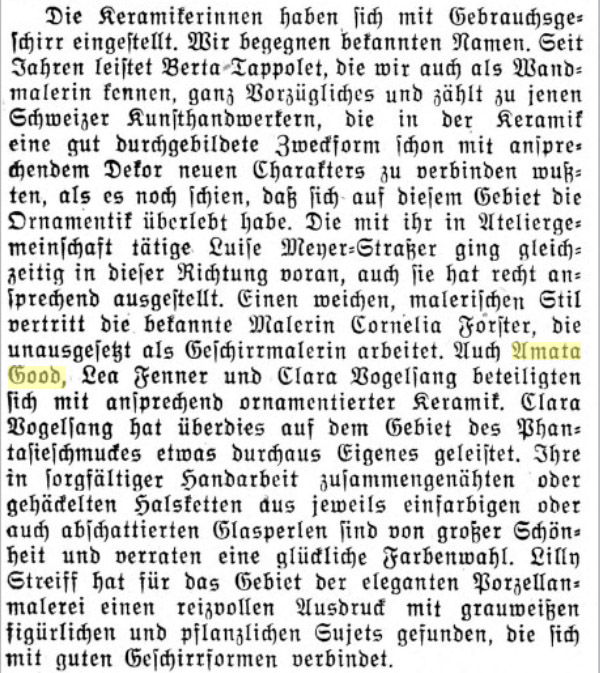
1944 Exhibition at the Kunsthaus art museum in Zurich with Berta Tappolet, Luise Meyer-Strasser, Cornelia Forster, Lea Fenner and Clara Vogelsang (Thurgauer Zeitung, Vol. 146, No. 187, 11th August 1944 Edition 02).
Between 1944 and 1950, there are no further reports of her work as a ceramic artist.
Translation Sandy Haemmerle
References:
Bodmer-Huber und Messerli-Bolliger 1986
Ernst Bodmer-Huber et Barbara E. Messerli-Bolliger, Die Tonwarenfabrik Bodmer in Zürich-Wiedikon. Geschichte, Produktion, Firmeninhaber, Entwerfer. Keramik-Freunde der Schweiz, Mitteilungsblatt 101, 3-60.
Messerli-Bolliger 1988 Barbara E. Messerli-Bolliger, Die Lenzburger Keramikerin Elisabeth Eberhardt 1875-1966. Lenzburger Neujahrsbläter 59, 1988, 20-81.
Irmiger 1926
Max Irmiger, „Die Weihnachtsausstellung der Ortsgruppe Bern S.W.B“, in: Das Werk, 13. Jg., Heft 2, hrsg. vom Bund Schweizer Architekten und dem Schwei-zerischen Werkbund, Zürich: Fretz, 1926, S. XXIII.
Messerli 2009
Christoph Messerli, Von der Souvenir- zur Studiokeramik. Die Berner Keramik im 19. und 20. Jahrhundert. Lizentiatsarbeit, Institut für Kunstgeschichte des Universität Bern (Bern 2009).
Messerli 2017
Christoph Messerli, 100 Jahre Berner Keramik. Von der Tuner Majolika bis zum künstlerischen Werk von Margrit Linck-Daepp (1987-1983). Hochschulschrift (Datenträger CD-ROM), Bern 2017.

