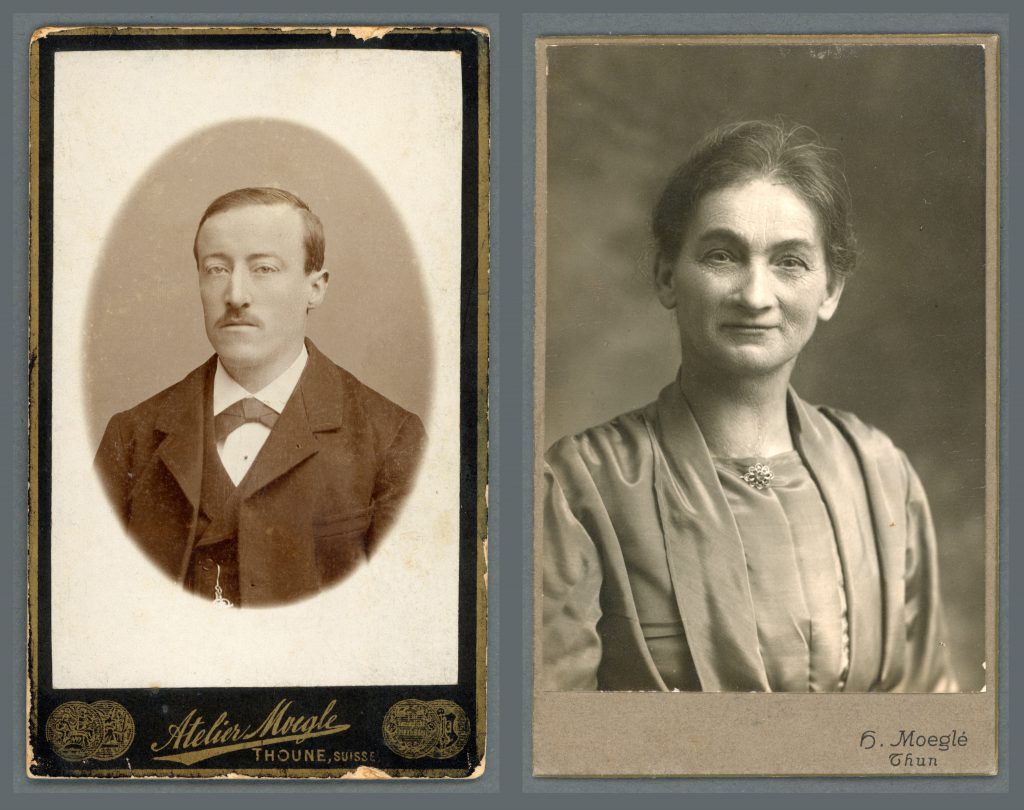
Karl Friedrich Schenk and his wife Magdalena Hossmann (from the archive of Kunstkeramik Luzern A.G., now in the collection of the Thun Castle Foundation)
Andreas Heege, Andreas Kistler, Margret Loder 2026
Karl Friedrich Schenk (17/7/1866-22/5/1919) came from a Heimberg potting family that originated from Röthenbach in the Emmental valley (family tree). His grandfather, Christian Schenk (1790-1861), was a shoemaker, his uncle, also called Christian (1826-1893) worked at a lead-glaze mill in Steffisburg, though it is not known which one (see Frank 2000). This was a specialised craft producing and selling lead-glazes, large amounts of which were needed by the potters, and probably also other glazes and coloured slips. Karl Friedrich Schenk’s father, Samuel Schenk (1835-1904), was a potter, as was his uncle, Jakob Schenk (1842-1904).
Samuel Schenk and his wife Elisabeth Hänni (1837-1911) had ten children. In 1870, Samuel purchased a potter’s workshop with small living quarters which had been built in 1831 at “im Kehr” in Heimberg (now 30 Haslikehrweg) from the heirs to the potter Ulrich Jenni (1820-1868) who had never married.
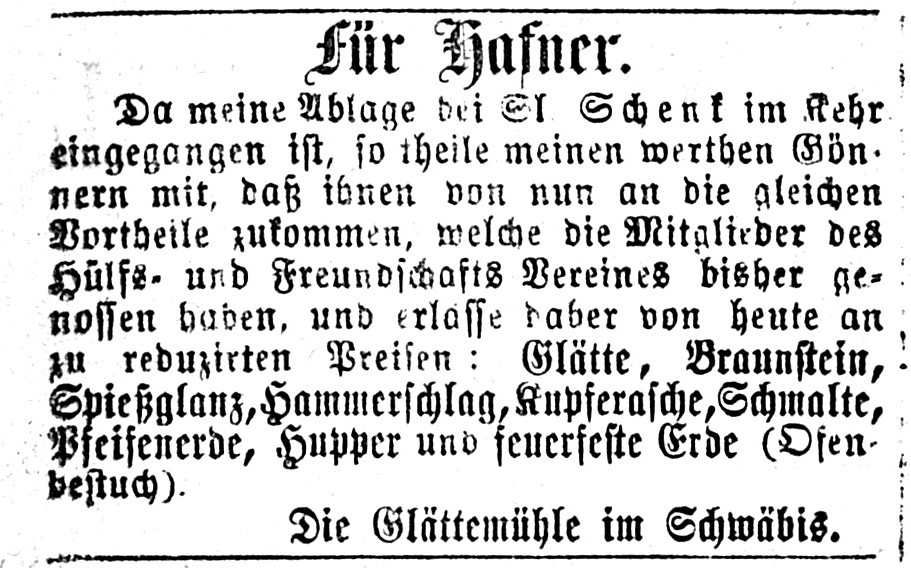
Up to 1876, Samuel Schenk appears to have been the custodian of the materials depot of the Wanzenried lead-glaze mill in Steffisburg-Schwäbis on behalf of the Hilfs- und Freundschaftsverein (benevolent society) of the Heimberg potters (Geschäftsblatt für den oberen Teil des Kantons Bern 23, No. 48, 1876).
It is unclear, how long Samuel actually worked as a potter; upon his death in 1904, he was in fact described as a wainwright. Nor do we know what type of pottery or decorations he produced, as no marked or signed pieces have come to light up to now.
In 1905, the estate including the workshop and barn passed to his widow, Elisabeth Schenk-Hänni (1837-1911), and when she died in 1911, it was divided between Eduard Schenk (carpenter, 1868-?) and Fritz Schenk-Kolb (potter, 1870-1958), Karl Friedrich Schenk’s brothers. At the time, Karl Friedrich and his other surviving siblings were bought out, while the use of the apiary near the homestead was granted free of charge until March 1912.
Four of the six surviving Schenk-Hänni sons also became potters. Gottfried Schenk 1862-1939 did not own a workshop but worked as a potter, and from 1911 at the latest he was employed as a labourer at the brickyard in Steffisburg. Ernst Schenk (1875-1951) was a pottery worker and from 1910 at the latest he became a railway worker. In 1901 he was able to buy a building with three potters’ workshops that had been built in 1835 at 28 Haslikehrweg. It is not known how long he produced pottery there. Fritz Schenk-Kolb (potter, 1870-1958) took over their father’s workshop at 30 Haslikehrweg and Karl Friedrich-Schenk does not appear to have ever had a workshop of his own.
We do not know which house Karl Friedrich Schenk and his family rented. One record mentions a location as “Heimberg, In der Au”, and when his wife died in 1924, her heirs were recorded as living “near the school in Heimberg”..
Various printed sources, his children’s birth announcements and records of the division of his parents’ estate in 1911 identify him as “municipal bailiff” and “beekeeper” (Brunner, J., Adress- Reise- und Reklamen-Taschenbuch für Thun und Berner Oberland Thun, 1908, p. 57). Both of these sidelines probably contributed considerably to the family’s earnings. Another source of income was his wife Magdalena’s work as a caretaker at the school in Heimberg.
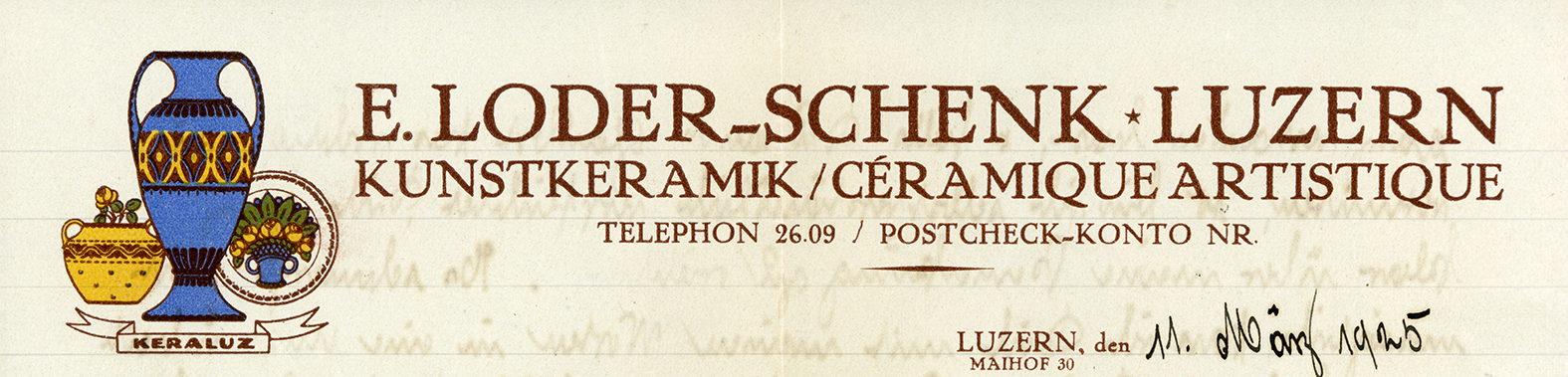
Karl Friedrich Schenk had married Magdalena Hossmann (29/10/1868-20/4/1924) from Gerzensee, resident in Aeschlen near Oberdiessbach, on 30/6/1894 in Langnau. The couple had four children, three of which survived to adulthood (family tree): Frieda Schenk (1900-1972), her sister Marie Rosa (1905-?) and their brother Karl (1910-?). Having completed a commercial apprenticeship with the Keller company, a chemical and soap factory in Konolfingen, Frieda Schenk married the ceramicist Emil Loder on 13th March 1925. That same year, the couple took over the running of the company Kunstkeramik Luzern (KERALUZ).
The question of whether Karl Friedrich Schenk did, in fact, decorate pottery, cannot be answered definitively. Following the proposition put forward by Hermann Buchs (1988, 78), early 20th century ceramic objects bearing the signature “KS Thun/Thoune” were subsequently attributed to Karl Friedrich Schenk. This would mean that he was able to use the workshop of one of his brothers to create and fire his own pottery.
The decorations in question, however, are highly reminiscent of products from the workshop of Karl Loder-Eyer which can be found mainly in his company’s photographic catalogue from 1914 (for instance, several identical decorations: Cat. 133, 136, 195). After Karl Loder-Eyer’s workshop was sold in 1915, several of his shapes and decorations were further developed by the company “DESA”. A new cooperative had already been set up on 13th September 1915 under the name “Steffisburg Art Pottery, formerly Karl Loder-Eyer”. On 18th January 1916, it was registered in the Swiss Official Gazette of Commerce under the name “Steffisburg Art Pottery, formerly Karl Loder-Eyer – Poterie artistique de Steffisbourg, ci-devant Loder-Eyer” (SOGC 34, 1916, 91) and re-registered in 1926 under “Desa Art Pottery Steffisburg-Station, formerly Loder-Eyer (Poterie artistique Desa Steffisbourg-Gare, ci-devant Loder-Eyer)” (SOGC 45, No. 222, 1693, 21st September 1927; the name was also entered in the land register of Thun, Bel. II, 9682, 1927), six years after the first “DESA mark” had been registered in 1920 (SOGC 38, 1920, 434). The company’s first technical manager, appointed in 1916, was Adolf Schweizer (1893-1967, see his obituary in the Thuner Tagblatt 91, issue 288 8th December 1967). He had just graduated from the School of Ceramics in Bern.
Since some of the shapes bearing the signature “KS” also have form numbers that later reappear in association with the “Steffisburg Art Pottery” or “Desa”, it is highly likely that the signatures “KS” and “KST” refer to “Kunsttöpferei Steffisburg” (Steffisburg Art Pottery) and therefore represent the early production of DESA from between 1916 and c. 1920.
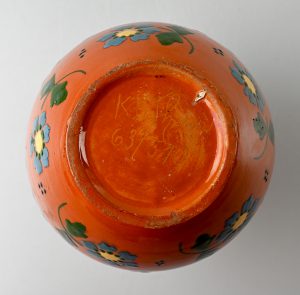
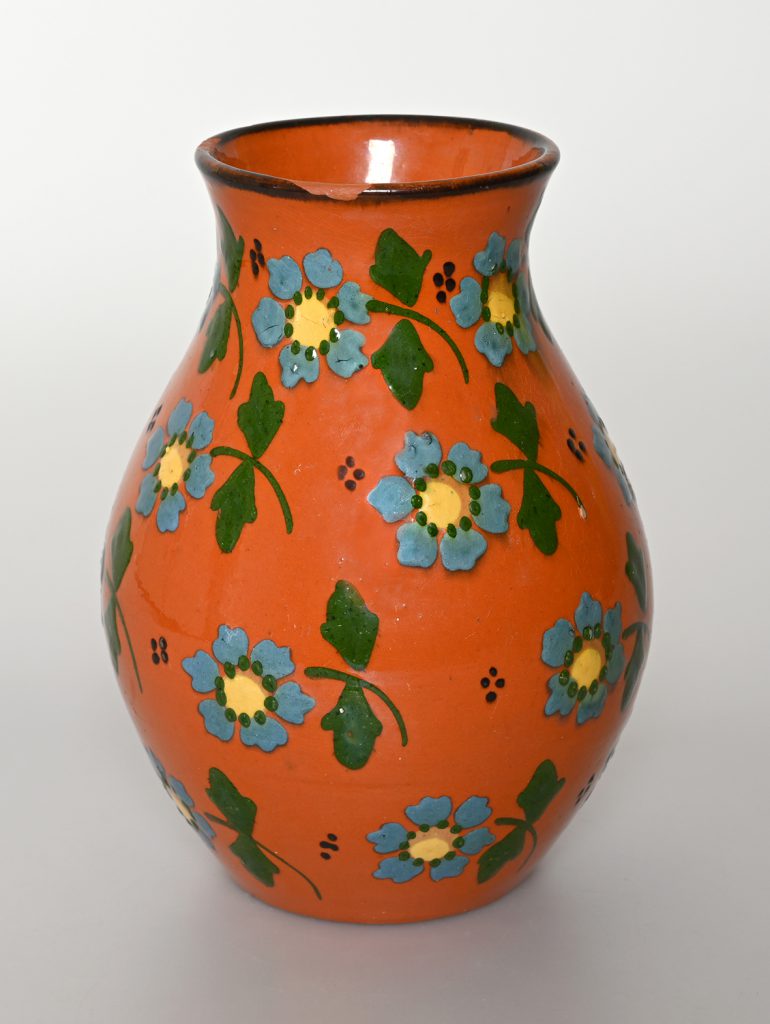
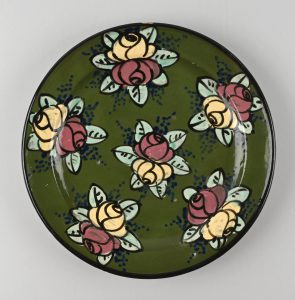
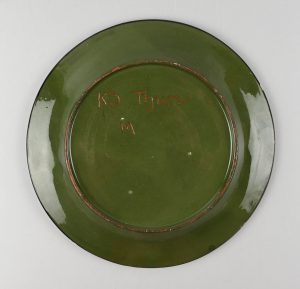
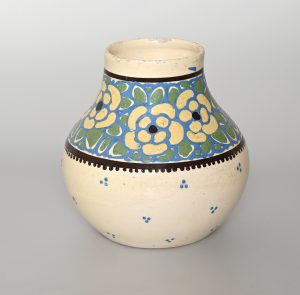
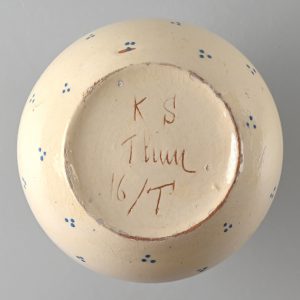
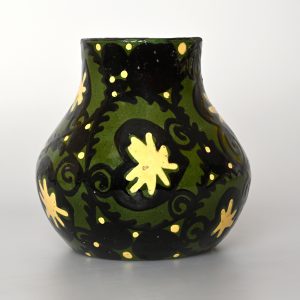
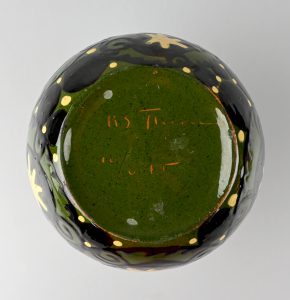
Pottery bearing the signature “KS Thun”, possibly made by Karl Friedrich Schenk or by the Steffisburg Art Pottery, from a private collection in Ebikon and from the Thun Castle Museum.
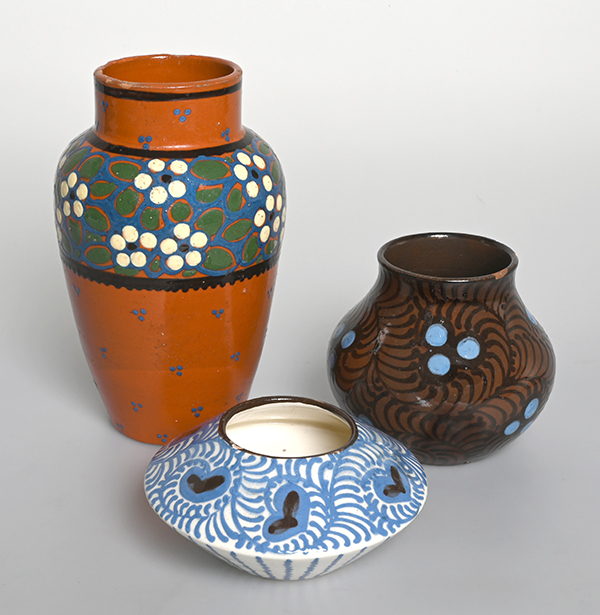
Pottery bearing the signature “KS Thun”, possibly made by Karl Friedrich Schenk or by the Steffisburg Art Pottery, in the collection of the School of Visual Arts and Design Bern and Biel.
Translation Sandy Haemmerle
References:
Frank 2000
Georg Frank, “Dank dem Gewerbefleiss früherer Jahrhunderte”. Die Nutzung der Wasserkraft in der bernischen Gemeinde Steffisburg vom ausgehenden 13. Jahrhundert bis zur Gegenwart, Thun 2000.

